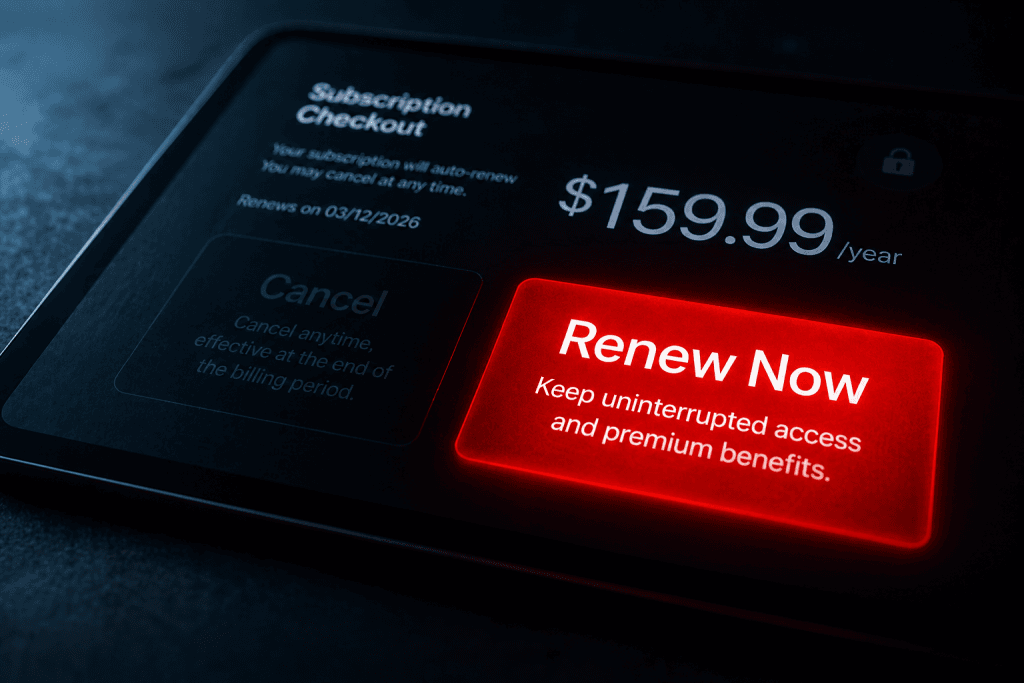
A deceptive checkout screen illustrating dark patterns in SaaS renewals that trick B2B founders into unwanted subscriptions.

Dark Patterns in SaaS Renewals: 3 Tricks Draining Your Budget

If you have ever spent 45 minutes clicking through endless menus just to cancel a $20 subscription,
you are not technologically inept. You are the victim of a deliberate psychological design.

Dark patterns in SaaS renewals

are deceptive user interface (UI) tactics explicitly engineered to
trick B2B users into taking actions they did not intend—most commonly,
failing to cancel a subscription or accidentally upgrading to a higher tier.

What Are Dark Patterns in SaaS Renewals?

Software companies know that B2B founders are busy.
They weaponize your lack of time against you.
Instead of winning your loyalty through product excellence,
they secure your recurring revenue through friction and confusion.
Here are the three most destructive tactics draining your corporate credit card today:

1. The Roach Motel (Easy In, Impossible Out)

You can sign up for the software in three seconds using a Google single sign-on.
But to cancel?
You must navigate through a hidden settings menu, complete an exit survey, and finally,
schedule a mandatory “offboarding call” with a retention specialist who is only available next week.
This is designed to make you give up and just pay for another month.

2. Forced Continuity (The Silent Upgrade)

This happens when a free trial quietly morphs into an expensive annual commitment
without a clear notification.
You enter your credit card for a 14-day test, and on day 15, you are charged $1,200.
These companies often bury the auto-renewal terms deep inside the Terms of Service.

3. Sneak into Basket

During the checkout or renewal process, 
the vendor pre-checks boxes for “premium support” or “extra user seats.” 
If you are moving fast, you end up paying for features you never explicitly requested.

The Operational Cost of Deception

The financial leak caused by dark patterns in SaaS renewals is staggering for remote teams.

These tactics are the primary reason companies suffer from auto-renewal dark patterns and budget bloat.
When software companies rely on trickery rather than value,
it completely destroys the trust required for a healthy B2B relationship.

How to Defeat These Deceptive Tactics

You must build a defensive perimeter around your corporate cards:
  • Use Virtual Cards:

    Never use your main corporate card for a new SaaS trial.
    Issue a single-use virtual card with a strict spending limit.
  • Centralize Billing Alerts:

    Integrate your billing software to alert you 7 days before any charge hits.
  • The 3-Click Rule:

    If a tool takes more than three clicks to cancel, it gets flagged during your next software stack audit.
Consumer protection agencies like the Federal Trade Commission (FTC) are cracking down on these practices,
but B2B buyers remain largely unprotected.

Stop letting deceptive design dictate your cash flow.
If a tool makes it hard to leave, it was never worth staying.

Why Trust ToolRelief?

ToolRelief is built to help professionals and teams make smarter software decisions,
reduce SaaS waste, and simplify complex tool stacks.

Written by Waleed Al-Qasem

Founder of ToolRelief. 
I write about the intersection of technology, remote work, and human productivity. 
My mission is to help teams eliminate digital noise and get back to doing deep, meaningful work.
Waleed Al-Qasem, Founder of ToolRelief
Written by Waleed Al-Qasem
Founder of Nexio Global and ToolRelief. I write about SaaS costs, AI tool overload, and practical ways to build simpler, more efficient workflows. After spending over $47K on SaaS tools and experiencing tool overlap firsthand, I now help teams make clearer software decisions with less noise. Read my full story →
If your workflow feels heavier with AI… 
You don’t need another tool. 
You need less. 
Explore ToolRelief to simplify your stack and regain control.
Scroll to Top