
Table of Contents
ToggleThe Hidden Cost of Free Tools (Why “Free” Is Killing Your Productivity)
free tools productivity problems
disadvantages of free software
free tools vs paid tools
tool overload productivity
cost of free apps
Introduction
Free tools feel like a shortcut.
No payment.
No approval.
No commitment.
But over time, something starts to break — not your tools, but your workflow.
If you’ve ever felt overwhelmed by too many apps, scattered data, or constant switching, you’re already paying the hidden cost of free tools.
And unlike paid software, this cost doesn’t appear on any invoice.
It shows up in lost focus, fragmented systems, and silent inefficiencies.
Why Free Tools Feel Like the Smart Choice
Free tools remove friction exactly when you need speed.
No budget approval
No risk
Instant access
That’s why they spread quickly inside teams.
But what feels like speed is often uncontrolled adoption.
And uncontrolled systems always come with a cost.
The Hidden Cost of Free Tools (What No One Talks About)
The real issue isn’t pricing.
It’s what free tools introduce without visibility.
✔ Invisible decisions
Where is your data stored?
Who owns access?
What happens if the tool disappears?
No ownership → no accountability.
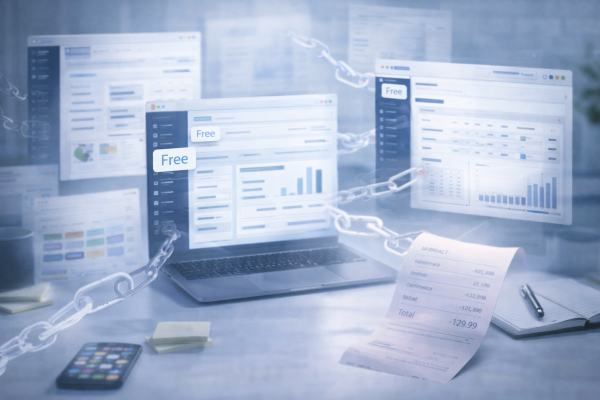
Free Tools Create Fragmentation (The Real Productivity Killer)
Free tools rarely replace existing systems.
They stack.
One tool for notes
Another for tasks
Another for sharing
Over time:
> Information gets scattered
> Context is lost
> Focus breaks
This is known as tool overload, a growing issue in modern workflows.
The Cognitive Cost (Your Brain Becomes the System)
Free tools don’t enforce structure.
So you compensate manually:
Copy-paste workflows
Switching between apps
Remembering locations
Your brain becomes the integration layer.
And that’s expensive.
Not financially — mentally.
Free Tools vs Paid Tools (The Real Difference)
This isn’t about money.
It’s about intention
Free Tools | Paid Tools |
|---|---|
Fast adoption | Slower decision |
No ownership | Clear ownership |
Fragmented | Structured |
Hidden cost | Visible cost
|
> Paid tools often remove complexity upfront
> Free tools push complexity to later
When Free Tools Become Expensive
Free tools become expensive when:
They store critical data
They shape daily workflows
They require workarounds
They slow down decisions
At that point:
“Free” only describes price — not impact
Why Teams Keep Using Free Tools (Even When They Hurt)
Because they feel harmless.
And questioning them feels unnecessary.
But that’s exactly the trap.
Free tools don’t hurt immediately.
They degrade systems slowly.
How to Avoid the Hidden Cost of Free Tools
Before using any tool, ask:
What problem does this solve?
What will it replace?
Who owns it long-term?
If there’s no answer:
> The cost has already started.
A Better Way to Think About Tools
The opposite of “free” isn’t “paid”.
The opposite is:
> intentional
A well-chosen paid tool can be cheaper than multiple free tools.
Because it removes:
friction
duplication
confusion