
SaaS Vendor Lock-In: Software Companies Holding Data Hostage
Quick Navigation ✔
ToggleLast quarter, a mid-sized B2B logistics firm reached out to me with what should have been a standard operational request.
They had outgrown their current enterprise project management tool and wanted to migrate to a leaner,
more agile platform.
They had done everything right.
They audited their workflow, identified the redundancies,
and found a better software alternative that would save them roughly $2,400 a month.
Then, they clicked the “Export Data” button.
Instead of receiving a clean, organized CSV file of their last three years of operational data,
they got a compressed folder filled with proprietary file types, broken meta-tags, and unreadable text strings.
When the founder contacted the software vendor’s support team, the response was chillingly corporate:
“Full raw data extraction is not supported on your current tier.
We can provide a custom migration consultant for a one-time fee of $15,000.”
That is not customer support. That is a ransom demand.
Welcome to the harsh reality of SaaS vendor lock-in.
In the B2B software industry, many companies do not build their valuation by creating the best product;
they build it by making it technically and financially excruciating for you to leave.
The Anatomy of Digital Extortion
When you first sign up for a B2B SaaS product, the onboarding process is beautifully frictionless.
They offer free migration, automated data syncing,
and dedicated account managers to help you move your operations into their ecosystem.
The door to enter is wide open.
But the door to exit is heavily guarded, barricaded, and rigged to trigger a financial alarm.
Software vendors know that the longer your data lives on their servers,
the more leverage they have over your budget.
This practice is rarely discussed during the honeymoon phase of the sales cycle,
but it is a deliberate engineering choice designed to trap your operations.
Tactic 1: Proprietary Data Formats
The most common trap is data formatting.
A software company will allow you to build complex workflows, tag clients, and establish communication pipelines.
However, they engineer their database in a way that is entirely incompatible with industry standards.
If you try to leave, you can only export raw text.
All the connections, tags, and relational structures—the actual value of your data—are instantly destroyed upon export.
Tactic 2: API Throttling
Some vendors appear open because they offer an API for developers.
But when you attempt a mass extraction to migrate to a competitor, you suddenly hit severe rate limits.
What should be a 10-minute automated data transfer is throttled to take six weeks,
forcing you to pay for another month (or year) of your subscription just to keep the pipeline open while the data trickles out.
Tactic 3: The “Ecosystem” Trap
This is the favorite tactic of mega-vendors.
They give you the core product at a discount, but to make it function properly,
you have to use their proprietary cloud storage, their internal messaging app, and their specific analytics dashboard.
By the time you realize the core product is flawed, ripping it out means tearing down your entire digital infrastructure.
Quick answer
SaaS vendor lock-in happens when leaving a tool is harder than buying it.
The most common version is data hostage risk: your files, workflows, history, automations, exports, or customer records technically belong to you, but are painful to move, expensive to export, or hard to rebuild somewhere else.
That is why the cheapest tool on paper can become expensive later.
The switching cost shows up when the team tries to leave.
Vendor lock-in becomes more expensive when teams do not know how much waste already exists in the stack.
Use the SaaS Waste Score Report to estimate whether unused seats,
duplicate tools, and renewal exposure are making the lock-in harder to escape.
Why SaaS Vendor Lock-In Becomes Expensive Over Time
SaaS vendor lock-in rarely feels dangerous on the first day of using a tool.
The problem grows slowly as your team stores more data, builds more workflows, connects more integrations,
trains more employees, and depends on more vendor-specific features.
By the time the tool feels too expensive or too restrictive, leaving is no longer a simple cancellation decision.
SaaS vendor lock-in turns switching into a migration project that requires time, planning, budget, and operational patience.
Vendor lock-in becomes more expensive when teams do not know how much waste already exists in the stack.
Use the SaaS Waste Score Report to estimate whether unused seats,
duplicate tools, and renewal exposure are making the lock-in harder to escape.
The Financial Impact on Your Runway
Vendor lock-in is a silent killer of B2B profitability.
When a software company knows you cannot easily leave, they possess absolute pricing power.
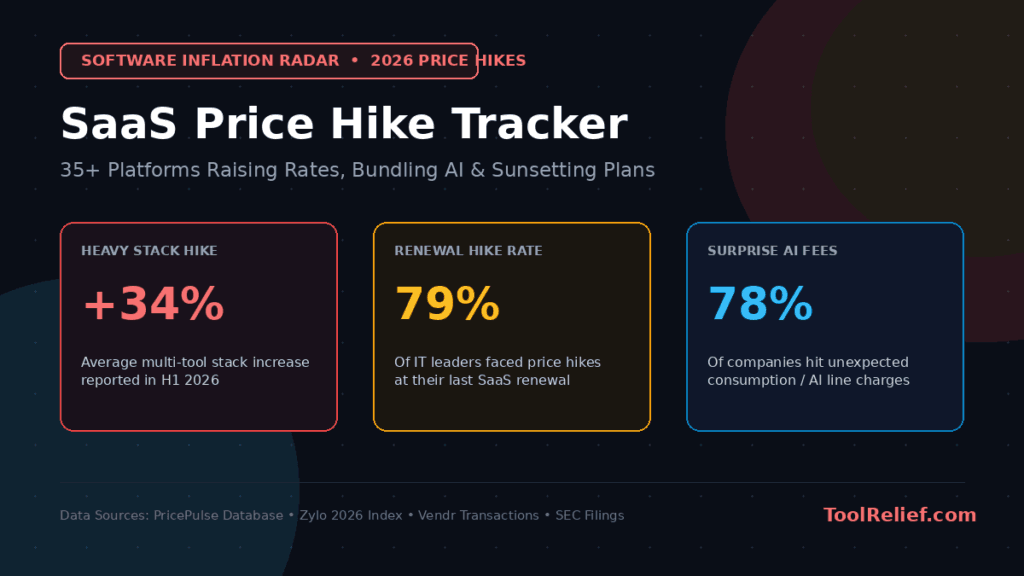
This is exactly why you see arbitrary 30% to 40% price hikes at the end of your annual billing cycle.
They aren’t raising prices because the software got 40% better.
They are raising prices because their internal metrics show that the “pain threshold”
of migrating your database is higher than the cost of simply paying the inflated invoice.
You are no longer paying for a service.
You are paying a penalty for your own data.
This artificially inflates your operational overhead and fundamentally breaks your ability to negotiate.
Red Flags: Spotting the Trap Before You Sign
You cannot fix vendor lock-in after the contract is signed and the data is uploaded.
The battle must be won during the procurement phase.
If you are auditing a new tool for your remote team, look for these three immediate red flags:
No “Bulk Export” Button:
If the software requires you to email support or submit a ticket just to download your own account data, walk away.
“Consulting Fees” for Data Extraction:
If the Service Level Agreement (SLA) includes clauses about hourly fees for custom data dumps,
they are already planning your exit penalty.Closed Integrations:
If the software refuses to integrate with neutral, third-party automation tools (like Make or Zapier)
and only connects to apps within its own corporate family, they are building a walled garden around your business.
Building Your "Exit Strategy"
In B2B operations,
buying software without an exit strategy is like signing a lease on a building without checking if there are doors.
You must engineer your tech stack with the assumption that every tool will eventually be replaced.
1. Demand a Data Portability Clause
Before upgrading to any enterprise tier,
have your legal or operations lead insert a simple Data Portability Clause into the contract.
It should explicitly state that upon termination, all company data will be provided within 7 days in an industry-standard,
machine-readable format (like CSV or JSON) at no additional cost.
2. Decouple Your Storage from Your Processing
Never let the app that processes your data be the only place that stores your data.
Implement an automated backup strategy that pushes your critical records (client lists, financial logs, project milestones)
to an independent, secure data warehouse that you control entirely.
3. The Neutral Ground Protocol
Keep your core business logic out of proprietary SaaS wrappers whenever possible.
The more you rely on a specific vendor’s unique automation language or closed-loop AI tools,
the harder it becomes to untangle your business from their servers.
You built your company to solve problems for your clients,
not to serve as a captive revenue stream for Silicon Valley.
Your data is your most valuable asset.
Stop letting software vendors treat it as their collateral.
What to check before you get locked in
Before a tool becomes mission-critical, check how easy it is to export data, move workflows, replace integrations,
and keep access to important history.
If a tool is hard to leave and keeps getting more expensive, add it to your SaaS inventory
and review it before the next renewal.
A SaaS Audit can also help identify which tools create the most lock-in risk across the stack.
Related Guides to Build Your System
If you are currently feeling trapped by your software stack,
these foundational blueprints will help you audit your operations and reclaim your leverage:
Sources & References
The market analysis regarding cloud computing lock-in and enterprise data portability is supported by industry-leading research:
Forrester Research: The Hidden Costs Of Cloud And SaaS Vendor Lock-In (Analysis of enterprise migration challenges).
The Cloud Native Computing Foundation (CNCF): Overcoming Vendor Lock-in with Open Source and Neutral APIs (Technical guidelines for maintaining data independence).
Harvard Business Review: Don’t Let Your Software Provider Hold You Hostage (Strategic procurement tactics for B2B executives).
 Read this article on Flipboard:
[Here]
Ready to Eliminate the Friction?
Are you tired of feeling extorted every time your software subscriptions come up for renewal?
You don’t have to accept arbitrary price hikes just because migrating feels too painful.
Take back control of your digital infrastructure today.
Take a hard look at your stack, identify the platforms holding your data hostage, and start building your exit strategy.
Your business agility depends on it.
Written by Waleed Al-Qasem
Founder of ToolRelief.
I write about the intersection of technology, remote work, and human productivity.
My mission is to help teams eliminate digital noise and get back to doing deep, meaningful work.
If your workflow feels heavier with AI…
You don’t need another tool.
You need less.
Explore ToolRelief to simplify your stack and regain control.