Share this article

software tool comparisons feeling fake

Why Tool Comparisons Feel Fake (And How to Actually Choose the Right Tool)

Quick Navigation ✔

Most tool comparisons feel fake because they ignore real usage and decision context.
This is not a comparison article.
This is a decision framework.
If you’ve ever searched for:
– “best tools”
– “Notion vs ClickUp”
– “top SaaS tools 2026”
You’ve probably felt it:
Something is off.
Most tool comparisons feel fake.
Not because they’re wrong —
but because they answer the wrong question.
And yet… they all feel the same.
Not wrong.
Not dishonest.
Just incomplete.
That feeling isn’t confusion.
It’s pattern recognition.
Good tools don’t fail.
Bad decisions do.
Many people rely on comparisons before they even understand what they actually need (see
> AI Tools for Beginners)

Why Tool Comparisons Often Feel Fake

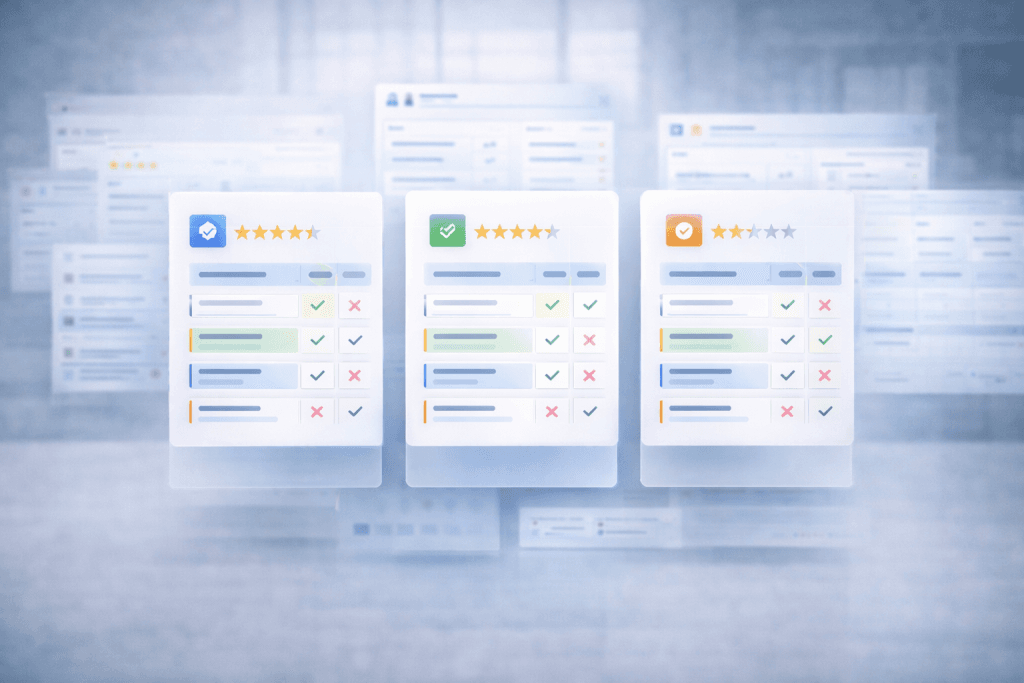
Most tool comparisons feel fake because they try to make a complex decision look simple.
They usually compare features, prices, ratings, and screenshots.
That can be useful, but it rarely explains how the tool will behave inside a real workflow.
A good comparison should help you understand the tradeoff.
A weak comparison only tells you which product looks better on paper.

The Real Problem Is Not the Tool

In most cases, the problem is not that one tool is good and the other is bad.
The real problem is that people compare tools before they understand what they actually need.
A team that needs structure may regret choosing a flexible tool.
A solo user who needs speed may regret choosing a platform built for large teams.
That is why many software decisions fail after the purchase, not before it.

What Fake-Looking Comparisons Usually Ignore

Most weak comparison articles ignore the details that actually affect the decision.
They do not ask how often the tool will be used, who will manage it,
how much training it requires, or whether the team already has a simpler tool that can do the same job.
These missing details matter more than small differences in feature lists.

The Problem With Most Tool Comparisons

Most tool comparisons aren’t fake because they’re inaccurate.
They’re fake because they answer the wrong question.
They focus on:
  • features
  • pricing
  • integrations
But ignore the only question that actually matters:
“Which tool will work for me long-term without regret?”
This is why choosing the right tool is more important than comparing features (see
> How to Choose the Right AI Tool)

How to Audit Your SaaS Stack in 30 Minutes

This is why most teams end up with bloated stacks (see: How to Audit Your SaaS Stack in 30 Minutes)

They Focus Too Much on Features

Feature lists can make tools look easy to compare, but they often create false confidence.
Two tools may both offer dashboards, automations, templates,
integrations, and reporting.
That does not mean they solve the same problem in the same way.
The better question is not “which tool has more features?”
The better question is “which tool fits the way I already work?”

They Hide the Cost of Complexity

A tool can look powerful during a comparison and still become expensive later.
The cost is not always the subscription price.
Sometimes the real cost is setup time, team confusion, duplicate workflows,
unused seats, and the effort required to keep everything organized.
This is where many comparison articles fall short.
They compare the purchase decision, but not the long-term ownership cost.

Why Feature-Based Comparisons Don’t Work

Modern tools are already good.
Whether you’re comparing:
  • Notion vs ClickUp
  • Trello vs Asana
  • Slack vs Microsoft Teams
They all:
  • cover most use cases
  • integrate with other tools
  • look great on paper
So comparisons zoom in on tiny differences:
  • one extra feature
  • slightly cheaper pricing
  • one additional integration
This creates false clarity.
It feels objective — but doesn’t help real decisions.
This often leads to tool regret after making the wrong decision (read
> The Psychology of Tool Regret)

Example: Notion vs ClickUp

Let’s make it real.
Notion:
  • flexible
  • powerful for customization
  • but can become messy fast
ClickUp:
  • structured
  • great for teams
  • but can feel overwhelming
Most comparison articles will say:

“ClickUp wins because it has more features”

But that’s not the real decision.
The real decision is:
 Do you prefer flexibility or structure?
 Can your team handle complexity?
That’s what actually matters.

The Ranking Illusion

“Top 5 tools.”
“Best tools in 2026.”
“1 Winner.”
These lists feel authoritative.
But in reality:
  1. Most tools are close in quality
  2. Rankings often reflect incentives, not outcomes
When tools are similar, ranking becomes storytelling — not truth.
This contributes to tool overload when people keep trying new tools (see
> Why SaaS Is So Expensive

The Hidden Incentive Problem

Many comparison articles are built to convert.
Not necessarily to help.
This doesn’t require lying.
It just means:
  • pros are emphasized
  • cons are softened
  • context is removed
The result feels useful…
until you actually use the tool.
Many tools seem useful in comparisons but create hidden complexity later (see
>
Tool Overload Isn’t a Productivity Problem)

Why You Still Feel Unsure After Reading Comparisons

After reading multiple comparisons, most people feel:
  • overwhelmed
  • confused
  • afraid of choosing wrong
That’s because comparisons optimize for choice, not confidence.
And confidence doesn’t come from more options.
It comes from understanding tradeoffs.

What Most Comparisons Ignore

Real decisions depend on things like:
  • your workflow
  • your team habits
  • your tolerance for complexity
  • your willingness to change tools
These don’t fit into comparison tables.
So they get ignored.

A Simple Framework for Choosing Tools

Instead of comparing tools, evaluate them using:
1. Decision Fit
Does this tool help you make better decisions?
2. Workflow Fit
Does it match how your team already works?
3. Complexity Cost
How much overhead does it add over time?
4. Abandon Risk
Will you still use it after 3 months?
The best tool isn’t the most powerful.
It’s the one you won’t abandon.

A Better Way to Compare Tools

Before trusting any tool comparison, look at the decision from your own workflow.
Ask whether the tool reduces friction or adds another layer of management.
Check whether your team can adopt it without constant reminders.
Look at what you already use before adding something new.
The right tool is not always the one with the best rating.
It is the one that stays useful after the first few weeks.

Simple Checklist Before Choosing a Tool

Use this checklist before relying on any comparison:
Does this tool solve a problem I already have?
Will I still use it after three months?
Does it replace another tool or only add more complexity?
Can my team understand it without heavy training?
Is the pricing clear after upgrades, seats, and usage limits?
If the answer is unclear, the comparison has not done enough work.

How to Actually Choose the Right Tool

Instead of asking:

“What is the best tool?”

Ask:
  • What will I still be comfortable using after 3 months?
  • What friction can I tolerate?
  • Do I need flexibility or structure?
The best tool isn’t the one with more features.
It’s the one you won’t abandon.

FAQ

Q: Why are tool comparisons misleading?
Because they focus on features instead of real-world usage and decision context.
Q: What should I look for instead of rankings?
Focus on workflow fit, usability, and long-term comfort.
Q: Are “best tools” lists reliable?
They can help, but shouldn’t be your only source of decision-making.

Closing

Most tool comparisons feel fake
because they try to simplify decisions that aren’t simple.
Real clarity takes time.
And it doesn’t always end with a clear winner.
Relief comes when you stop asking:

“Which tool is best?”

and start asking:

“Which choice will still feel right later?”

That’s where better decisions begin.

Final Takeaway

Tool comparisons are not useless, but they are often incomplete.
They can help you discover options, but they should not make the decision for you. A strong software decision comes from understanding your workflow, your tolerance for complexity, and the cost of maintaining the tool over time.
The goal is not to find the tool that wins the comparison.
The goal is to choose the tool you will not regret using later.
Instead of comparing endlessly, it’s better to simplify your system and focus on fewer tools (see
> Too Many Tools? Here’s How to Simplify Your Stack)

Final Thoughts

Tool comparisons are not useless.
But they are incomplete.
They help you see options,
but not consequences.
The goal is not to find the “best tool.”
The goal is to make a decision you won’t regret later.

Written by Waleed Al-Qasem

Founder of ToolRelief. 
I write about the intersection of technology, remote work, and human productivity. 
My mission is to help teams eliminate digital noise and get back to doing deep, meaningful work.
Waleed Al-Qasem, Founder of ToolRelief
Written by Waleed Al-Qasem
Founder of Nexio Global and ToolRelief. I write about SaaS costs, AI tool overload, and practical ways to build simpler, more efficient workflows. After spending over $47K on SaaS tools and experiencing tool overlap firsthand, I now help teams make clearer software decisions with less noise. Read my full story →
If your workflow feels heavier with AI… 
You don’t need another tool. 
You need less. 
Explore ToolRelief to simplify your stack and regain control.

Share this article
Scroll to Top