Last verified: 2026-08-01
TOOLRELIEF DECISION INTELLIGENCE
- Decision
- Use Software Bundle vs Individual Licenses: When Bundles Save Money to compare the documented alternatives and understand the costs, constraints, and trade-offs that materially affect the choice.
- Evidence Basis
- Comparative analysis of the capabilities, costs, constraints, limitations, and trade-offs documented for the options evaluated on this page.
- Best Used For
- Shortlisting alternatives and identifying the trade-offs that materially affect the final choice.
- Decision Boundary
- The better option depends on the requirements and constraints of the actual use case. Product capabilities, pricing, contracts, implementation conditions, and third-party terms can change.
software bundle vs individual licenses is the decision this guide resolves. A bundle can look cheaper because the checkout page adds the list prices of every included product. That arithmetic is misleading when only two tools are useful, three overlap with software you already pay for, or the license cannot cover client work. The correct comparison values replacement outcomes—not the number of logos in the box.
Choose the bundle only when the products you will actually deploy replace higher-cost licenses, the rights match your devices and users, and the break-even point arrives before support or update risk becomes material.
software bundle vs individual licenses — the short decision
Choose the bundle only when the products you will actually deploy replace higher-cost licenses, the rights match your devices and users, and the break-even point arrives before support or update risk becomes material.
Affiliate disclosure: ToolRelief is an independent publisher, not the seller or service provider. Some links may be affiliate links, which can earn ToolRelief a commission without changing your price. We evaluate the decision factors, limits, and evidence before presenting a commercial action.
Compare Verified Digital Product Offers
Build a usable bundle inventory
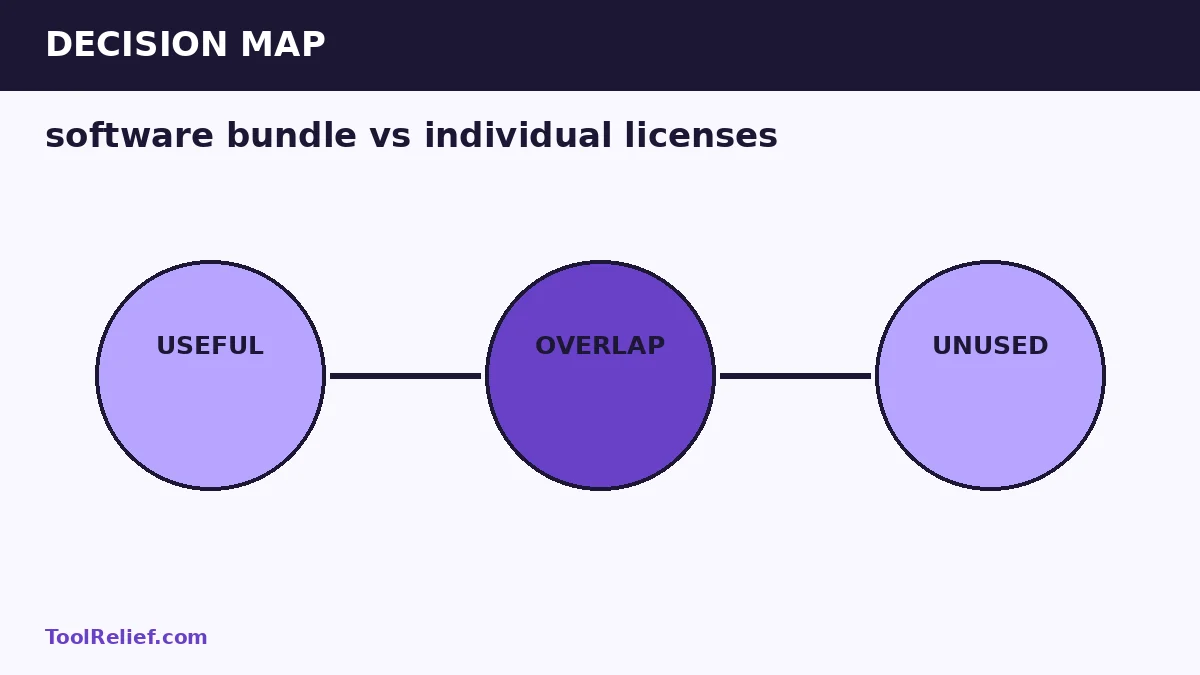
List every included product, then mark it as required, useful, redundant, or irrelevant. A product counts as required only when it supports a named workflow that already has an owner and a budget.
Do not assign value to a tool merely because it has a retail price. A video editor is worth zero to a team that does not publish video, and a second cleanup utility may be worth zero when an existing security suite already covers the task.
Calculate replacement value instead of advertised value
Replacement value is the amount you can stop paying elsewhere, not the vendor's summed list price. Use the lowest realistic alternative that meets the same requirement, then subtract migration, training, and renewal costs.
For a one-year decision, compare bundle cost with twelve months of avoidable subscriptions. For a multi-year license, add a risk discount because compatibility, operating-system support, and product continuity are uncertain.
Test overlap and workflow ownership
Map each included product to one workflow and one accountable user. If two products serve the same workflow, value only the stronger one unless the second has a distinct operational purpose.
Bundles create hidden SaaS waste when teams activate many apps without retiring anything. Require a cancellation or consolidation action for every claimed saving.
Read license rights before counting seats
Check whether the purchase is per device, per user, per household, or per business. Confirm commercial-use rights, transfer rules, activation limits, operating systems, and whether upgrades are included.
A bundle that covers one PC may be less valuable than two individual team licenses. Client-work restrictions can also invalidate a purchase for an agency even when the software technically works.
Model the break-even date and failure cases
Divide the net bundle price by the monthly cost of the licenses it truly replaces. Then stress-test the result: one product becomes unused, a key feature moves behind a paid upgrade, or a device change consumes another activation.
A purchase is stronger when it still breaks even under a conservative scenario rather than only under the vendor's best-case assumptions.
Bundle value scorecard
| Question | Bundle evidence | Reject when |
|---|---|---|
| Usable products | Named owner and workflow for each counted tool | Value depends on products nobody plans to use |
| Replacement savings | Subscriptions or purchases that will actually be removed | No current cost is retired |
| License fit | Seats, devices, commercial rights, OS and activation terms | Rights do not match the buyer |
| Update horizon | Written upgrade and support terms | Essential compatibility depends on an unclear future upgrade |
| Break-even | Conservative date based on avoidable cost | Savings require unrealistic adoption |
A practical example
A small agency sees a seven-product bundle for $99. Only the PDF utility and backup tool replace current subscriptions worth $14 per month. After a $30 migration allowance, the bundle breaks even in about nine months. The other five products add no financial value. The deal is still rational—but for two verified replacements, not seven advertised products.
Pre-purchase checklist
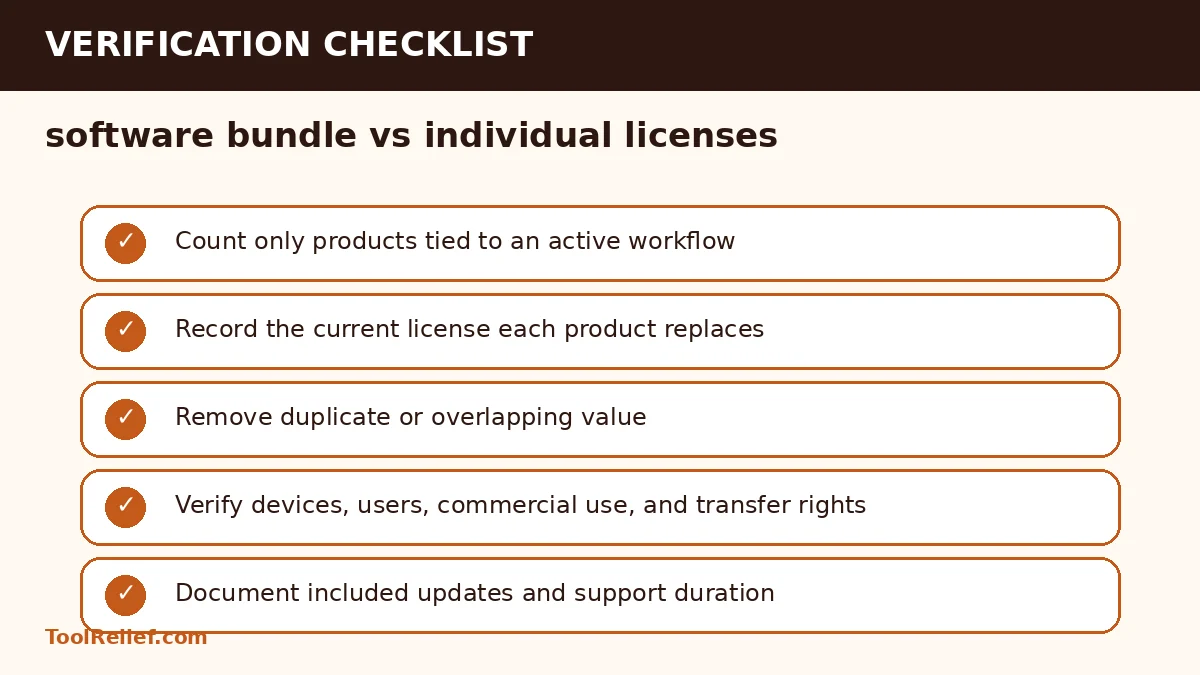
- Count only products tied to an active workflow
- Record the current license each product replaces
- Remove duplicate or overlapping value
- Verify devices, users, commercial use, and transfer rights
- Document included updates and support duration
- Calculate conservative and worst-case break-even dates
- Save the checkout page and license terms
Use a minimum evidence standard
A strong software bundle vs individual licenses decision uses three levels of evidence. First, confirm the provider or seller statement that governs the transaction. Second, verify the operational detail at the exact checkout, account, property, location, or policy level. Third, preserve independent evidence such as the receipt, confirmation, screenshot, or issuer record. A general marketing page cannot replace transaction-specific terms.
When two options remain close, prefer the one with clearer ownership and reversibility. Clear ownership means the buyer knows who can change, support, cancel, refund, or correct the transaction. Reversibility means the financial and operational cost of a mistake is limited. This standard prevents a small displayed saving from transferring a much larger unresolved risk to the buyer.
Document the decision before checkout
Create a compact decision record for software bundle vs individual licenses. Save the date, selected option, final price, applicable terms, seller or provider, cancellation or refund deadline, and the evidence that supports the choice. A record is especially important when a promotion, currency, policy, or inventory condition can change after the transaction.
Reject the option when any critical condition remains unverified: useful, overlap, or unused. The goal is not to eliminate every uncertainty; it is to identify which party owns the risk and whether the expected value justifies accepting it.
Review the decision after the transaction
After purchase or booking, compare the confirmation with the decision record. Verify the charged amount, product or service configuration, dates, names, currency, renewal or cancellation settings, and support contact. Correct a mismatch immediately while the checkout evidence is fresh and any cancellation or refund window remains open.
Schedule a later review when the obligation continues. For software, review renewal, usage, seats, and update rights. For travel, review schedule changes, payment status, deadlines, and policy updates. This closes the loop: the software bundle vs individual licenses decision is not complete until the delivered transaction matches what was approved.
Related ToolRelief decision guides
Frequently asked questions
Are software bundles always cheaper than individual licenses?
No. They are cheaper only when the included products replace costs you would otherwise pay and their license rights fit the intended use.
Should every included product receive its list-price value?
No. Give value only to products with a real workflow, owner, and alternative cost.
How should lifetime bundle updates be valued?
Treat unclear update rights conservatively and test whether the purchase breaks even before a paid upgrade could become necessary.
Sources and verification
Decision: Recheck the current price, terms, eligibility, and provider responsibilities at the final checkout. The software bundle vs individual licenses framework is designed to make the commercial decision auditable rather than automatic.
Last Updated on August 1, 2026