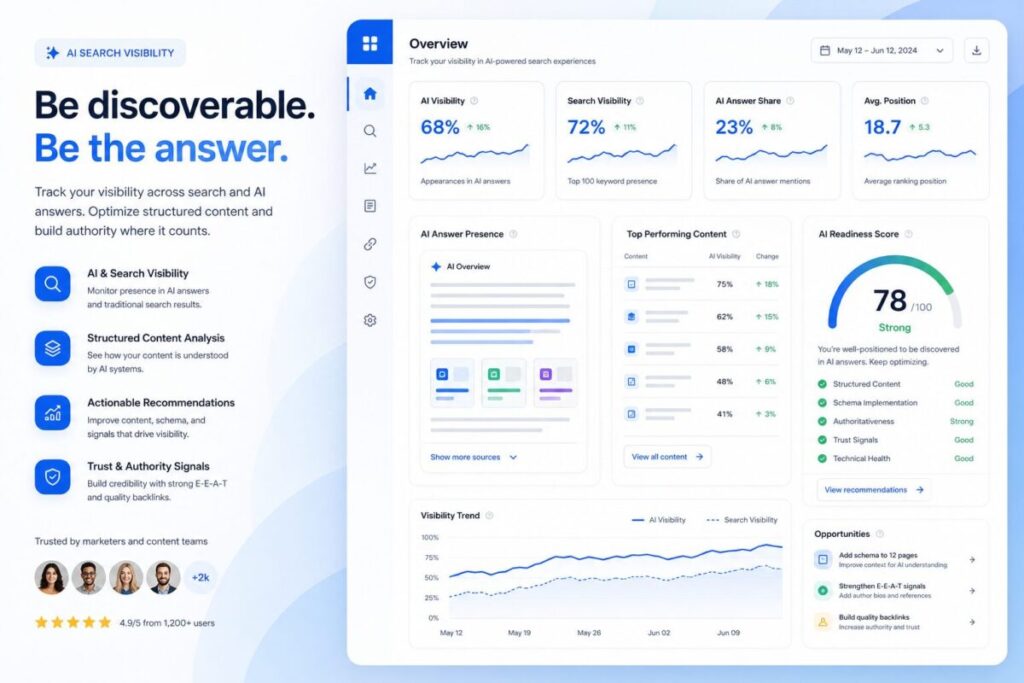
Search is no longer only about matching keywords.
Modern discovery depends on whether a page clearly communicates what it is about, who it helps, why it is useful, and whether it can be trusted.
A page that is difficult to understand, outdated, unsupported, or generic may struggle even if it contains the right keywords.
A stronger page usually has:
- a clear purpose
- original usefulness
- fresh or reviewed information
- trustworthy sources when needed
- structured headings
- clear entities such as tools, products, categories, and use cases
- comparison or decision support
- useful internal links
- trust signals
- a clear next step
That is what this calculator is designed to evaluate.
Who Should Use This Calculator?
This calculator is useful for:
- website owners
- bloggers
- SaaS companies
- affiliate site owners
- SEO teams
- content teams
- startup founders
- agencies
- tool directories
- comparison sites
- business owners with landing pages
- creators building topical authority
If you rely on organic visibility, AI-assisted discovery, buyer guides, comparison pages, or content-driven conversions,
this tool gives you a fast way to identify weak points.
What The Calculator Measures
1. Page Purpose
A strong page should make it immediately clear who it helps and what problem it solves.
2. Original Usefulness
Modern search systems and users both reward useful pages.
Generic summaries are weaker than pages with examples, data, templates, calculators, checklists, comparisons, or practical guidance.
3. Freshness
A page should show signs of being maintained.
Last reviewed dates, updated examples, new sources, and refreshed recommendations can make the page more trustworthy.
If visibility problems come from unclear positioning or weak tool decisions, use the AI Tools Decision Framework to review the underlying software choice.
4. Source Support
Important claims should be supported by trusted sources where appropriate.
This is especially important for SEO, finance, security, health, legal, product pricing, and technical topics.
5. Structure
Clear H1, H2, and H3 structure helps both users and systems understand the page.
6. Entity Clarity
A page should clearly identify relevant tools, products, companies, categories, concepts, and use cases.
7. Comparison Value
Pages that help users make a decision are often stronger than pages that only describe a topic.
8. Internal Linking
Useful internal links help users continue their journey and help the site connect related topics.
9. Trust Signals
Author notes, reviewer notes, methodology, last reviewed dates, transparent limitations, and source notes can make a page more credible.
10. Conversion Clarity
A good page should give the user a useful next step: a calculator, checklist, template, guide, audit, comparison, or contact option.
How To Improve A Low Score
If your score is low, start with the basics:
- Rewrite the introduction so the page purpose is obvious.
- Add a “last reviewed” or “last updated” note.
- Add original examples, templates, data, or checklists.
- Add relevant internal links.
- Add source support for important claims.
- Improve headings.
- Add comparison tables or decision guidance.
- Add a clear CTA or next step.
Do not improve the page only for algorithms. Improve it so a real person can make a better decision after reading it.

 Travel Disruption 2026: Rights, Delays, EES & ETIASFlight disruption, passenger rights, and European entry systems all changed materially around 2026. This benchmark separates...
 Travel Cost Leakage 2026: Fees, FX & Real Trip CostsThe price you first see is not always the price your trip ultimately carries. This report...
 Travel Booking Friction 2026: Why Booking Gets HarderTravel booking friction is rarely caused by one bad website. It emerges when inventory, prices, contract...
 Travel Decision Stack: Plan, Verify, Book & BeyondTravel decisions are not independent. Entry requirements affect booking risk, arrival airports affect ground transport, fare...
 SaaS Contract Negotiation: Pricing & Terms Before SigningA strong SaaS contract is more than a discounted quote. Use this pre-signature framework to negotiate...
 Best Time to Buy Software: Buy Now or Wait?Should you buy software now or wait for a better price? This decision framework weighs current...