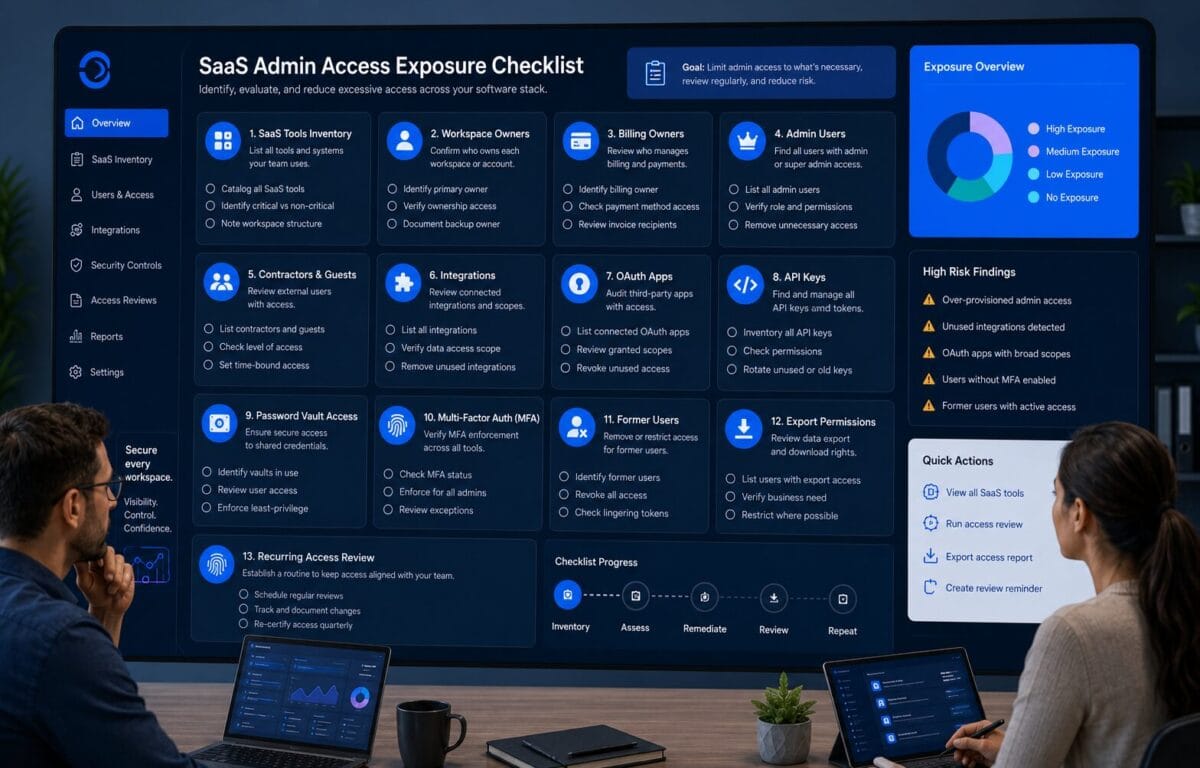
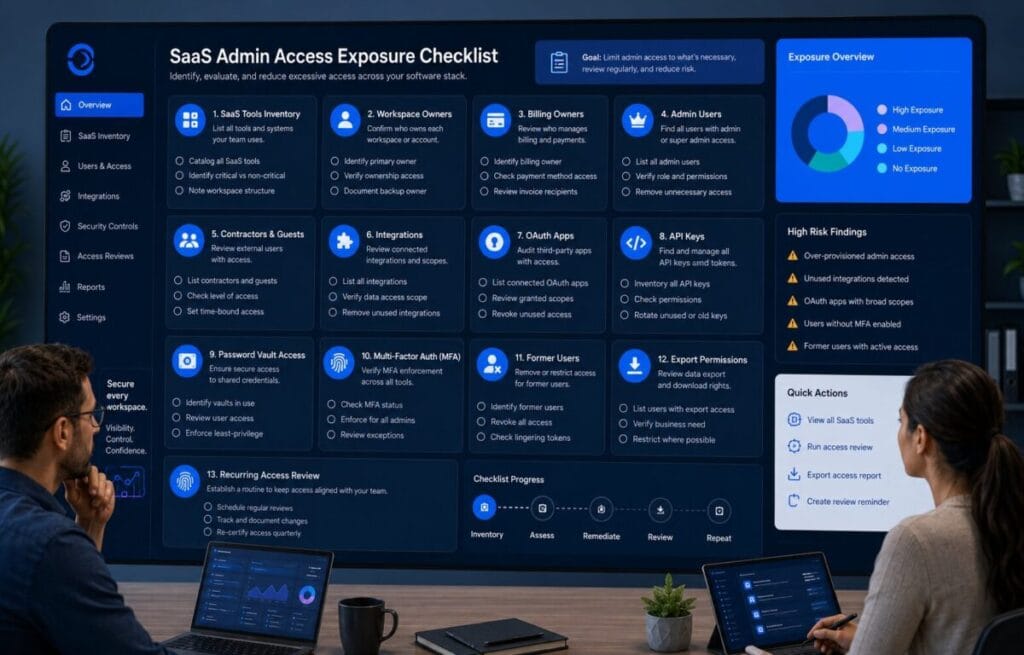
SaaS Admin Access Exposure Checklist
Quick Navigation ✔
ToggleUse this SaaS admin access exposure checklist before adding more users, contractors, integrations, billing owners, workspace owners, or admin roles to your software stack.
SaaS admin exposure often hides inside everyday tools, not only inside VPN, ZTNA, or remote access systems. A small team may have clean VPN access but still have too many people controlling SaaS workspaces, billing settings, exports, integrations, OAuth apps, API keys, and admin dashboards.
Decision Snapshot
Review workspace owners, billing owners, admin users, contractors, integrations, OAuth apps, API keys, password vault access, MFA, former users, export permissions, and recurring access review.
The goal is to identify who can control, export, invite, bill, integrate, automate, or administer critical SaaS tools — then decide which permissions should be removed, limited, reviewed, or owned.
Review exposure before adding more users, contractors, integrations, or billing owners.
Admin exposure often hides in everyday SaaS workspaces, billing settings, exports, and integrations.
Check owners, admins, MFA, API keys, OAuth apps, password vault access, and former users.
Every critical SaaS tool needs owners, review cadence, and offboarding accountability.
Who Should Use This SaaS Admin Access Exposure Checklist
This SaaS admin access exposure checklist is for small teams, remote teams, lean operators, solo founders, small businesses, agencies, and internal managers who use multiple SaaS tools without a clear access review process.
Teams with many SaaS tools
Use it when your team has many workspaces, admin users, billing owners, integrations, and shared operational tools.
Teams adding users or contractors
Use it before adding employees, agencies, contractors, consultants, vendors, or temporary users to critical SaaS tools.
Teams without access review cadence
Use it when former users, old integrations, shared admin credentials, or unclear ownership may still exist.
This is not a buying guide. It is not a SaaS management platform article. It is not a vendor roundup. It is an operational access review for teams that want to reduce hidden SaaS admin exposure before adding more users, contractors, integrations, or billing owners.
The SaaS Admin Access Exposure Checklist
The purpose of this SaaS admin access exposure checklist is to help small teams see what is usually invisible. SaaS admin exposure is not only about who can log in. It is about who can invite users, remove users, change roles, access billing, export data, change security settings, create integrations, approve OAuth apps, generate API keys, connect automation tools, view sensitive records, access password vaults, or keep access after leaving.
SaaS Admin Access Exposure Checklist: List Critical SaaS Tools
SaaS admin access exposure checklist inventory items
- [ ] List critical SaaS tools.
- [ ] List collaboration tools.
- [ ] List project management tools.
- [ ] List CRM or customer data tools.
- [ ] List finance, billing, or accounting tools.
- [ ] List analytics and reporting tools.
- [ ] List marketing and automation tools.
- [ ] List password manager and identity tools.
- [ ] List file storage and document tools.
- [ ] List developer, code, or deployment tools if used.
- [ ] Mark which tools contain sensitive data.
- [ ] Mark which tools are business-critical.
- [ ] Mark which tools have multiple admins.
Why it matters
You cannot review SaaS admin exposure if you do not know which SaaS tools matter. Small teams often remember the obvious tools but forget smaller systems that still hold important data, billing access, integrations, customer information, or automation permissions.
What small teams often miss
Small teams often miss old workspaces, forgotten analytics tools, billing systems, automation platforms, shared file tools, old project boards, customer support apps, legacy CRM accounts, design tools, documentation spaces, and apps used by contractors or agencies.
Next action
Create a simple SaaS inventory: tool, business function, owner, billing owner, admin users, sensitive data, and review status.
Identify Workspace Owners and Billing Owners
Checklist items for SaaS owners and billing owners
- [ ] Identify workspace owners.
- [ ] Identify billing owners.
- [ ] Identify security or admin owners where available.
- [ ] Identify recovery email or recovery contact for each tool.
- [ ] Confirm whether the workspace owner still works with the team.
- [ ] Confirm whether the billing owner still owns the payment method.
- [ ] Confirm whether a contractor or agency controls any workspace.
- [ ] Confirm whether the founder is the only recovery owner.
- [ ] Confirm whether billing and admin access are separated where needed.
- [ ] Document who can change plan, seats, billing, invoices, or workspace settings.
Why it matters
Workspace ownership and billing ownership are control points. If ownership is unclear, the team may lose control during employee turnover, contractor changes, payment updates, or tool migration.
What small teams often miss
Small teams often let ownership follow whoever created the tool first. That person might be a founder who no longer manages the tool, a former employee, a contractor, an agency account, a personal email address, a finance user, or a technical user.
Next action
For every critical SaaS tool, assign at least one active internal workspace owner and one billing owner.
Identify All Admin Users
Checklist items for SaaS admin users
- [ ] Identify all admin users.
- [ ] Identify super admins or workspace owners.
- [ ] Identify billing admins.
- [ ] Identify security admins.
- [ ] Identify users who can invite new users.
- [ ] Identify users who can change roles.
- [ ] Identify users who can export data.
- [ ] Identify users who can manage integrations.
- [ ] Identify users who can access audit or activity settings.
- [ ] Identify users who were made admin temporarily.
- [ ] Remove admin roles that are no longer needed.
- [ ] Document why each admin role exists.
Why it matters
Admin access is one of the highest-exposure areas inside SaaS tools. A user with admin access may be able to invite people, export data, change settings, approve integrations, manage billing, or remove other users.
What small teams often miss
Small teams often miss temporary admin roles. Someone becomes admin to fix a setup issue, connect an integration, help with billing, import data, or support a contractor. The task ends, but admin access remains.
Next action
Create an admin list for each critical SaaS tool. For each admin, ask: “Does this person still need admin access today?”
Review Contractor and Agency Admin Access
Checklist items for contractor and agency SaaS admin access
- [ ] List contractors with SaaS admin access.
- [ ] List agencies with SaaS admin access.
- [ ] List freelancers with SaaS admin access.
- [ ] List consultants and vendors with SaaS admin access.
- [ ] Confirm what each external user needs to manage.
- [ ] Confirm whether each external admin needs full admin access.
- [ ] Confirm whether external admin access has an expiration date.
- [ ] Confirm who internally owns each contractor or agency relationship.
- [ ] Remove external admin access that is no longer justified.
- [ ] Review whether external users can invite users, export data, or change billing.
- [ ] Review whether external users have access to connected integrations.
- [ ] Review whether agency staff changed while access stayed active.
Why it matters
Contractor and agency access can create hidden SaaS admin exposure. External admin access should have a narrow scope, internal owner, and removal plan.
What small teams often miss
Small teams often grant agency access to one account and then forget that the agency may add staff, change team members, or keep admin rights after the project ends.
Next action
Review every contractor or agency admin account and document owner, scope, expiration, admin level, removal date, and last review date.
Review Integrations, OAuth Apps, API Keys, and Automations
Checklist items for SaaS integrations and OAuth exposure
- [ ] List integrations connected to each critical SaaS tool.
- [ ] List OAuth apps connected by users or admins.
- [ ] List API keys created for workflows or automations.
- [ ] List automation tools connected to SaaS apps.
- [ ] Identify who created each integration or API key.
- [ ] Identify whether the integration is still used.
- [ ] Identify what data each integration can access.
- [ ] Identify whether the integration can write, export, delete, or modify records.
- [ ] Remove integrations that are no longer needed.
- [ ] Review integrations created by former employees or contractors.
- [ ] Document the owner for each active integration.
- [ ] Schedule a recurring integration review.
Why it matters
SaaS exposure is not only user access. Integrations, OAuth apps, API keys, and automations can keep access alive even after a user leaves.
What small teams often miss
Small teams often offboard people but forget OAuth apps, API keys, automation workflows, CRM integrations, reporting connectors, analytics exports, email marketing connections, spreadsheet syncs, billing integrations, and old developer tokens.
Next action
Create an integration register: tool, integration, owner, data access, created by, still used, and remove or keep.
Review Password Manager and Shared Admin Credentials
Checklist items for SaaS admin password access
- [ ] Review password manager access for SaaS admin credentials.
- [ ] Identify shared admin logins.
- [ ] Identify who can view admin passwords.
- [ ] Identify who can copy or export credentials.
- [ ] Identify contractor or agency access to password vaults.
- [ ] Confirm MFA is enabled for password manager access.
- [ ] Remove users who no longer need vault access.
- [ ] Rotate shared admin passwords where needed.
- [ ] Remove credentials stored outside the password manager where possible.
- [ ] Review browser-saved admin passwords.
- [ ] Document who owns each shared admin credential.
- [ ] Replace shared admin accounts with individual users where possible.
Why it matters
Shared admin credentials can weaken SaaS access review. Even if a user is removed from a SaaS tool, they may still have a copied password, a shared login, or access to the password vault that stores admin credentials.
What small teams often miss
Small teams often review SaaS users but not password vault access. They may remove a contractor from a tool but forget that the contractor still had access to the shared credential.
Next action
Review password manager access as part of every SaaS admin review. If a shared admin credential exists, assign an owner and decide whether it should be rotated, removed, or replaced with named users.
Check MFA on SaaS Admin Accounts
Checklist items for SaaS admin MFA
- [ ] Confirm MFA is enabled on all critical SaaS admin accounts.
- [ ] Confirm MFA is enabled for workspace owners.
- [ ] Confirm MFA is enabled for billing owners where supported.
- [ ] Confirm MFA is enabled for security admins.
- [ ] Confirm MFA is enabled for contractor or agency admins.
- [ ] Confirm MFA is enabled for password manager access.
- [ ] Review backup recovery methods.
- [ ] Avoid shared admin accounts that bypass individual MFA.
- [ ] Review whether high-risk admin roles need stronger MFA.
- [ ] Document who can reset admin access.
Why it matters
SaaS admin accounts often control sensitive settings, users, billing, exports, integrations, and data access. MFA does not solve every SaaS admin risk, but weak or inconsistent MFA increases exposure.
What small teams often miss
Small teams often enable MFA for email but not for every admin account. They may also assume MFA is active because the tool supports it, but never confirm whether every admin has enabled it.
Next action
Make a list of admin users without MFA. Fix those accounts before adding new users, contractors, or integrations.
Review User Invitations and Role Changes
Checklist items for SaaS user invitations and role changes
- [ ] Review pending user invitations.
- [ ] Review recently added users.
- [ ] Review recently upgraded roles.
- [ ] Review users with temporary admin access.
- [ ] Review users who changed roles inside the company.
- [ ] Review users who moved off a project.
- [ ] Review users invited by contractors or agencies.
- [ ] Review whether users can invite others.
- [ ] Review whether users can approve role changes.
- [ ] Remove pending invitations that are no longer needed.
- [ ] Downgrade roles that were elevated temporarily.
- [ ] Document who approved role changes.
Why it matters
Invitations and role changes can create exposure quietly. A user may be invited and never onboarded, a contractor may be invited by an agency, or a temporary admin role may stay active.
What small teams often miss
Small teams often forget pending invites and temporary role upgrades. Someone becomes admin to help with setup, import data, change settings, or connect a tool, then remains admin indefinitely.
Next action
Review all pending invitations and role changes. Remove unused invites and downgrade temporary admin access.
Review Export, Billing, and Security Permissions
Checklist items for SaaS admin permissions
- [ ] Identify users who can export data.
- [ ] Identify users who can access billing settings.
- [ ] Identify users who can change payment methods.
- [ ] Identify users who can view invoices.
- [ ] Identify users who can change security settings.
- [ ] Identify users who can manage integrations.
- [ ] Identify users who can invite or remove users.
- [ ] Identify users who can change workspace settings.
- [ ] Identify users who can access customer data exports.
- [ ] Identify users who can create API keys.
- [ ] Remove high-impact permissions that are not needed.
- [ ] Document why each high-impact permission exists.
Why it matters
Admin risk is not only about having the word “admin” next to a user’s name. Some users may not be full admins but still have high-impact permissions.
What small teams often miss
Small teams often assume role names tell the full story. A user may have export rights without being a full admin, control billing without managing users, or manage integrations without controlling security settings.
Next action
Identify high-impact permissions separately: export, billing, invite, role change, integration, API, and security settings. Remove permissions that are not justified.
Review Former Employee and Contractor Access
Checklist items for former SaaS users
- [ ] Review former employee accounts.
- [ ] Review former contractor accounts.
- [ ] Review former agency users.
- [ ] Review vendor support accounts.
- [ ] Review temporary users from old projects.
- [ ] Remove former users from SaaS tools.
- [ ] Remove former users from password manager vaults.
- [ ] Remove former users from integrations where possible.
- [ ] Review API keys or automations created by former users.
- [ ] Transfer ownership of files, dashboards, automations, or workflows.
- [ ] Rotate shared credentials if needed.
- [ ] Document the offboarding completion date.
Why it matters
Offboarding often fails inside SaaS tools because access is scattered. A former user may be removed from email but still appear in a SaaS workspace, password vault, integration, document system, or automation workflow.
What small teams often miss
Small teams often treat offboarding as one account removal. SaaS access is usually spread across tools, vaults, integrations, documents, dashboards, and automations.
Next action
Run SaaS offboarding as a checklist, not a memory task. Former users should be removed from tools, vaults, integrations, and admin roles.
Assign SaaS Admin Ownership
Checklist items for SaaS admin ownership
- [ ] Assign an owner for each critical SaaS tool.
- [ ] Assign a backup owner where needed.
- [ ] Assign a billing owner.
- [ ] Assign an admin access reviewer.
- [ ] Assign an integration owner.
- [ ] Assign an offboarding owner.
- [ ] Document who approves new admins.
- [ ] Document who approves new integrations.
- [ ] Document who reviews contractors or agencies.
- [ ] Document who reviews role changes.
- [ ] Document where ownership is tracked.
Why it matters
SaaS admin exposure grows when ownership is unclear. Small teams do not need a heavy governance program, but they do need clear responsibility.
What small teams often miss
Small teams often assume the tool owner is obvious. It usually is not. The person who pays for the tool may not manage users, and the person who uses the tool daily may not control billing.
Next action
Create a SaaS ownership register: tool, workspace owner, billing owner, admin reviewer, integration owner, and backup owner.
Set a Recurring SaaS Access Review Cadence
Checklist items for recurring SaaS access review
- [ ] Set a recurring SaaS access review cadence.
- [ ] Review critical SaaS tools monthly or quarterly.
- [ ] Review admin users.
- [ ] Review billing owners.
- [ ] Review contractors and agencies.
- [ ] Review former users.
- [ ] Review integrations, OAuth apps, and API keys.
- [ ] Review shared admin credentials.
- [ ] Review high-impact permissions.
- [ ] Review pending invitations.
- [ ] Document removals and role changes.
- [ ] Schedule the next review before closing the current one.
Why it matters
SaaS exposure changes over time. New users are added, contractors come and go, admins change roles, integrations are connected, billing ownership changes, and workflows get created and forgotten.
What small teams often miss
Small teams often review SaaS access only after a problem, billing surprise, contractor exit, or tool migration. A lighter recurring review is easier than a rushed cleanup later.
Next action
Set a recurring review date for critical SaaS tools. For many small teams, a monthly or quarterly review is enough.
SaaS Admin Exposure Score
Use this score to decide whether SaaS admin exposure is controlled or needs cleanup. A low score does not mean every SaaS tool is dangerous. It means admin exposure is not clear enough yet.
0 = Not reviewed
The area has not been reviewed, ownership is unclear, or exposure is unknown.
1 = Partially controlled
The area has been reviewed, but gaps, exceptions, or unclear ownership remain.
2 = Controlled
The area is reviewed, documented, owned, and controlled enough for current operations.
Score: 0 / 1 / 2
Score: 0 / 1 / 2
Score: 0 / 1 / 2
Score: 0 / 1 / 2
Score: 0 / 1 / 2
Score: 0 / 1 / 2
Score: 0 / 1 / 2
Score: 0 / 1 / 2
Score: 0 / 1 / 2
Score: 0 / 1 / 2
16–20
SaaS admin exposure is controlled. Owners, admins, integrations, MFA, former users, and access review are clear enough for current operations.
9–15
SaaS admin exposure needs cleanup. Some review work is done, but gaps remain before adding more users or integrations.
0–8
High SaaS admin exposure; review before adding more users or integrations. Pause expansion until basic control points are reviewed.
When SaaS Admin Access Is High Risk
SaaS admin access is higher risk when too many people can control, export, invite, bill, integrate, automate, or administer important tools without clear ownership.
SaaS admin access is not automatically dangerous. The risk increases when permissions are broad, old, shared, unmanaged, or ownerless.
What to Fix Before Adding More Users or Contractors
Before adding more users, contractors, agencies, integrations, or billing owners, fix the access gaps that create avoidable exposure.
Adding more users to an unclear SaaS environment makes future cleanup harder. Before expansion, make ownership, admin roles, integrations, credentials, and offboarding visible.
SaaS Admin Offboarding Checklist
Use this checklist when an employee, contractor, agency user, consultant, or temporary collaborator leaves the team or no longer needs SaaS admin access.
- [ ] Confirm the user no longer needs access.
- [ ] Remove the user from critical SaaS tools.
- [ ] Remove admin roles.
- [ ] Remove billing access.
- [ ] Remove workspace owner access if applicable.
- [ ] Transfer workspace ownership if needed.
- [ ] Transfer billing ownership if needed.
- [ ] Transfer dashboards, files, workflows, or automations.
- [ ] Remove the user from password manager vaults.
- [ ] Rotate shared admin credentials if needed.
- [ ] Review integrations created by the user.
- [ ] Review OAuth apps connected by the user.
- [ ] Review API keys created by the user.
- [ ] Review automation workflows created by the user.
- [ ] Remove pending invitations sent by or to the user.
- [ ] Review file sharing links if relevant.
- [ ] Confirm MFA recovery methods are updated if needed.
- [ ] Document the offboarding date.
- [ ] Confirm the user no longer appears in active admin lists.
- [ ] Schedule a follow-up review for complex access.
SaaS admin offboarding should not depend on memory. If a user had admin, billing, integration, API, export, or password vault access, offboarding needs more than removing one login.
Service Categories Mentioned in This Checklist
This section is not a ranking and not a vendor list. These are service categories that may appear during a practical SaaS admin access review.
Password Managers
Examples only: 1Password, Bitwarden.
This category appears because SaaS admin exposure often includes shared credentials, password vault access, admin passwords, recovery credentials, and contractor credential access.
ZTNA / Zero Trust Access Platforms
Examples only: Cloudflare Zero Trust, Twingate.
This category may appear when some SaaS or admin workflows need app-level access controls, identity-aware policies, or contractor-specific access rules.
Business VPN / Managed VPN Platforms
Example only: NordLayer.
This category may appear when some admin workflows or private apps still depend on controlled remote access.
Hardware Security Keys
Example only: YubiKey.
This category may appear when high-risk SaaS admin accounts need stronger MFA.
SaaS Access Review / Admin Ownership Workflow
No vendor pitch needed now.
This category appears because SaaS admin exposure is often an ownership and review problem.
Offboarding / Access Review Workflow
No vendor pitch needed now.
This category appears because former users, contractors, agencies, and old integrations are common sources of SaaS admin exposure.
Where This Fits Inside ToolRelief
This asset is part of ToolRelief’s External Service Demand Engine. It supports users who are reviewing SaaS admin exposure, access ownership, user permissions, contractor access, integrations, and offboarding risk.
Model comparison
Replacement paths
Broader access cleanup
VPN replacement review
App-level access readiness
Contractor access review
Current VPN review
Security routing
Software trend monitoring
Device context
Parent decision system
Review SaaS Admin Exposure Before Adding More Users or Integrations
Use ToolRelief’s Contractor Access Security Checklist and Secure Remote Access Checklist to decide which SaaS permissions should be removed, limited, reviewed, or owned.