TOOLRELIEF DECISION INTELLIGENCE
- Decision
- Use Best AI Tools for Marketing in 2026: Pick by Use Case to evaluate the software or technology question investigated on this page before taking the next material action.
- Evidence Basis
- Documented product information, published evidence, comparative analysis, direct observation, and clearly labeled models where applicable.
- Best Used For
- Reducing uncertainty before taking the next material action.
- Decision Boundary
- This page provides independent decision support rather than a guaranteed outcome. Product capabilities, pricing, third-party terms, and operating conditions can change.
Best AI Tools for Marketing in 2026: Pick by Use Case
Quick Navigation ✔
ToggleMarketing teams do not need more AI tools.
They need fewer disconnected workflows.
The best AI tools for marketing in 2026 are useful only when they replace a real job:
campaign writing, SEO research, content repurposing, automation, reporting, or customer follow-up.
This guide uses the ToolRelief approach:
do not choose an AI tool because it looks impressive.
Choose it because it can replace manual work, reduce software overlap, and make the marketing stack easier to manage.
Latest ToolRelief Guides, Hubs, and Decision Tools
Explore the newest ToolRelief resources for AI tools, cybersecurity, VPN decisions, hosting deals, software risk, and smarter tool stack choices.
Latest from ToolRelief
Fresh guides, research notes, and practical SaaS waste insights.

ResearchSep 1, 2026Travel Disruption 2026: Rights, Delays, EES & ETIASFlight disruption, passenger rights, and European entry systems all changed materially around 2026. This benchmark separates...

ResearchSep 1, 2026Travel Cost Leakage 2026: Fees, FX & Real Trip CostsThe price you first see is not always the price your trip ultimately carries. This report...

GuideSep 1, 2026Travel Booking Friction 2026: Why Booking Gets HarderTravel booking friction is rarely caused by one bad website. It emerges when inventory, prices, contract...

GuideSep 1, 2026Travel Decision Stack: Plan, Verify, Book & BeyondTravel decisions are not independent. Entry requirements affect booking risk, arrival airports affect ground transport, fare...

ResearchAug 29, 2026SaaS Contract Negotiation: Pricing & Terms Before SigningA strong SaaS contract is more than a discounted quote. Use this pre-signature framework to negotiate...

ResearchAug 29, 2026Best Time to Buy Software: Buy Now or Wait?Should you buy software now or wait for a better price? This decision framework weighs current...
ResearchSep 1, 2026Travel Disruption 2026: Rights, Delays, EES & ETIASFlight disruption, passenger rights, and European entry systems all changed materially around 2026. This benchmark separates...
ResearchSep 1, 2026Travel Cost Leakage 2026: Fees, FX & Real Trip CostsThe price you first see is not always the price your trip ultimately carries. This report...
GuideSep 1, 2026Travel Booking Friction 2026: Why Booking Gets HarderTravel booking friction is rarely caused by one bad website. It emerges when inventory, prices, contract...
GuideSep 1, 2026Travel Decision Stack: Plan, Verify, Book & BeyondTravel decisions are not independent. Entry requirements affect booking risk, arrival airports affect ground transport, fare...
ResearchAug 29, 2026SaaS Contract Negotiation: Pricing & Terms Before SigningA strong SaaS contract is more than a discounted quote. Use this pre-signature framework to negotiate...
ResearchAug 29, 2026Best Time to Buy Software: Buy Now or Wait?Should you buy software now or wait for a better price? This decision framework weighs current...Explore ToolRelief
Calculators, audits, templates, playbooks, and decision tools.

HomeToolRelief HomeStart from the main ToolRelief hub.
ToolsSaaS Cost Optimization ToolsFree tools for finding and reducing SaaS waste.

AuditSaaS AuditReview your stack and identify waste signals.

FrameworkThe SystemThe ToolRelief SaaS waste detection framework.
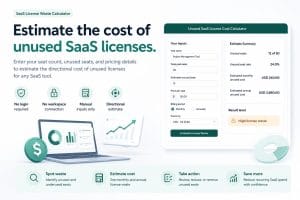
CalculatorUnused SaaS License Cost CalculatorEstimate wasted spend from unused software seats.
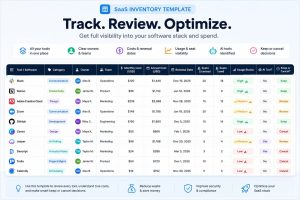
TemplateSaaS Inventory TemplateTrack tools, owners, costs, renewals, and usage.

CalculatorsBusiness CalculatorsPractical calculators for planning and decisions.

CalculatorBusiness Days CalculatorCount workdays, deadlines, and delivery windows.TRLiveToolRelief LiveSee what is new across ToolRelief.

LibraryResearch LibrarySaaS waste research, patterns, and cost intelligence.
PlaybookHidden SaaS Waste PlaybookLearn where hidden SaaS waste usually appears.

ReviewFree SaaS Waste ReviewRequest a free review of your SaaS waste signals.

HomeToolRelief HomeStart from the main ToolRelief hub.
ToolsSaaS Cost Optimization ToolsFree tools for finding and reducing SaaS waste.
AuditSaaS AuditReview your stack and identify waste signals.
FrameworkThe SystemThe ToolRelief SaaS waste detection framework.
CalculatorUnused SaaS License Cost CalculatorEstimate wasted spend from unused software seats.
TemplateSaaS Inventory TemplateTrack tools, owners, costs, renewals, and usage.
CalculatorsBusiness CalculatorsPractical calculators for planning and decisions.
CalculatorBusiness Days CalculatorCount workdays, deadlines, and delivery windows.TRLiveToolRelief LiveSee what is new across ToolRelief.
LibraryResearch LibrarySaaS waste research, patterns, and cost intelligence.
PlaybookHidden SaaS Waste PlaybookLearn where hidden SaaS waste usually appears.
ReviewFree SaaS Waste ReviewRequest a free review of your SaaS waste signals.Quick Pick: Best AI Marketing Tool by Use Case
The best AI tools for marketing are not always the tools with the most features. Start with the job you want to remove from your workflow, then choose the smallest stack that can handle it.
Best for brand copy and campaign writing
Use a dedicated AI writing or campaign platform when your main problem is producing consistent emails, landing pages, ads, and brand-safe marketing copy.
Best for SEO and content planning
Use an SEO-focused AI tool when the workflow includes keyword research, content briefs, on-page optimization, and search-driven article planning.
Best for market research
Use an AI research tool when your team needs faster competitive research, source discovery, trend summaries, and campaign angle development.
Best for repurposing content
Use a repurposing tool when one long video, podcast, webinar, or article needs to become social posts, clips, email ideas, and short-form content.
Best for automation and distribution
Use an automation platform when your problem is moving campaign data, leads, posts, approvals, or assets between marketing tools.
Best for CRM and campaign operations
Use a CRM or marketing operations platform when your team needs one place for leads, campaigns, customer data, reporting, and follow-up workflows.
How ToolRelief Evaluates AI Marketing Tools
Most businesses accidentally build a “Frankenstein” software stack.
They buy one tool for email, another for social media, another for SEO, and another for analytics.
The Integration Nightmare:
Forcing these tools to talk to each other usually requires complicated workarounds or expensive API connectors like Zapier.
Data Silos:
When your data is scattered across five platforms, you lose the “big picture” of your customer’s journey.
Subscription Fatigue:
Paying $50/month for six different tools drains your marketing budget before you even launch an ad.
The best ai tools for marketing solve this by acting as centralized intelligence hubs.
They don’t just generate text; they analyze trends, execute campaigns,
and report on the ROI from a single interface.
How ToolRelief Evaluates AI Marketing Tools
To earn a spot on this list, a marketing tool must pass our strict reduction framework:
Consolidation: Can it replace at least two other tools in your current stack?
Quality of Output: Does it sound like a human expert or a generic robot?
Operational Relief: Does it save actual hours of manual labor per week?
Here is the minimalist marketing stack for 2026.
Category 1: AI Content and Campaign Tools
If you are paying separate subscriptions for a blog writer, an ad copywriter,
and a social media planner, these tools will provide immediate financial relief.
1. Jasper (Enterprise & Pro): The Brand Voice Master
Jasper is no longer just a “writing assistant”; it has evolved into a comprehensive marketing brain.
How it reduces weight: Jasper’s “Brand Voice”
feature allows you to scan your existing website so the AI learns your exact tone, style, and vocabulary.
You no longer have to rewrite AI-generated text to make it sound like your company.
It also includes built-in project management for marketing campaigns.The Minimalist Verdict: If you are a mid-sized agency or an in-house team,
Jasper is one of the best ai tools for marketing because it entirely replaces
the need for entry-level copywriters and multiple drafting apps.
2. Copy.ai (GTM Platform): The Workflow Automator
While Jasper focuses heavily on brand voice,
Copy.ai has pivoted toward automating entire Go-To-Market (GTM) strategies.
How it reduces weight: Copy.ai allows you to create “Workflows.”
For example, you can drop a link to a competitor’s blog post, and the AI will automatically research it,
write a counter-argument article, generate three LinkedIn posts, and draft a promotional email sequence—all in one click.The Minimalist Verdict: For solo founders and lean teams,
Copy.ai acts as an entire marketing department, drastically reducing the time between ideation and execution.
Category 2: AI SEO and Research Tools
The days of manually cross-referencing keyword spreadsheets are over.
3. Surfer SEO (with Surfer AI): SEO Workflow Platform
SEO used to require three tools: one for keyword research, one for content writing,
and one for on-page optimization.
Surfer consolidates this into a single, frictionless process.
How it reduces weight:
Surfer analyzes the top-ranking pages on Google for your target keyword
and tells you exactly how many words, headings, and specific phrases you need to use.
With its AI integration, it can generate an optimized article that matches these exact parameters in minutes.The Minimalist Verdict:
It replaces your SEO consultant and your basic writing app.
It is arguably the best ai tools for marketing for anyone heavily reliant on organic Google traffic.
4. Perplexity Pro (for Market Research)
While not traditionally labeled a marketing tool,
Perplexity has become the strong fit when for elite marketers in 2026.
How it reduces weight:
Instead of spending four hours Googling industry statistics to put in a whitepaper, you can ask Perplexity.
It searches the live web and provides synthesized, highly accurate answers with direct citations.The Minimalist Verdict:
It completely replaces the tedious “research phase” of content marketing,saving hours of cognitive load.
Category 3: AI Automation and Content Distribution Tools
Creating the content is only half the battle.
Distributing it is where most teams experience burnout.
5. Lately.ai: The Social Media Repurposer
If you produce long-form content (like podcasts, webinars, or long blogs),
Lately.ai is a useful for teams that to a lean stack.
How it reduces weight:
You upload a video or an article,and Lately.ai’s neural network chops it up into dozens of highly engaging,
perfectly formatted social media posts.
It learns which types of posts get the most engagement from your specific audience
and optimizes future posts accordingly.The Minimalist Verdict:
It eliminates the need for a dedicated social media manager to manually slice content
and schedule it across platforms.
6. HubSpot (with Content Hub AI): CRM and Campaign Operations Platform
HubSpot is a giant, but its recent AI integrations have made it remarkably efficient.
How it reduces weight:
By having your CRM, your email marketing, and your website CMS in one place,
HubSpot’s AI can do things disconnected apps cannot.
It can automatically draft personalized emails based on exactly what a customer looked at on
your website yesterday.The Minimalist Verdict:
The setup is heavy and expensive.
However, if you are scaling a serious enterprise,
consolidating into HubSpot is the ultimate way to cure “app fatigue.”
7. Zapier Central: The Invisible Connector
Sometimes, you cannot replace a tool.
Zapier Central is the AI bot that makes them talk.
How it reduces weight:
Zapier Central allows you to talk to your apps in plain English.
You can say, “Whenever a new lead comes into Facebook Ads,
write a personalized welcome email in Gmail and add their details to my Google Sheet.”The Minimalist Verdict:
It replaces the need to hire a developer to build custom API integrations,
keeping your operational costs near zero.
How to Audit Your Marketing Stack
Before you purchase any of the best ai tools for marketing listed above,
apply the ToolRelief methodology.
Look at your credit card statement and list every marketing software you currently pay for.
Ask yourself:
•Can Jasper or Copy.ai replace my three different writing and brainstorming apps?
•Can Surfer replace my expensive, complex SEO software?
•Can I automate my distribution to free up four hours a week?
Do not add an AI tool to your workflow unless you are actively canceling an older,
less efficient subscription.
Conclusion: Focus on the Message, Automate the Rest
Marketing will always require a human touch.
Artificial intelligence cannot replicate your unique business experience,
your empathy for the customer, or your strategic vision.
However, AI is exceptionally good at handling the repetitive, heavy tasks that drain your energy.
By adopting a lean stack of the best ai tools for marketing,
you stop being a “software manager” and return to being a true marketer.
Embrace the consolidation, reduce your digital weight,
and watch your campaigns—and your clarity—scale.
Frequently Asked Questions (FAQ)
Q: Will AI marketing tools get my website penalized by Google?
A: No, as long as you prioritize quality. Google penalizes “spammy,” low-value content.
Using the best ai tools for marketing to help structure, research, and optimize your writing is safe.
Always ensure a human reviews and adds unique value to the final output.
Q: Can one AI tool handle all my marketing?
A: Not entirely, but platforms like HubSpot or Copy.ai are getting close.
We recommend a “Minimalist Stack” of 2-3 tools rather than hunting for a mythical “all-in-one”
solution that does everything poorly.
Q: What is the best AI tool for marketing overall?
A: There is no single best AI marketing tool for every team.
The best choice depends on whether you need help with writing, SEO, research, automation, CRM workflows, or content repurposing.
Q: How do I avoid paying for too many AI marketing tools?
A: Start by listing the workflow each tool replaces.
If two tools help with the same writing, research, automation, or reporting task, keep one primary tool and remove the overlap.
Sources & References
McKinsey & Company: The Economic Potential of Generative AI in Marketing (Market research and growth statistics).
Search Engine Journal: How AI is Changing SEO and Content Marketing in 2026.
Ready to Cut the Clutter?
If your marketing workflow feels chaotic, you don’t need more tactics.
You need less software.
Take our [AI Stack Audit] to identify which marketing tools are wasting your budget and slowing you down.
Written by Waleed Al-Qasem
Founder of ToolRelief.
I write about the intersection of technology, remote work, and human productivity.
My mission is to help teams eliminate digital noise and get back to doing deep, meaningful work.
If your workflow feels heavier with AI…
You don’t need another tool.
You need less.
Explore ToolRelief to simplify your stack and regain control.