
TOOLRELIEF DECISION INTELLIGENCE
- Decision
- Use The Ultimate AI Software Stack Audit Cut SaaS Costs in7 Days to identify material gaps, cost pressure, control weaknesses, or risk signals before deciding what requires action.
- Evidence Basis
- A structured audit model using the criteria, signals, thresholds, and operating assumptions documented on this page.
- Best Used For
- Finding decision pressure, waste, risk, or control gaps before renewal, purchase, consolidation, or corrective action.
- Decision Boundary
- This page provides independent decision support rather than a guaranteed outcome. Product capabilities, pricing, third-party terms, and operating conditions can change.
The Ultimate AI Software Stack Audit: Cut SaaS Bloat in 7 Days
Quick Navigation ✔
ToggleIn the business world of 2026, companies are no longer struggling with a lack of technology;
they are suffocating under the weight of too much of it.
Over the past three years, the explosion of generative AI led to panic-buying.
Teams purchased specialized AI wrappers for writing, separate apps for note-taking,
standalone tools for image generation, and expensive platforms for data analysis.
This panic-buying created massive “digital weight.”
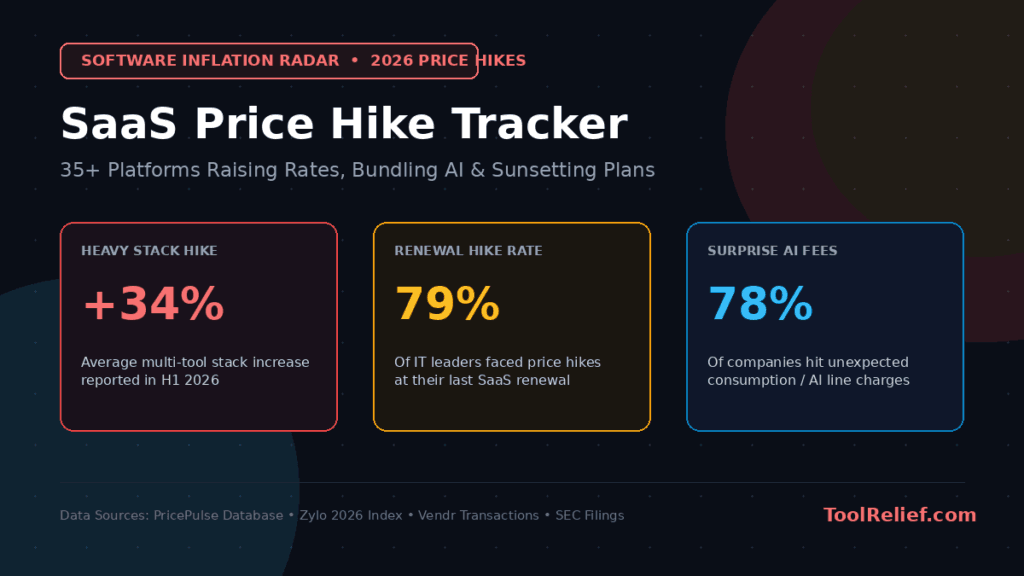
According to recent industry data, the average mid-sized company wastes over 30% of its software budget on unused,
overlapping, or redundant SaaS (Software as a Service) subscriptions.
At ToolRelief, our core mandate is absolute clarity through extreme reduction.
Adding more software does not solve operational chaos; it multiplies it.
To reclaim your budget and your team’s focus, you must perform a ruthless
AI software stack audit.
This is not a casual review.
This is a comprehensive, 7-day operational surgery designed to identify bloat, eliminate overlapping tools,
and consolidate your digital ecosystem into a lean, high-performance machine. Here is the exact blueprint.
A serious AI software stack audit should not stop at tool counts. Use the SaaS cost optimization tools to connect AI sprawl with actual subscription waste.
Quick answer
An AI software stack audit helps you find which AI tools are actually useful, which ones overlap,
and which subscriptions are quietly adding cost without improving the workflow.
The goal is not to cancel every AI tool.
The goal is to see the stack clearly:
who uses each tool, what job it handles, what it costs, and whether another tool already does the same thing.
If your team uses ChatGPT, Claude, Gemini, Perplexity, AI writing tools, AI meeting tools, coding assistants,
and automation tools at the same time, an audit can show where the overlap starts turning into waste.
Phase 1: The Brutal Inventory (Days 1-2)
You cannot manage what you cannot see.
The first step of any successful AI software stack audit is dragging every single subscription out of the shadows.
“Shadow IT” (software that employees buy without IT approval) is the number one killer of SaaS budgets.
Step 1: The Financial Scan
Do not rely on employee surveys; people forget what they are subscribed to.
You must follow the money.
Pull your company credit card statements and expense reports for the last 90 days.
Search for keywords like “AI,” “Software,” “Subscription,” “Pro,” and “Premium.”
Action Item:
Create a master spreadsheet (The Audit Ledger). List the tool name,
the monthly/annual cost, and the specific employee whose card is being charged.
Step 2: The SSO and Browser Check
Many tools offer free trials that automatically convert to paid subscriptions.
Check your Single Sign-On (SSO) dashboard (like Okta or Google Workspace)
to see which third-party apps have active access to your company’s data.
Phase 2: The Redundancy Identification (Days 3-4)
Once you have your Master Ledger, you will likely be shocked by the sheer volume of apps.
Now, the AI software stack audit becomes analytical.
We must identify overlapping utility.
The core rule of the ToolRelief methodology is:
Never pay twice for the same functionality.
The “Feature Overlap” Matrix
Look at your list and group tools by their primary function.
You will likely find severe overlaps.
The Writing Overlap:
Are you paying for Jasper AI ($50/mo), Grammarly Premium ($15/mo),
AND Notion AI ($10/mo)? All three utilize foundational language models.
You only need one.The Communication Overlap:
Are you paying for Slack (messaging), Zoom (video),
and Asana (project management)?
Modern AI updates to platforms like ClickUp or Microsoft Teams now handle all three functions natively.The AI Engine Overlap:
Are your developers paying for GitHub Copilot, while your marketing team pays for ChatGPT Plus,
and your executives pay for Claude Pro?
The Utilization Test
For every tool on your list, you must answer one question:
“Has this tool been used to generate revenue or save a measurable amount of time in the last 14 days?”
If the answer is no, mark it in red. It is dead weight.
Phase 3: The Consolidation Strategy (Days 5-6)
This is where the magic happens.
A proper AI software stack audit does not just cancel tools;
it replaces fragmented systems with unified hubs.
Strategy 1: Migrate to Foundational Models
The biggest shift in 2026 is moving away from expensive “AI wrappers” and going straight to the source.
Instead of paying a marketing agency software $100/month to write SEO blogs,
you can use a custom prompt in Claude 3.5 Sonnet for $20/month.Instead of paying a specialized data visualization app $200/month,
you can upload your CSV files directly into ChatGPT’s Advanced Data Analysis.
Strategy 2: Embrace the “Lean Stack”
Force your operations into a minimalist framework.
A world-class company can run on just three core pillars:
The Intelligence Engine:
Pick one primary AI (e.g., ChatGPT Plus or Claude Pro).
The Execution Hub:
Pick one project management tool that has native AI integration
(e.g., Notion, ClickUp, or Linear).The Automation Layer:
Use an invisible connector (like Make.com or Zapier) to make your apps talk to each other,
eliminating the need for specialized manual software.
(For a highly specific example of this,
read our blueprint on [How to Build a One-Person AI Marketing Agency]).
Phase 4: The Execution and Offboarding (Day 7)
By Day 7 of your AI software stack audit,
your spreadsheet should have a clear “Keep,” “Cancel,” or “Replace” status next to every tool.
Now, you must execute the cancellations safely.
The 3-Step Safe Cancellation Protocol:
The Data Export:
Never click “Cancel” immediately.
First, export all intellectual property, chat logs, prompts, and customer data.
If you are canceling a CRM, export to CSV.
If you are canceling a design tool, download the source files.The 14-Day Overlap:
If you are moving a team from an expensive tool (like Salesforce) to a leaner AI tool (like HubSpot AI),
run them simultaneously for exactly 14 days. This ensures no critical operations break during the transition.Revoke Access:
After canceling, go back to your Google Workspace or IT dashboard and explicitly revoke API
and SSO access for the canceled apps to ensure security compliance.
What to do next
If your AI stack already feels crowded, start by listing every paid AI tool, who owns it, what it is used for,
and whether another product already handles the same job.
For a quick estimate, use the AI Subscription Waste Calculator.
If the overlap is part of a bigger SaaS cost problem, start with a full SaaS Audit.
The Financial Impact of the Audit
Performing an AI software stack audit is not an administrative chore;
it is a highly profitable financial maneuver.
Consider a small agency of 10 people:
Before Audit:
Paying for 15 different SaaS tools, overlapping AI subscriptions, and specialized wrappers.
(Average cost: $1,200/month).After Audit:
Consolidated into one project manager, one foundational AI engine, and one automation tool.
(Average cost: $350/month).
That is a savings of over $10,000 a year, added directly back to your profit margins.
More importantly, it removes the cognitive load of dashboard-switching from your employees’ daily lives.
Conclusion: Make the Audit a Quarterly Habit
Software bloat is like a digital weed; it will always try to grow back.
The ease of signing up for a “$15/month” tool makes it inevitable.
To maintain absolute clarity, this 7-day AI software stack audit should not be a one-time event.
It must become a mandatory quarterly practice for your leadership team.
Stop managing your software, and start managing your business.
Cut the bloat, consolidate your intelligence, and enjoy the extreme focus that comes with a minimalist tech stack.
Frequently Asked Questions (FAQ)
Q: Who should be responsible for the AI software stack audit?
A: In a small company, the Founder or CEO.
In a mid-sized company, the COO or IT Director.
It must be someone with access to financial records
and the authority to mandate behavioral changes across departments.
Q: How do I handle employees who resist giving up their favorite apps?
A: Emphasize that consolidation reduces their daily friction.
Often, employees cling to tools because they are familiar with them, not because they are the best.
Provide clear training (or custom AI prompts) for the new, consolidated system to ease the transition.
Q: Is it safe to rely on just one foundational AI model for everything?
A: It is efficient, but it requires strategy.
If you rely heavily on one model, ensure you regularly back up your custom prompts and data.
For a detailed breakdown of which primary model to choose, read our comparison guide.
Sources & References
Flexera: State of the Cloud and SaaS Report 2026 (Statistics on SaaS waste and shadow IT).
Gartner: The Future of Enterprise AI Consolidation (Market research on software optimization).
Harvard Business Review: How “Digital Exhaust” is Killing Employee Productivity
(The psychological impact of app switching).
Ready to Start Your Audit?
Don’t wait for the end of the fiscal year.
Use our interactive [AI Stack Audit] tool right now to get a personalized breakdown of where you can cut costs today.
Written by Waleed Al-Qasem
Founder of ToolRelief.
I write about the intersection of technology, remote work, and human productivity.
My mission is to help teams eliminate digital noise and get back to doing deep, meaningful work.
If your workflow feels heavier with AI…
You don’t need another tool.
You need less.
Explore ToolRelief to simplify your stack and regain control.