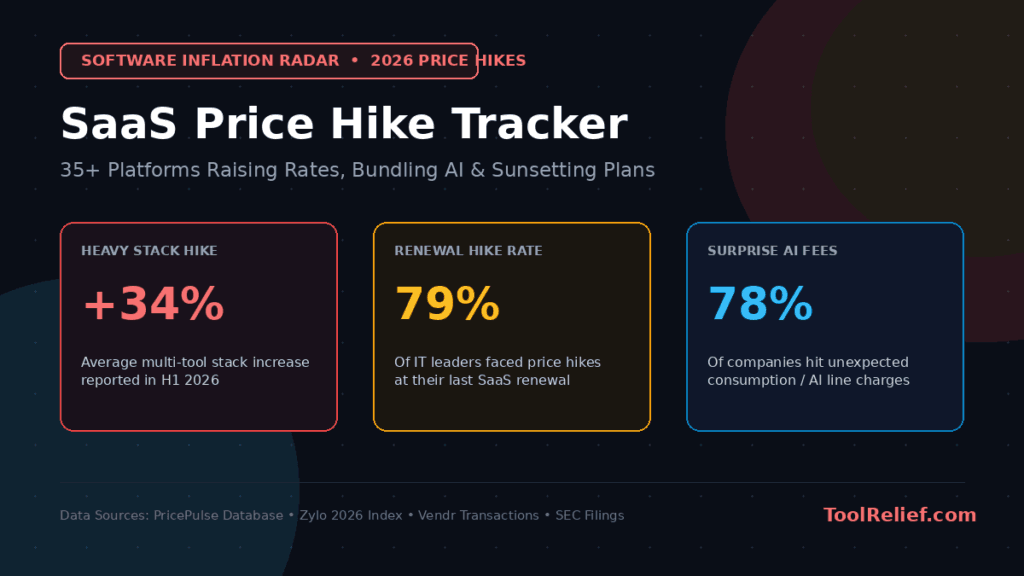

SaaS Renewal Drift: 3 Ways 9% Price Creep Drains Your Budget
Quick Navigation ✔
ToggleTake a look at the invoice for your primary CRM or project management tool from 24 months ago.
Now, compare it to the invoice you paid this morning.
You haven’t added any new users.
You haven’t upgraded your tier.
Yet, the bill is mysteriously 9% higher.
It is only a $45 difference this month, so your finance team approves it without a second thought.
But multiply that $45 by the 40 different software applications your startup uses,
compounded over three years.
Suddenly, you are bleeding tens of thousands of dollars for absolutely zero added value.
This is the SaaS renewal drift.
It is a deliberate, algorithmic form of price creep designed to fly under the radar of busy founders.
As a core component of the SaaS overbilling epidemic,
it relies on your exhaustion and Digital Weight to continuously extract more revenue from your budget.
Quick answer
SaaS renewal drift happens when a subscription slowly moves away from what the team actually needs,
but keeps renewing anyway.
Price creep happens when the cost rises through seat growth, plan changes, add-ons, annual increases,
or quiet contract changes that nobody reviews closely enough.
Together, they create a simple problem:
the tool may still be useful, but the price, terms, seats, or plan may no longer match the value your team gets from it.
What is the SaaS Renewal Drift?
The SaaS renewal drift is a pricing strategy where software vendors implement incremental,
unannounced, or heavily obfuscated price increases during your subscription renewal periods.
Unlike a massive 50% price hike that would cause you to immediately cancel and migrate to a competitor,
a drift is calculated to be “annoying, but not annoying enough to leave.”
It exploits the psychological friction of switching tools.
Vendors know that migrating your entire team’s workflow to avoid a 9% price increase feels mathematically inefficient,
so you simply swallow the cost.
Here are the three deceptive tactics driving this algorithmic price creep in 2026:
1. The “Inflation and Enhancement” Alibi
When you finally notice the price creep and email support, you will receive a templated response:
“Due to global inflation and the continuous enhancement of our platform with new features,
we have adjusted our pricing.”
This is a clever deflection.
You are being forced to pay for “new features”—often useless AI wrappers—that you never asked for
and your team never uses.
2. The Legacy Plan Phase-Out
You signed up three years ago on a great “Pro” plan.
Today, the vendor decides that plan no longer exists.
They quietly migrate you to the “Enterprise Essential” plan.
It has the exact same features as your old plan, but costs 12% more.
If you don’t read the fine print in the 45-day renewal notice email (which usually ends up in the spam folder),
the new price is locked in.
3. Shadow Tiering
This is the most insidious tactic.
The vendor doesn’t raise the base price of the software; instead,
they lower the usage limits of your current tier.
Suddenly, the API limits you have comfortably relied on for two years are now “Premium” features.
You are hit with overage fees, forcing you to upgrade just to maintain your baseline operations.
How to Stop the Drift and Benchmark Your Spending
If you treat SaaS billing as a passive expense, the SaaS renewal drift will eat your profit margins alive.
You must treat software renewals as an active financial negotiation.
To break the cycle of price creep, you need data. Here is your operational playbook:
Step 1: Benchmark Your True Costs
Stop guessing if your current bill is fair.
Before your next renewal, use our free SaaS Cost Benchmark Tool.
This interactive tool allows you to compare your exact monthly software spending against industry averages based on your team size.
If your CRM costs are 15% higher than the market baseline, you are a victim of the drift.
Step 2: Consolidate the Noise
Vendors rely on you having too many tools to monitor effectively.
You can’t track price creep if your marketing team uses ten different apps.
Use the AI Tool Stack Builder to design a minimalist, focused tech stack.
Fewer tools mean fewer renewal traps to manage.
Step 3: Audit for Waste
Are you paying a premium price for tools that are barely being used?
Are zombie SaaS seats compounding your inflated renewal costs?
Run a quick diagnostic through our SaaS Waste Audit Tool to identify overlapping features
and inactive users before you negotiate with your vendor.
Software companies are banking on your complacency.
They use data algorithms to maximize how much money they can extract from you without triggering a cancellation.
It is time you used your own data to fight back.
Centralize your SaaS cost optimization tools, benchmark your invoices, and refuse to pay the drift.
What to do before the next renewal
Before the next renewal, check three things:
who owns the tool, how many seats are actually active, and whether the current plan still fits the way the team uses it.
If the renewal date is close, use the SaaS Renewal Risk Calculator to estimate the urgency.
If the tool has seat waste or unclear ownership, add it to your SaaS inventory before the contract rolls forward again.
Sources & References
Gartner: Managing SaaS Costs in the Enterprise (Insights into how vendor pricing strategies and
unmanaged renewals lead to 20-30% budget overspends).
If you’re trying to reduce SaaS costs and eliminate unnecessary tools,
you can use these free SaaS cost optimization tools to analyze your spending, benchmark your stack,
and identify hidden waste.
 Read this article on Flipboard:
[Here]
Written by Waleed Al-Qasem
Founder of ToolRelief.
I write about the intersection of technology, remote work, and human productivity.
My mission is to help teams eliminate digital noise and get back to doing deep, meaningful work.
If your workflow feels heavier with AI…
You don’t need another tool.
You need less.
Explore ToolRelief to simplify your stack and regain control.