
TOOLRELIEF DECISION INTELLIGENCE
- Decision
- Use AI Tool Stack for Solo Founders Under $100 to evaluate the software or technology decision covered on this page and identify the next useful action.
- Evidence Basis
- Documented product information, published evidence, comparative analysis, direct observation, and clearly labeled models where applicable.
- Best Used For
- Reducing uncertainty before taking the next material action.
- Decision Boundary
- This page provides independent decision support rather than a guaranteed outcome. Product capabilities, pricing, third-party terms, and operating conditions can change.
AI Tool Stack for Solo Founders Under $100/Month
A strong AI tool stack for solo founders is not about collecting every shiny app on the internet. That is how a lean business turns into a subscription graveyard before it even has stable revenue.
The smarter move is simple: build a small, sharp, money-aware stack that helps one person write faster, sell better, automate boring work, publish more, and avoid paying for five tools that all do the same job.
The best AI tool stack for solo founders should feel like a tiny operating system. Not a pile of tabs. Not a dopamine shopping cart. Not a fake “productivity stack” that quietly drains $300 a month.
If a tool does not make money, save time, replace another tool, protect the business, or increase output, it does not belong in the stack.
The $100 Rule for a Lean AI Tool Stack
Solo founders do not need enterprise software. They need leverage. The job of your stack is to make one person feel like three without creating the monthly bill of a small company.
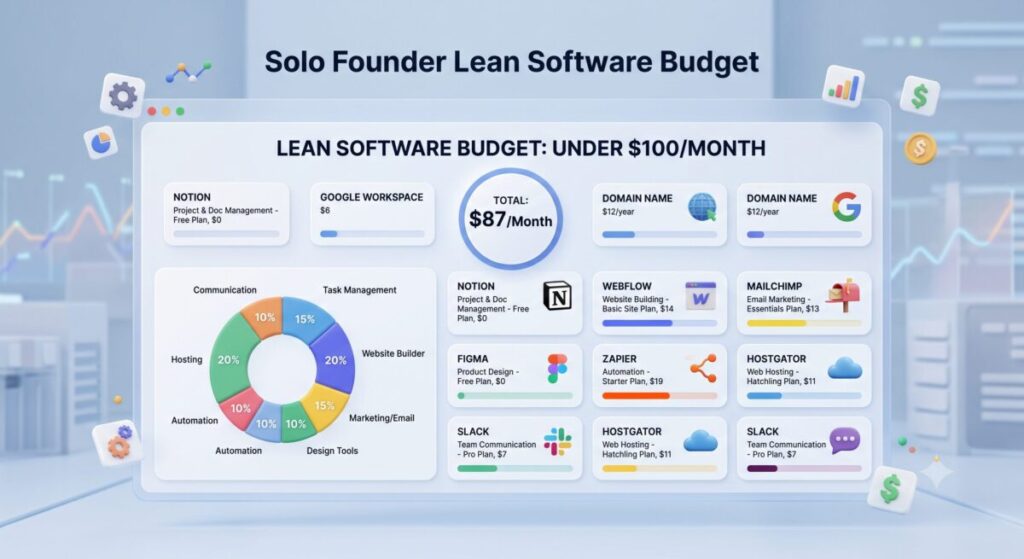
Under a $100/month budget, the goal is not to buy the most tools. The goal is to cover the highest-value work with the fewest paid subscriptions.
| Stack Layer | What It Should Handle | Monthly Budget Range | Decision Rule |
|---|---|---|---|
| AI Core | Writing, research, planning, coding help, analysis | $20–$30 | Pick one primary AI assistant before paying for another |
| Automation Layer | Lead routing, content workflows, simple alerts, repetitive tasks | $0–$15 | Upgrade only when the workflow repeats every week |
| Design Layer | Graphics, thumbnails, social posts, simple video assets | $0–$15 | Use one broad creative tool before adding niche tools |
| Website and Infrastructure | Landing pages, publishing, forms, analytics, lead capture | $5–$25 | Match hosting to actual traffic and complexity, not ego |
| Tracking Layer | Renewals, subscriptions, owners, usage, cancellation decisions | $0–$10 | Track first, buy later |
| Testing Budget | One experimental tool at a time | $10–$25 | No tool gets permanent budget without proving value |
This is the clean starting point. Not glamorous. Not bloated. Not built for screenshots. Built for survival, speed, and margin.
The Real Problem: Solo Founders Buy Tools Like They Have a Team
Most solo founders do not have a software problem. They have a discipline problem disguised as a software problem.
They buy a writing tool because content feels hard. Then they buy a social tool because distribution feels hard. Then they buy a project management tool because execution feels messy. Then they buy another AI tool because the landing page promised “10x productivity.”
Thirty days later, they are not 10x more productive. They are just subscribed to more things.
A serious AI tool stack for solo founders starts by cutting the fantasy. You are not building a corporate department. You are building a lean machine that must earn back every dollar.
The Minimal AI Tool Stack Most Solo Founders Actually Need
A solo founder can do a lot with five layers. Anything beyond that has to fight for its place.
1. One Primary AI Assistant
Your AI core is the brain of the stack. It should support writing, research, offer planning, landing page drafts, email ideas, content repurposing, code support, analysis, and messy thinking.
2. One Automation Layer
Automation should remove boring work. It should not become a second business. If it does not repeat, do not automate it yet.
3. One Design and Publishing Layer
Most solo founders do not need a full creative department. They need fast assets that look good enough to publish consistently.
4. One Website and Infrastructure Base
Your website is not decoration. It is the center of your stack: landing pages, lead capture, publishing, calculators, templates, and decision tools.
5. One Tracking System
This is the boring layer that saves real money. Track every paid tool, renewal, owner, use case, and cancel date.
Control Rule
A tool does not deserve budget because it is interesting. It deserves budget when it creates leverage.
1. One Primary AI Assistant
Your AI core is the brain of the stack. It should support writing, research, offer planning, landing page drafts, email ideas, content repurposing, code support, analysis, and messy thinking.
The trap is paying for multiple premium AI assistants before you know what each one uniquely does for your business.
If two AI tools are helping you write, summarize, brainstorm, and plan in almost the same way, one of them is probably waste. Before adding another paid AI subscription, run your setup through the AI Subscription Waste Calculator.
2. One Automation Layer
Automation should remove boring work. It should not become a second business.
Use automation for simple, repeatable actions: sending form leads to a sheet, saving ideas into a database, moving email subscribers into a list, notifying you when a high-value action happens, or connecting basic marketing workflows.
If you need three hours to build an automation that saves five minutes a month, that is not leverage. That is tool theater.
Before buying another automation product, use the Software Decision Finder to check whether the tool actually belongs in your stack.
3. One Design and Publishing Layer
Most solo founders do not need a full creative department. They need fast assets that look good enough to publish consistently.
This layer should help create blog graphics, Pinterest images, LinkedIn visuals, lead magnet covers, thumbnails, simple short-form clips, and lightweight brand assets.
The waste starts when you pay separately for design, video, stock assets, social formatting, and AI image workflows before you have a distribution system that justifies the cost.
4. One Website and Infrastructure Base
Your website is not decoration. It is the center of your stack.
It should support landing pages, lead capture, analytics, affiliate pages, sponsor pages, content publishing, calculators, templates, and decision tools.
The wrong move is buying infrastructure for the business you imagine. The right move is buying infrastructure for the business you are actually running this month.
If you are publishing content and collecting leads, keep it simple. If you are running backend scripts, databases, or software-heavy workflows, then a stronger hosting layer may make sense. Either way, the infrastructure must serve the business, not your ego.
5. One Tracking System
This is the boring layer that saves real money.
Track every paid tool. Track renewal dates. Track what the tool does. Track whether you used it this month. Track what it replaced. Track the cancel date before the trial converts.
Use the SaaS Inventory Template or the SaaS Subscription Tracker Template before buying another dashboard to manage the dashboards you already bought.
The Stack You Should Avoid
A bad AI tool stack for solo founders usually looks impressive until you open the billing page.
| Bad Stack Pattern | Why It Hurts |
|---|---|
| Three paid AI chatbots | You pay for overlapping thinking engines before defining use cases |
| Separate apps for writing, SEO, images, video, and notes | You create subscription sprawl before revenue justifies it |
| Premium project management software for one person | You spend more time organizing work than doing work |
| Tools bought during hype cycles | You pay for excitement, not operating leverage |
| Tools with no clear outcome | Nobody knows why the subscription exists, so it never gets cancelled |
The enemy is not software. The enemy is unmanaged software.
That is why a serious AI tool stack for solo founders needs a cleanup rhythm, not just a buying plan.
The ToolRelief $100 Stack Model
Here is a sharper model for staying under $100/month without building a weak stack.
| Category | Budget Limit | What to Buy First | What to Avoid |
|---|---|---|---|
| AI Core | $20–$30 | One premium AI assistant | Paying for multiple AI tools with the same job |
| Automation | $0–$15 | Simple repeatable workflow automation | Complex automations with no revenue connection |
| Design and Content | $0–$15 | One broad creative platform | Five niche tools before consistent publishing |
| Website and Hosting | $5–$25 | Fast, stable publishing and lead capture | Overbuilding infrastructure too early |
| Tracking | $0–$10 | A template or simple tracker | Buying another SaaS just to track SaaS |
| Testing | $10–$25 | One experimental tool at a time | Letting trials turn into permanent subscriptions |
This gives you an aggressive but controlled AI tool stack for solo founders. Fast enough to execute. Cheap enough to survive. Clean enough to scale.
When to Upgrade Beyond $100/Month
Going above $100/month is not the problem. Going above $100/month without a business reason is the problem.
Upgrade when the tool creates revenue
If a tool helps close clients, publish more, generate qualified leads, improve conversion, or ship faster, it may deserve budget.
Upgrade when manual work costs more than the subscription
If a tool saves five hours a month and those hours can be used for sales, delivery, or publishing, the tool may be cheap.
Upgrade when one tool replaces several others
A $30 tool that replaces three $15 tools is not expensive. It is consolidation.
Upgrade when the risk of not having the tool is higher than the cost
Backups, security, analytics, forms, and infrastructure may not feel exciting. But weak foundations can become expensive fast.
Before increasing your monthly software budget, compare your current spending against the SaaS Cost Benchmark Tool.
The Monthly Cleanup Routine
A lean stack does not stay lean by accident. It stays lean because you cut things before they become normal.
- List every paid tool in your business.
- Mark each one as Core, Useful, Experimental, or Dead.
- Cancel anything marked Dead.
- Put Experimental tools on a 30-day timer.
- Check whether two tools solve the same problem.
- Move renewal dates into one tracker.
- Run a fast waste check with the SaaS Waste Audit Tool.
This routine is simple, but it protects your margin. That is the difference between a founder who buys tools and a founder who controls the machine.
Continue the ToolRelief Decision Path
This first page is the starting point. The full decision cluster connects solo founders, small teams, marketing stacks, agency stacks, renewals, consolidation, calculator support, and the central Software Decision Finder.
How This Page Connects to the Full ToolRelief Decision System
This page is the starting point for solo founders building a lean stack. But it is not the only decision you will face.
If you are not sure how many AI tools are too many, read how many AI tools you should actually use.
If your stack already feels bloated, use the guide to managing multiple AI tools before paying for another subscription.
If you are building a one-person service business, study the one-person AI marketing agency guide.
If your main decision is which AI assistant should anchor the stack, review ChatGPT Plus vs Claude before paying for overlapping premium plans.
As the new ToolRelief decision pages go live, this stack will also connect to the dedicated pages for small-team AI budgets, AI overlap checklists, one-person agency software stacks, tools that replace multiple apps, and software decisions about what to cut, keep, or replace.
FAQ: AI Tool Stack for Solo Founders
What is the best AI tool stack for solo founders?
The best AI tool stack for solo founders usually includes one primary AI assistant, one automation layer, one design tool, one website or hosting base, and one tracking system for subscriptions. The point is not to buy more tools. The point is to build a small stack that creates more output with less waste.
Can a solo founder run a business with under $100/month in software?
Yes. A solo founder can often run a lean business under $100/month by choosing multi-use tools, avoiding overlapping subscriptions, and tracking every renewal. The budget breaks when tools are bought emotionally instead of operationally.
Should solo founders pay for multiple AI tools?
Usually not at the beginning. Multiple AI tools only make sense when each one has a separate job. If two tools are both used for writing, planning, research, and summaries, one of them is probably unnecessary.
How often should I audit my AI software stack?
Audit your stack at least once per month. This catches forgotten trials, duplicate tools, renewal traps, and tools that no longer support the business.
What is the biggest software mistake solo founders make?
The biggest mistake is buying tools before defining the workflow. A tool should not create the process. The process should justify the tool.
Final Decision: Build a Stack That Moves Faster Than One Person
A serious AI tool stack for solo founders should not look like a crowded app drawer. It should work like a small operating system.
Start with one AI core. Add automation only when the workflow repeats. Use one creative layer. Keep infrastructure simple. Track every renewal. Cancel tools that do not create leverage.
If the stack already feels messy, start with the Software Decision Finder and then run the numbers through the AI Subscription Waste Calculator.
The goal is not to look like a big company.
The goal is to move faster than one.