
TOOLRELIEF DECISION INTELLIGENCE
- Decision
- Use Software Spend Signals Center to evaluate the software or technology decision covered on this page and identify the next useful action.
- Evidence Basis
- Documented product information, published evidence, comparative analysis, direct observation, and clearly labeled models where applicable.
- Best Used For
- Reducing uncertainty before taking the next material action.
- Decision Boundary
- This page provides independent decision support rather than a guaranteed outcome. Product capabilities, pricing, third-party terms, and operating conditions can change.
Find where your software-spend decision needs evidence.
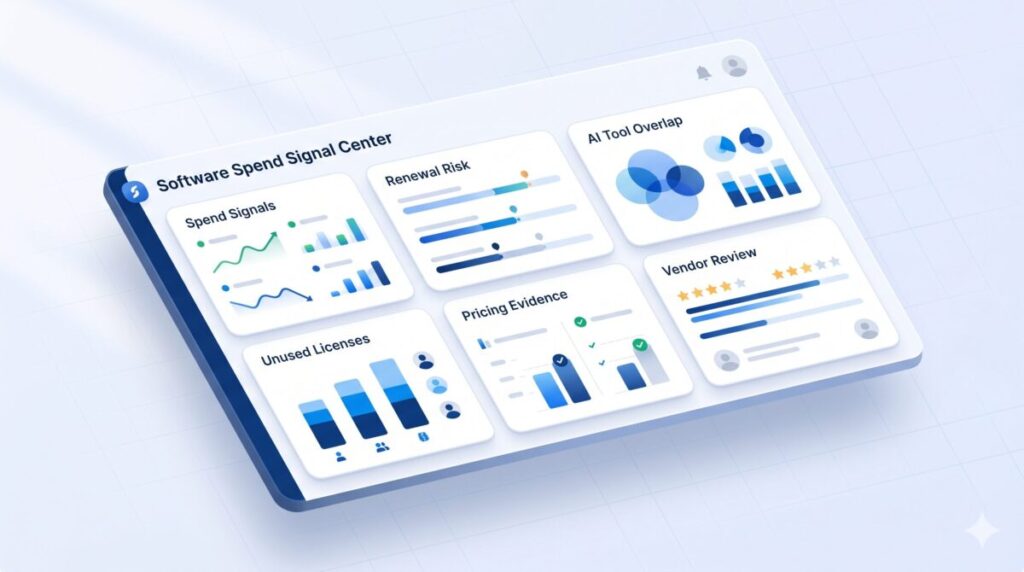
Detect renewal pressure, seat gaps, pricing changes, AI overlap, ownership gaps, and incomplete evidence—then route each case to the right ToolRelief decision instrument. No hidden waste score. No invented savings rate.
What changed in your software spend?
Turn a software concern into a traceable signal case.
Record only what you know. Missing fields remain unknown; the page derives evidence coverage, decision timing, and routing from your entries.
Executive view: evidence, timing, and exposure only.
The detailed entry workpaper is hidden in this view. Use Analyst view to add or edit signal cases.
Add a signal case
Measure evidence coverage and decision timing—not “portfolio quality.”
These values describe the records you entered. They are not probability scores and they do not imply that an undocumented field is waste.
Signal case board
Known recurring run-rate
What changed?
Prioritize with explicit rules—not a hidden risk score.
Ordering: nearest entered decision deadline first, then known monthly-equivalent financial scope, then unresolved evidence count. The reason for each position is shown.
| # | Case | State | Why now | Evidence | Decision date | Known monthly eq. | Next route |
|---|---|---|---|---|---|---|---|
| Add cases to build the remediation / evidence queue. | |||||||
Upcoming decision dates
What this center will not infer
- Missing usage evidence does not mean a product is unused.
- Capability similarity does not prove substitutability.
- Upcoming renewal timing is not a recommendation to cancel.
- Known recurring amount is not guaranteed savings.
- Unknown is preserved as unknown; it is not silently converted to zero.
- Different currencies are not combined without an explicit external FX method.
Every conclusion has a boundary—and every external reference has a role.
External standards inform vocabulary, evidence practices, inventory discipline, and licensing / SaaS review. They do not provide your vendor prices, usage, contract terms, or final decision.
ToolRelief signal method
- USER-PROVIDED: product identity, owners, costs, seats, dates, constraints, evidence sources, and notes you enter.
- DERIVED: evidence coverage, monthly-equivalent recurring value, deadline status, queue ordering, and currency-specific totals calculated directly from entries.
- OBSERVED EXTERNALLY: institutional or standards-based guidance listed in the source register.
- MODELED: ToolRelief routing rules and signal-family requirements shown transparently on this page.
- INTERPRETATION: next-action routing based on explicit evidence gaps—not probability estimates.
Evidence semantics
- Known: a field contains an entered value or explicit recorded state.
- Unknown: the workpaper does not contain enough evidence for that field.
- Partial: some evidence exists, but it does not fully support the requested decision.
- Publicly observed: a claim can be tied to a public source such as vendor documentation.
- Derived: a value can be recomputed from the underlying entries.
FinOps Foundation — Licensing & SaaS capability
Used to support the evidence model around licensing terms, renewals, usage, procurement, ITAM/SAM coordination, purchased-versus-assigned entitlements, and SaaS cost / usage visibility.
NIST Cybersecurity Framework 2.0 — asset / supplier service inventory examples
Used to support inventory discipline for externally provided services, including SaaS offerings, and the practice of updating those inventories when services change.
Take the signal register into the operating workflow.
Export case-level data, copy spreadsheet-ready rows, create a structured decision brief, or print a compact review dossier for Finance, IT, Procurement, Operations, or leadership.
The signal identifies the gap. Specialized assets resolve the next question.
Move only when the evidence state points to a more specific control, audit, inventory, AI, or routing decision.
Software Renewal Signals
Review renewal timing, cancellation windows, ownership gaps, and contract pressure before the commercial decision window closes.
Continue the renewal decision → Seat / entitlement evidenceUnused License Signals
Reconcile purchased, assigned, active, guest, former-user, and ownership evidence before reclaiming seats.
Continue the seat decision → AI-specific evidenceAI Tool Overlap Signals
Review AI assistants, add-ons, embedded coverage, ownership, and duplicated use cases before expanding the stack.
Continue the AI decision → Cross-domain / ambiguousSaaS Portfolio Audit Board
Escalate when the evidence gap spans ownership, usage, contracts, financial scope, or several portfolio controls.
Continue the portfolio audit → System of recordSoftware Asset Ledger
Build the baseline inventory when the core problem is incomplete vendor, owner, cost, renewal, and evidence records.
Continue to the ledger → AI planningAI Tool Stack Builder
Use when the question is which AI capabilities should exist in the future stack—not whether current evidence is complete.
Build the future AI stack → Shareable communicationSaaS Waste Score Report
Use when a compact, explainable summary is needed after evidence has been reviewed and the assumptions are understood.
Open the shareable report → Broader software decisionSoftware Decision Finder
Route questions that expand beyond spend signals into keep, cut, replace, consolidate, security, hosting, or another software decision.
Route the broader decision →ToolRelief provides independent decision support. This page is not legal, procurement, accounting, tax, security, compliance, privacy, or financial advice and does not guarantee savings, product suitability, or a specific commercial outcome.
Software spend signals, without black-box scoring.
What is a software spend signal?
A signal is a condition that deserves review—such as an approaching renewal, incomplete usage evidence, unclear ownership, a pricing change, or possible capability overlap. It is not automatically proof of waste.
Does this page calculate a waste score?
No. It calculates only values that can be derived from entered records, such as evidence completeness, monthly-equivalent recurring amounts, decision timing, and queue ordering.
Why are currencies kept separate?
Combining currencies requires an explicit FX method and a date or rate source. This module keeps each entered currency separate rather than inventing an exchange rate.
Does possible overlap mean I should cancel a tool?
No. Capability similarity is a review trigger. Substitutability depends on workflows, integrations, data, security, contracts, users, and other operational constraints.
Where is the data stored?
The current workpaper lives in browser memory while the page is open. A local snapshot is stored in browser local storage only when you explicitly choose Save local snapshot.