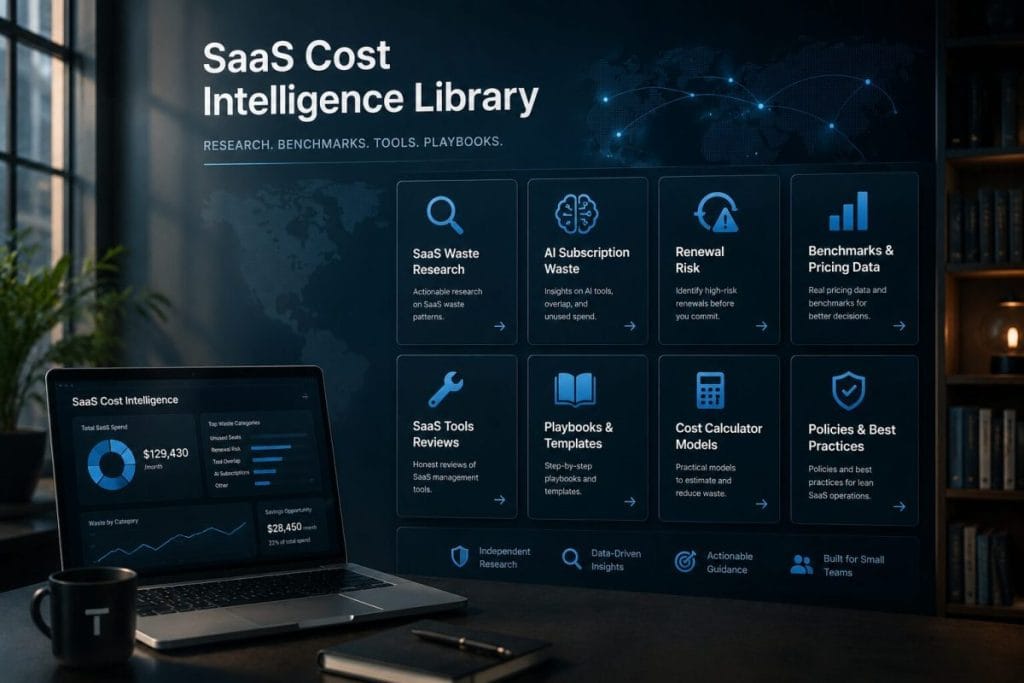
SaaS Cost Intelligence Library
ToolRelief’s SaaS Cost Intelligence Library is a research hub for founders, CFOs, COOs, operators,
and small teams that want to understand where software spend leaks, why SaaS costs grow quietly,
and how to make better tool decisions before renewals become expensive surprises.
This library brings together ToolRelief research notes, SaaS waste patterns,
AI subscription waste analysis, pricing evidence,
tool experiments, benchmarks, founder notes, practical playbooks, and methodology pages.
It is designed to help teams move from vague software cost concerns to clearer decisions.
Featured Executive Resource
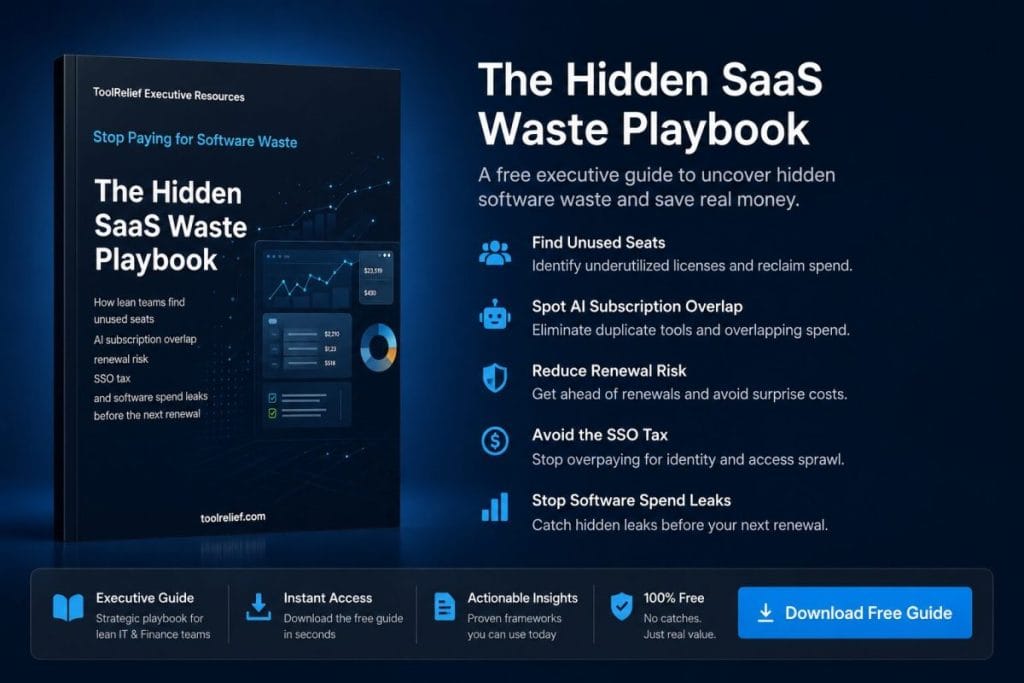
The Hidden SaaS Waste Playbook
A free executive guide that turns ToolRelief’s SaaS cost research, waste patterns, checklists, and tools into a practical software waste review system for lean teams.
Inside the playbook:
SaaS Waste Score breakdown
7 hidden SaaS waste patterns
Offboarding and unused seat review
AI tool overlap planner
Renewal risk and pricing friction review
Keep / Cut / Consolidate matrix
30-minute SaaS waste audit worksheet
7-day software cleanup schedule
Free PDF. No signup required. Built from ToolRelief’s SaaS Cost Intelligence Library.
What Is the SaaS Cost Intelligence Library?
The SaaS Cost Intelligence Library is ToolRelief’s public research hub for SaaS waste, AI subscription waste,
renewal risk, pricing evidence, benchmarks, and practical playbooks.
What This Library Covers
The ToolRelief research library focuses on practical SaaS cost problems, including:
- unused software seats
- SaaS waste
- SaaS spend per employee
- AI subscription waste
- software renewal risk
- SSO tax
- vendor lock-in
- minimum seat requirements
- tool overlap
- software offboarding leaks
- unclear tool ownership
- shadow IT
- pricing-page friction
- small-team SaaS operations
- cost cleanup workflows
The goal is not to publish generic software advice.
The goal is to organize useful, source-aware,
decision-focused research that helps small teams understand what to review, what to question,
and which ToolRelief tool to use next.
Start With the Right Tool
If you are not sure where to begin, start with the ToolRelief tools that match your current problem.
| If your problem is… | Use this ToolRelief tool |
|---|---|
| You do not know where SaaS waste may be hiding | SaaS Waste Score Report |
| You want to review unused seats and overlapping tools | SaaS Waste Audit Tool |
| You want to compare software spend against benchmarks | SaaS Cost Benchmark Tool |
| You are worried about auto-renewals or renewal surprises | SaaS Renewal Risk Calculator |
| You think AI subscriptions are becoming hard to control | AI Subscription Waste Calculator |
| You want to build a leaner AI tool stack | AI Tool Stack Builder |
You can also visit the full SaaS Cost Optimization Tools page to compare all ToolRelief tools in one place.
Library Shelves
SaaS Waste Research
SaaS waste often starts quietly.
A team adds tools, upgrades plans, keeps old seats active, forgets contractor access,
or renews software that no longer has a clear owner.
This shelf covers patterns such as unused seats, tool overlap, software offboarding leaks,
shadow IT, duplicate tools, unclear ownership, and hidden recurring software spend.
Start here:
- The SaaS Waste Pattern Library
- Tool Experiment: 5 Small-Team SaaS Waste Scenarios
- Founder Research Note: Why SaaS Waste Is Hard to See Until Renewal Month
- The Keep / Cut / Consolidate SaaS Framework
- The 30-Minute SaaS Audit Playbook
- Software Offboarding Checklist
- SaaS Spend Review Worksheet
Related tools:
AI Subscription Waste
AI tools can spread across a team faster than traditional SaaS.
One person adds a writing tool, another adds a coding assistant, another adds a meeting tool,
and soon the team has overlapping AI subscriptions with no clear owner.
This shelf covers AI tool overlap, role-based AI stack planning, experimental AI subscriptions,
scattered billing, and cleanup workflows for small teams.
Start here:
- AI Subscription Waste: A ToolRelief Research Note
- Tool Experiment: AI Subscription Waste Across 6 Roles
- Founder Research Note: What AI Tool Overlap Taught Me About Modern SaaS Waste
- The 7-Day AI Tool Cleanup Playbook
- AI Tool Stack Cleanup Checklist
- How ToolRelief Uses AI Without Publishing Unverified Claims
Related tools:
SaaS Renewal Risk
SaaS renewal risk appears when software contracts renew before a team has reviewed usage,
ownership, pricing, cancellation terms, or seat count.
This shelf focuses on renewal surprises, cancellation windows, auto-renewal exposure,
annual commitments, owner confusion, and practical review workflows.
Start here:
- SaaS Renewal Risk Patterns Small Teams Miss
- Tool Experiment: Renewal Risk in a 20-Person Remote Team
- Founder Research Note: Why SaaS Waste Is Hard to See Until Renewal Month
- Pricing Evidence: Minimum Seats and Annual Plans
- Pricing Evidence: Contact Sales as a Cost Visibility Problem
- The 30-Minute SaaS Audit Playbook
Related tool:
SSO Tax and Vendor Lock-In
Some SaaS products place security features, SSO, SAML, OIDC, admin controls,
or export features behind higher-priced plans.
For small teams, this can create a difficult choice between budget control and operational security.
This shelf covers SSO tax, vendor lock-in, pricing restrictions, data export friction,
and security-feature paywalls.
Start here:
- SSO Tax Evidence: Why Security Features Cost More
- Pricing Evidence: Contact Sales as a Cost Visibility Problem
- Pricing Evidence: Minimum Seats and Annual Plans
Related reading:
SaaS Pricing Evidence
Pricing pages often reveal cost patterns before a team signs up:
minimum seats, annual billing pressure, unclear cancellation paths,
hidden enterprise requirements, SSO restrictions, or “Contact Sales” pricing.
This shelf collects pricing-page observations and explains what they may mean for small teams.
Start here:
- Pricing Evidence: Minimum Seats and Annual Plans
- Pricing Evidence: Contact Sales as a Cost Visibility Problem
- SSO Tax Evidence: Why Security Features Cost More
- SaaS Cost Per Employee Benchmarks: What They Can and Cannot Tell You
- SaaS Spend Review Worksheet
Related tool:
Tool Experiments
ToolRelief tool experiments use realistic small-team scenarios to test how SaaS waste,
AI subscription overlap, renewal risk, and benchmark questions may appear in practical situations.
These experiments are educational scenario tests.
They do not represent private customer case studies.
Start here:
- Tool Experiment: 5 Small-Team SaaS Waste Scenarios
- Tool Experiment: AI Subscription Waste Across 6 Roles
- Tool Experiment: Renewal Risk in a 20-Person Remote Team
- How ToolRelief Tests SaaS Cost Tools
- How ToolRelief Builds Realistic SaaS Scenarios
Related starting point:
Founder Research Notes
Founder research notes document what ToolRelief is learning while studying SaaS cost optimization,
software waste, AI tool overlap, pricing patterns, and content performance.
These notes are not fake case studies.
They are transparent research reflections from the ToolRelief operating process.
Start here:
- Founder Research Note: Why SaaS Waste Is Hard to See Until Renewal Month
- Founder Research Note: What AI Tool Overlap Taught Me About Modern SaaS Waste
- AI Subscription Waste: A ToolRelief Research Note
- How ToolRelief Uses AI Without Publishing Unverified Claims
- How ToolRelief Checks Sources and Claims
Benchmarks and Claims
Benchmarks are useful only when they are used carefully.
A statistic may support one claim but not another.
ToolRelief separates source-backed claims from interpretation, scenarios,
and editorial judgment.
This shelf explains SaaS cost statistics, license utilization claims, spend-per-employee references,
and what each benchmark can or cannot prove.
Start here:
- SaaS Cost Per Employee Benchmarks: What They Can and Cannot Tell You
- SaaS Spend Review Worksheet
- How ToolRelief Checks Sources and Claims
- The SaaS Waste Pattern Library
Related tool:
Playbooks and Checklists
Research is useful only if it leads to action.
ToolRelief playbooks turn SaaS cost patterns into practical review steps.
Start here:
- The 30-Minute SaaS Audit Playbook
- The 7-Day AI Tool Cleanup Playbook
- Software Offboarding Checklist
- AI Tool Stack Cleanup Checklist
- SaaS Spend Review Worksheet
- The Keep / Cut / Consolidate SaaS Framework
Related page:
Methodology
ToolRelief’s methodology pages explain how we research SaaS cost topics, check sources,
review AI-assisted drafts, label scenarios, verify claims, and separate evidence from interpretation.
Start here:
- How ToolRelief Checks Sources and Claims
- How ToolRelief Uses AI Without Publishing Unverified Claims
- How ToolRelief Builds Realistic SaaS Scenarios
- How ToolRelief Tests SaaS Cost Tools
- The SaaS Waste Pattern Library
How ToolRelief Uses This Library
The library supports three connected goals.
First, it helps readers understand SaaS cost problems in a practical way.
Second, it connects research directly to ToolRelief tools,
so visitors can move from reading to reviewing their own software spend.
Third, it creates a public knowledge structure around ToolRelief’s editorial standards,
research process, source checks, and decision frameworks.
The library is not meant to replace the ToolRelief blog.
It gives the blog, tools, frameworks, and glossary a stronger research foundation.
Important Methodology Note
ToolRelief separates:
- source-backed claims
- ToolRelief interpretation
- pricing-page observations
- educational scenarios
- internal tool experiments
- founder research notes
- editorial recommendations
When this library uses a statistic, the goal is to explain what the number supports,
what it does not prove, and how small teams should interpret it.
When this library uses a scenario,
it should be treated as an educational example unless clearly stated otherwise.
When this library uses AI-assisted workflows, the content must still be reviewed, edited,
and checked for accuracy, usefulness, and source quality before publication.
Recommended Next Step
If you want a practical starting point, begin with the SaaS Cost Optimization Tools page and
choose the tool that matches your current problem.
If you want to understand the research foundation behind ToolRelief,
start with the methodology pages and the SaaS Waste Research shelf.
Last updated: May 30, 2026
Written by Waleed Al-Qasem
Founder of ToolRelief.
I write about the intersection of technology, remote work, and human productivity.
My mission is to help teams eliminate digital noise and get back to doing deep, meaningful work.
Founder of Nexio Global and ToolRelief. I write about SaaS costs, AI tool overload, and practical ways to build simpler, more efficient workflows. After spending over $47K on SaaS tools and experiencing tool overlap firsthand, I now help teams make clearer software decisions with less noise. Read my full story →
If your workflow feels heavier with AI…
You don’t need another tool.
You need less.
Explore ToolRelief to simplify your stack and regain control.