Founder Research Note: What AI Tool Overlap Taught Me About Modern SaaS Waste
AI tool overlap is one of the clearest signs that SaaS waste is changing.
Traditional SaaS waste often appears through unused seats, forgotten renewals, duplicate tools,
or contractor accounts that remain active after a project ends.
AI waste can appear faster.
A team can add multiple AI tools in a short period because each tool feels useful, affordable, and easy to test.
One tool helps with writing.
Another helps with coding.
Another helps with research.
Another helps with meeting notes.
Another helps with images.
Another helps with automation.
The problem is not that AI tools are bad.
The problem is that AI tools can spread faster than the team’s ability to review ownership, usage, overlap, billing, and workflow fit.
This ToolRelief founder research note explains what AI tool overlap reveals about modern SaaS waste.
Quick answer
AI tool overlap is one of the newer forms of SaaS waste because teams can now buy multiple tools that all promise to write,
summarize, research, automate, analyze, or assist with the same work.
The overlap usually starts innocently.
One person tries a writing tool, another tests a research assistant, someone else pays for an AI meeting tool,
and another team adds an AI feature inside software they already use.
The problem is not that the tools are useless.
The problem is that nobody has mapped which AI tool owns which job, which ones duplicate each other,
and which subscriptions should stay after the experiment ends.
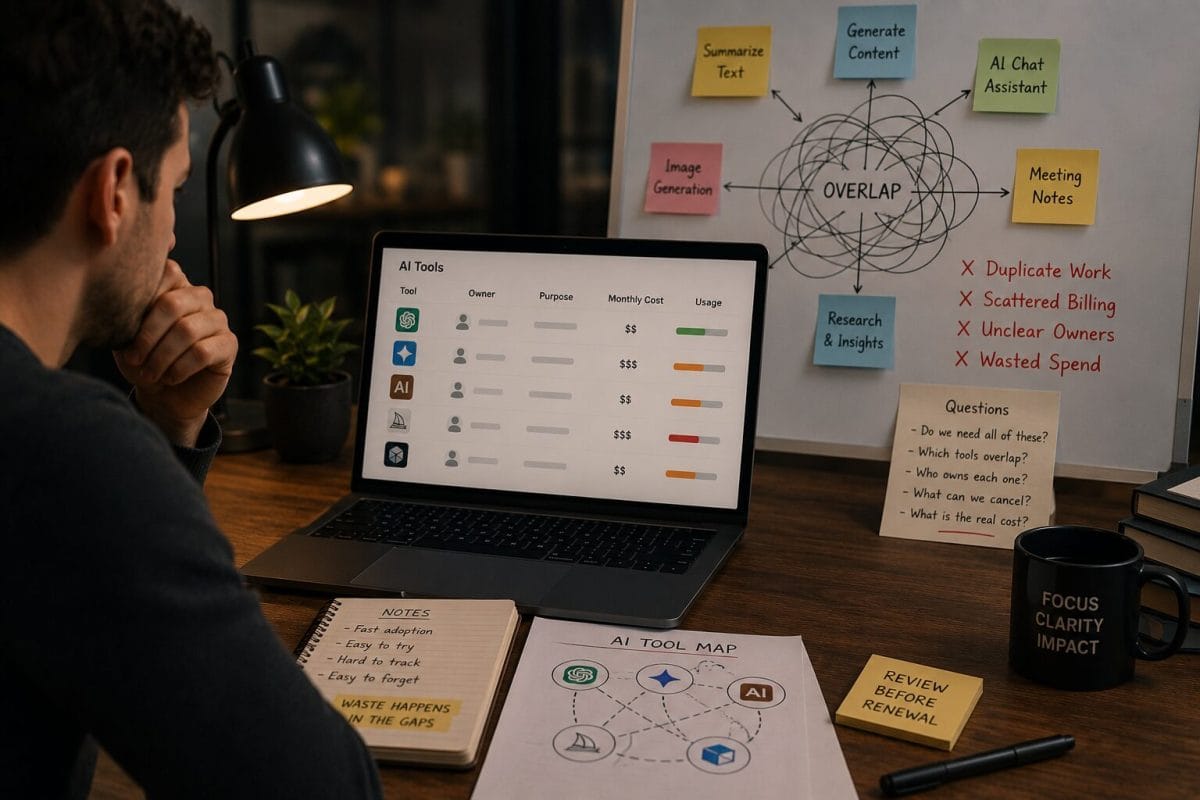
Why AI Tool Overlap Creates Modern SaaS Waste
AI tool overlap shows how modern SaaS waste can grow when teams add useful AI tools faster than they review ownership,
billing, usage, and workflow fit.
Why AI Tool Overlap Matters
AI tools are different from many traditional SaaS products.
They often have:
- fast sign-up flows
- low monthly prices
- individual user adoption
- strong perceived productivity value
- broad feature overlap
- rapid feature changes
- personal-account usage
- unclear team ownership
- experimental use cases
That combination makes AI tools powerful.
It also makes them easy to add without a structured review.
A team may not notice AI subscription waste until several tools are already part of the monthly software baseline.
The Core ToolRelief View
AI tool overlap is not mainly a technology problem.
It is an operating problem.
The question is not:
“Should teams use AI tools?”
The better question is:
“Which AI tool owns which workflow?”
If the team cannot answer that, the stack may be growing without structure.
What AI Tool Overlap Looks Like
AI tool overlap can appear in several ways.
Writing Overlap
A team may use:
- a general AI assistant
- a dedicated AI writing tool
- an SEO content assistant
- a social post generator
- a sales email assistant
Each tool may produce text.
The team needs to decide which tool owns which writing workflow.
Research Overlap
A team may use:
- a general AI assistant
- a research assistant
- a document summarizer
- a note-taking AI
- a browser-based AI search tool
Each tool may summarize or analyze information.
The team needs to decide which one is essential and which ones are experimental.
Meeting Overlap
A team may use:
- an AI meeting recorder
- built-in meeting summaries
- a general assistant for notes
- a CRM call summary feature
- a project management AI recap
Several tools may touch the same meeting workflow.
The team needs to decide which tool creates the official record.
Coding Overlap
A developer may use:
- a coding assistant
- a general AI assistant
- an IDE extension
- a code review assistant
- a documentation AI
Specialized tools may be valuable, but the team should still understand which tools are essential and which are optional.
Creative Overlap
A marketing or design team may use:
- an AI image generator
- a design platform with AI features
- a presentation AI
- a video AI tool
- a social creative generator
Some tools may only be needed during specific campaigns.
Without review, campaign tools can become permanent subscriptions.
What AI Overlap Taught ToolRelief
The biggest lesson is that SaaS waste is no longer only about old software.
It is also about new software entering too quickly.
In traditional SaaS waste, a team may keep an old tool for too long.
In AI subscription waste, a team may add new tools faster than it can organize them.
Both create waste, but the operating pattern is different.
Traditional SaaS waste often asks:
“What should we remove?”
AI subscription waste often asks:
“What should we standardize before the stack becomes messy?”
The Difference Between Useful Redundancy and Waste
Not every overlap is bad.
Sometimes two AI tools with similar features serve different users or workflows.
For example:
- a developer may need a coding assistant
- a marketer may need a writing assistant
- a founder may need a research assistant
- a designer may need an image tool
That can be reasonable.
Overlap becomes waste when the team cannot explain why each tool deserves to remain paid.
The decision should be based on workflow clarity, not just feature similarity.
The Workflow Ownership Question
The most important question ToolRelief uses for AI tool overlap is:
Which tool owns the workflow?
Examples:
- Which tool owns blog drafting?
- Which tool owns sales follow-up drafts?
- Which tool owns meeting summaries?
- Which tool owns code assistance?
- Which tool owns image generation?
- Which tool owns research summaries?
- Which tool owns internal documentation?
- Which tool owns automation planning?
If the answer is unclear, the team may have overlap risk.
AI Tool Overlap as a Budget Signal
AI tools may look inexpensive one by one.
But several subscriptions can create a meaningful recurring baseline.
A team may not treat AI spend as SaaS spend because the tools were added individually.
That is a mistake.
AI tools should be included in the software spend review.
A team should know:
- which AI tools are paid
- who uses them
- what they cost
- which workflows they support
- whether they overlap
- when they renew
- who owns the decision
AI spend is software spend.
AI Tool Overlap as a Renewal Signal
AI subscriptions may renew monthly or annually.
If the team does not track them, renewals can happen by default.
This is especially common when AI tools were added for experiments.
A tool may be used heavily during one project, then forgotten.
The tool may remain active because the monthly cost feels small.
That creates a renewal pattern:
- Test the tool.
- Use it for a short project.
- Forget to review it.
- Keep paying.
- Add another tool later.
This is how AI overlap becomes SaaS waste.
AI Tool Overlap as an Ownership Signal
AI tools often enter through individuals, not procurement.
That means ownership can be unclear.
A founder may pay for one tool.
A marketer may pay for another.
A developer may use another.
A contractor may bring another.
An operations lead may test another.
The team may not have one view of the AI stack.
This creates questions:
- Who owns each AI tool?
- Who approves new AI tools?
- Who reviews AI subscriptions?
- Who checks whether tools overlap?
- Who decides which tools stay paid?
- Who removes tools after experiments end?
Without ownership, AI stacks expand by default.
A Realistic Example
A small team uses six AI tools:
- General AI assistant
- AI writing assistant
- AI coding assistant
- AI meeting note tool
- AI image generator
- AI research assistant
The team may need several of these tools.
But it should review:
- which roles use each tool
- which workflows are covered
- which tools overlap
- which tools were experimental
- which tools renew soon
- which tools are personal vs company-paid
- which tools should be consolidated
- which tools should have an owner
This is an educational scenario. It is not a private customer case study.
What Small Teams Should Do
Small teams do not need to stop using AI.
They need a lightweight AI subscription review habit.
Start with:
- List every paid AI tool.
- Assign an owner to each one.
- Map each tool to a workflow.
- Identify feature overlap.
- Check active usage.
- Review billing source.
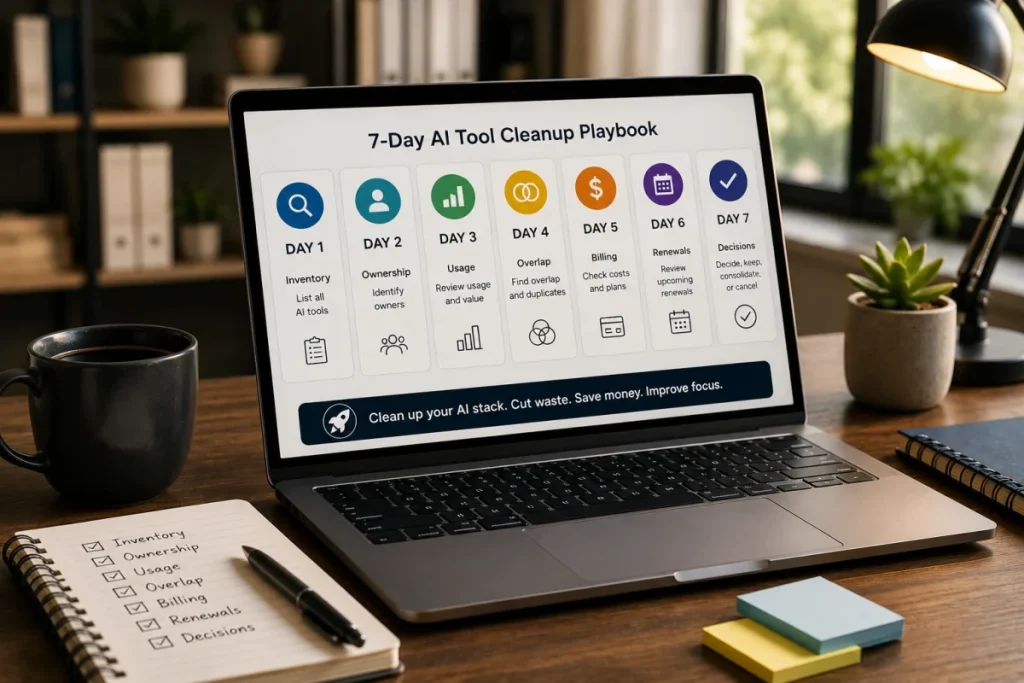
- Add renewal dates.
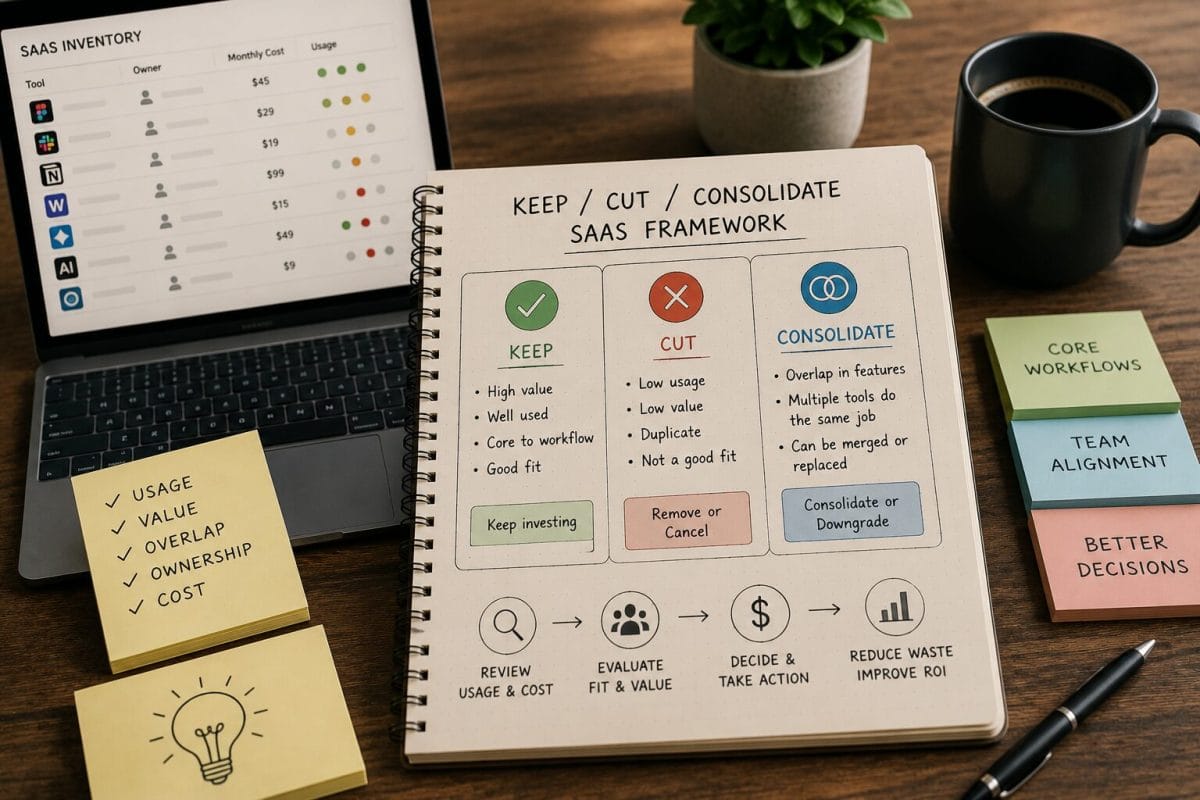
- Decide keep, cut, consolidate, downgrade, or review later.
This review can be simple.
The point is to prevent AI tools from becoming invisible recurring costs.
The ToolRelief AI Stack Review Model
ToolRelief uses a simple review model:
1. Role
Who uses the AI tool?
2. Workflow
What job does it perform?
3. Owner
Who is responsible for the subscription?
4. Usage
Is it actively used?
5. Overlap
Does another tool do the same job?
6. Billing
Who pays for it?
7. Renewal
When does it renew?
8. Decision
Should the team keep, cut, consolidate, downgrade, or review later?
This model helps small teams manage AI adoption without turning it into a heavy procurement process.
What This Means for Modern SaaS Waste
AI tool overlap shows that SaaS waste is becoming more dynamic.
Waste is not only created by old tools that should have been cancelled.
It can also be created by new tools that were never organized.
This means modern SaaS waste has two sides:
Old-stack waste
- unused seats
- old tools
- forgotten renewals
- contractor accounts
- plan mismatch
- tools surviving by habit
New-stack waste
- AI tool overlap
- experimental subscriptions
- scattered personal accounts
- feature duplication
- no AI stack owner
- role confusion
- fast subscription growth
Small teams need to review both.
Next step for AI tool overlap
If your AI stack feels crowded, do not start by canceling tools randomly.
Start by mapping the workflow.
List each AI tool, what it is used for, who owns it, what it costs, and which other tools can do the same job.
Then use that map to decide what to keep, cut, or consolidate.
Recommended ToolRelief Workflow
If your team is dealing with AI tool overlap, use this order:
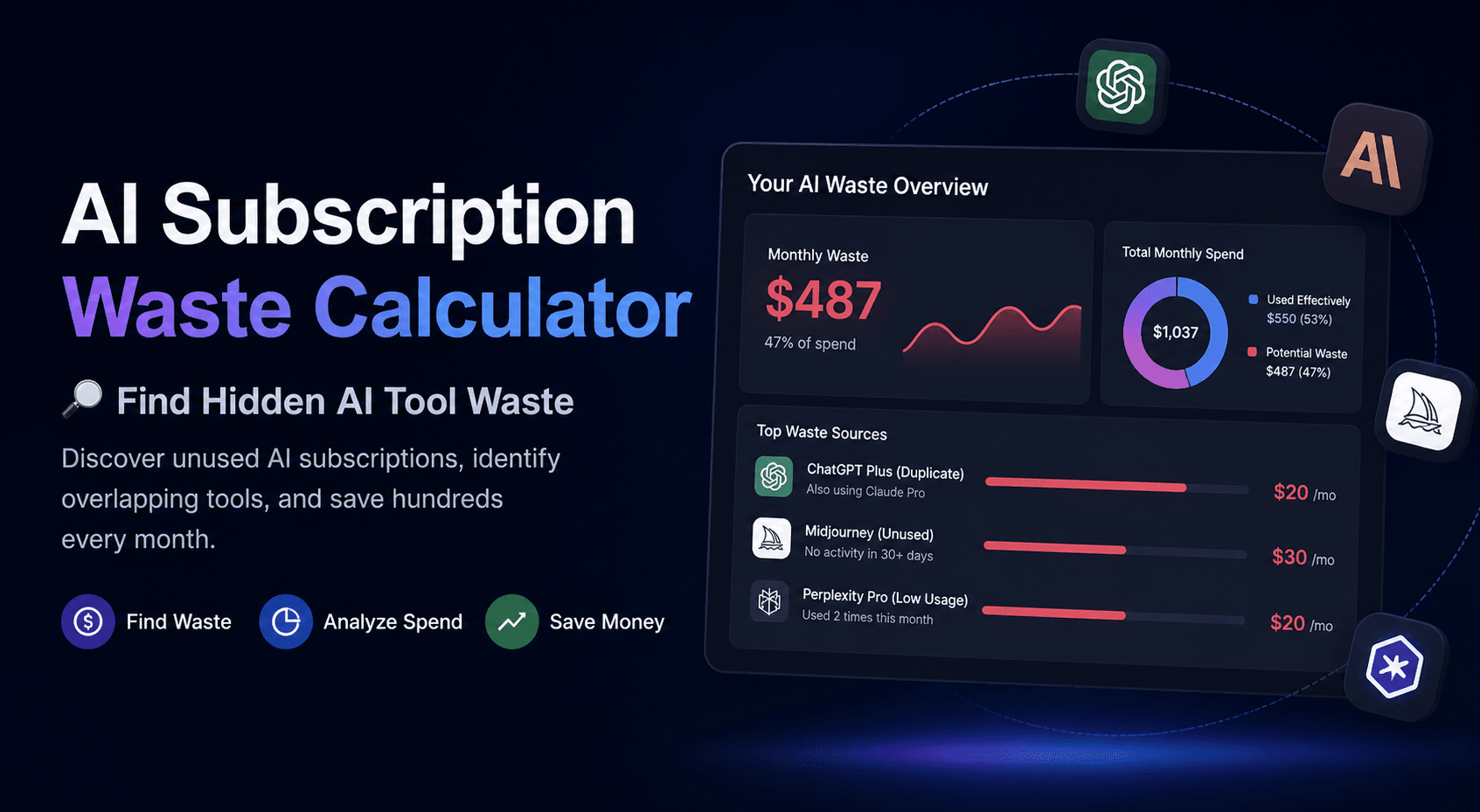
- AI Subscription Waste Calculator
Estimate possible waste from overlapping or unnecessary AI subscriptions. - AI Tool Stack Builder
Plan a leaner AI stack by role, workflow, and budget. - SaaS Waste Audit Tool
Review AI tools as part of the wider software stack. - SaaS Renewal Risk Calculator
Check whether AI subscriptions are renewing before the team reviews them.
Related ToolRelief Reading
- SaaS Cost Intelligence Library
- AI Subscription Waste: A ToolRelief Research Note
- Tool Experiment: AI Subscription Waste Across 6 Roles
- How ToolRelief Uses AI Without Publishing Unverified Claims
- The SaaS Waste Pattern Library
- Tool Experiment: 5 Small-Team SaaS Waste Scenarios
Methodology Note
This page is a ToolRelief founder research note based on AI tool workflow analysis, SaaS cost research,
realistic small-team scenarios, internal editorial review, and ToolRelief’s tool design process.
It does not represent private customer data, guaranteed savings, legal advice, financial advice, or a market-wide statistical study.
ToolRelief separates founder research notes from source-backed claims, educational scenarios, pricing-page observations,
internal tool experiments, and editorial interpretation.
Last updated: May 30, 2026
Last Updated on June 15, 2026