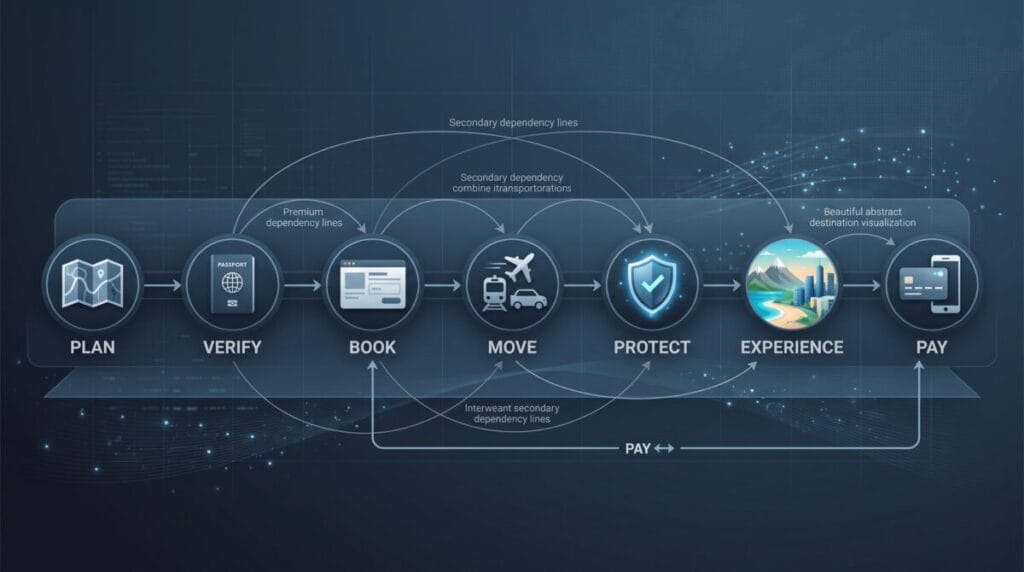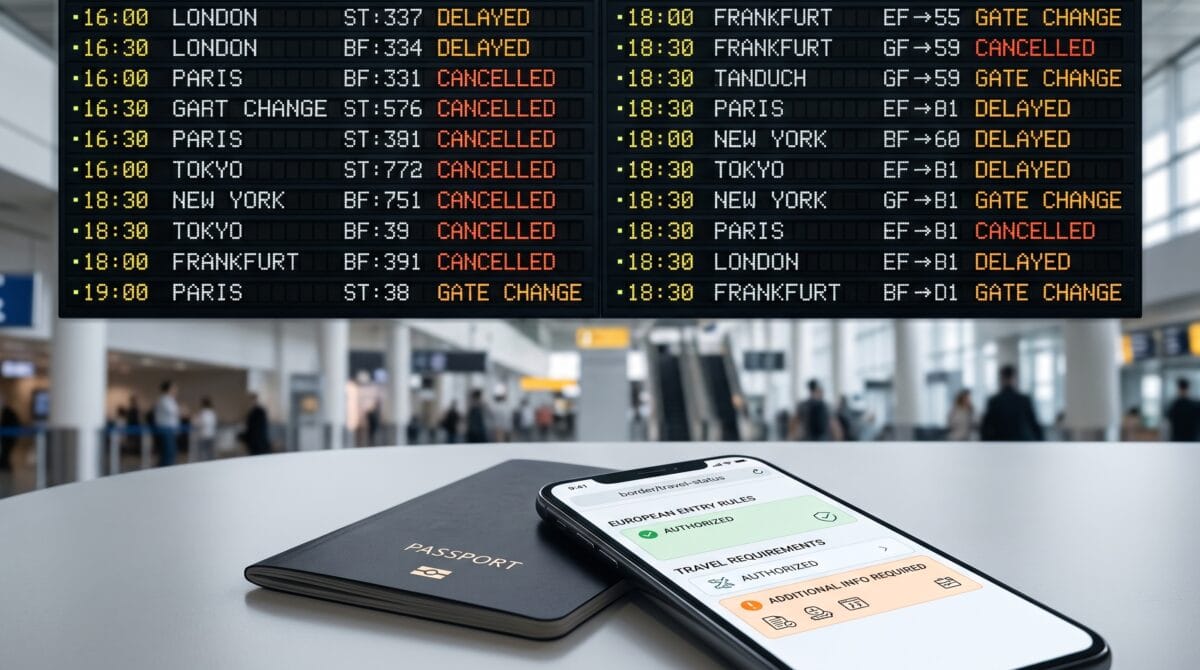
Travel Disruption 2026: the current picture is being shaped by two different forces at once: measurable flight-performance problems and a fast-changing passenger-protection and border-control environment.
In the United States, Bureau of Transportation Statistics data for 2025 shows that 76.42% of 7,736,770 reported flight operations arrived on time. Another 21.78% were recorded as arrival delays, 1.53% were cancelled, and 21,106 flights were diverted.
In Europe, the passenger-rights story is more complicated. The European Parliament and Council completed adoption of a major update to EU air passenger rules in July 2026, but the updated framework is not yet the rule travelers should assume is active today. The existing compensation threshold of more than three hours remains relevant, and the adopted framework itself preserves that threshold and the existing €250, €400, and €600 compensation bands.
At the border, the EU's Entry/Exit System is already operational, while ETIAS is not. EES began a progressive rollout on October 12, 2025 and became fully operational on April 10, 2026. Official EU guidance currently says ETIAS is planned to start in the last quarter of 2026, but no exact start date has been announced and travelers do not need to apply yet.
The most important travel-protection question in 2026 is not simply “What changed?” It is “Which rule is active for my trip today, and which change has only been adopted for later?”
This benchmark separates those layers using current public information from the U.S. Department of Transportation, Bureau of Transportation Statistics, European Parliament, Council of the European Union, European Commission, UK Civil Aviation Authority, and GOV.UK.
Travel Disruption 2026: What Applies Now, What Is Adopted, and What Is Not Active Yet?
Quick Navigation ✔
ToggleThis is the most important table in the benchmark because several different legal and border changes are often described online as if they became active at the same time.
| Status | System / Rule | Position as of September 1, 2026 | What Travelers Should Understand |
|---|---|---|---|
| NOW | Current EU air passenger rights | Compensation may apply after a delay of more than three hours, subject to route, cause, and other eligibility conditions. | Current EU protections remain the practical starting point until the newly adopted framework takes effect. |
| ADOPTED / UPCOMING | Updated EU air passenger-rights framework | European Parliament approved the joint text on July 7, 2026; the Council gave final clearance on July 13, 2026. | The adopted framework preserves the more-than-three-hour compensation threshold and the €250 / €400 / €600 bands while adding and clarifying other rights. |
| NOT YET ACTIVE | Updated EU framework effective date | The Council says the updated rules enter into force 12 months and 20 days after publication in the Official Journal. | ToolRelief is not stating a calendar effective date because the relevant Official Journal publication date has not yet been independently verified. |
| NOW | EU Entry/Exit System (EES) | Progressive operation began October 12, 2025. Full operation began April 10, 2026. | Non-EU short-stay travelers can encounter digital entry/exit registration and biometric collection at participating Schengen external borders. |
| NOT YET ACTIVE | ETIAS | Official EU guidance says ETIAS is planned to start in the last quarter of 2026. The exact date has not been announced. | No ETIAS application is required now. The EU says it will announce the specific launch date several months in advance. |
| NOW | UK Electronic Travel Authorisation (ETA) | The UK ETA system is already operational for covered non-visa nationals. | Do not confuse the active UK ETA with the future EU ETIAS system. |
Decision consequence: a traveler entering Europe in September 2026 may encounter EES border procedures but should not buy or apply for an ETIAS authorization that the official EU system is not yet accepting.
If your trip involves visa, authorization, residency, transit, or entry-rule uncertainty, use ToolRelief's visa and entry requirement decision tools after checking the relevant government's current rules.
How Bad Was US Flight Disruption in 2025?
Bureau of Transportation Statistics annual data provides a cleaner benchmark than anecdotal airport stories.
The BTS Marketing Carrier on-time dataset reports 7,736,770 flight operations in 2025. Of those:
- 5,912,162 arrived on time — 76.42%.
- 1,685,320 were recorded as arrival delays — 21.78%.
- 118,168 were cancelled — 1.53%.
- 21,106 were diverted.
Viewed together, the BTS figures mean approximately 23.58% of the reported 2025 operations were delayed, cancelled, or diverted rather than arriving on time. That percentage is a ToolRelief calculation using the BTS annual counts, not a separate BTS headline metric.
2024 vs 2025: The Direction Was Worse
| Metric | 2024 | 2025 | Change |
|---|---|---|---|
| Reported flight operations | 7,546,968 | 7,736,770 | +189,802 operations |
| On-time arrivals | 78.10% | 76.42% | -1.68 percentage points |
| Arrival delays | 20.29% | 21.78% | +1.49 percentage points |
| Cancellations | 1.36% | 1.53% | +0.17 percentage points |
Source and denominator: U.S. Bureau of Transportation Statistics, Marketing Carrier On-Time Performance annual table. The figures apply to the reporting population defined by BTS and should not be described as every flight operated everywhere in the United States.
BTS itself warns that arrival-delay counts in the TranStats table may not exactly match delay figures in the separate Air Travel Consumer Report. ToolRelief therefore keeps this table within one BTS dataset rather than mixing denominators from different reports.
That distinction matters. “US flights were late X% of the time” sounds simple, but aviation datasets can use different reporting carriers, airport populations, and operational definitions.
What Does US Flight Disruption Mean for Passenger Protection?
A bad delay and a legal right to cash compensation are not the same thing.
For domestic US itineraries, the Department of Transportation states that airlines are not federally required to provide cash compensation simply because a flight is delayed or cancelled.
DOT's current Cancellation and Delay Dashboard also shows that the major US carriers listed there do not commit to cash compensation for a delay of three hours or more, even for controllable disruptions.
That does not mean US passengers have no rights.
A passenger is entitled to a refund if an airline cancels the flight and the passenger chooses not to travel or accept an alternative. DOT also provides refund rights for qualifying significant schedule changes or delays when the traveler decides not to take the changed or delayed trip.
Those refund rights are legally and economically different from the fixed cash-compensation framework used in Europe.
US protection is often centered on refund rights and airline-specific disruption commitments. EU and UK regimes can add fixed compensation for qualifying disruption.
What EU Flight-Delay Compensation Applies Right Now?
As of September 1, 2026, current EU passenger-rights guidance says passengers may be entitled to compensation when a flight is more than three hours late, or when a flight is cancelled less than 14 days before departure, subject to the law's route and eligibility conditions and exceptions such as qualifying extraordinary circumstances.
The current compensation bands remain:
| Journey | Current Compensation Band | Current Delay Reference |
|---|---|---|
| Journeys up to 1,500 km | €250 | Potential compensation after a qualifying delay of more than three hours |
| Intra-EU journeys over 1,500 km, and other journeys between 1,500 km and 3,500 km | €400 | Potential compensation after a qualifying delay of more than three hours |
| Other longer journeys | €600 | Potential compensation after a qualifying delay of more than three hours |
EU citizenship is not required. According to the Council of the European Union, EU air passenger rights can cover passengers flying within the EU, passengers departing the EU for a non-EU destination, and passengers arriving in the EU from outside the EU on an EU airline.
The exact result for a specific journey depends on more than the delay clock. Route, operating carrier, cancellation notice, rerouting, reason for disruption, and extraordinary-circumstance rules can all affect entitlement.
ToolRelief therefore does not treat this benchmark as an individual claim decision. If a disruption has already occurred and you need to evaluate your next action, continue to ToolRelief's flight delay compensation decision surface.
Is EU261 Changing in 2026?
Yes—but the most repeated version of the story is now outdated.
During the legislative process, higher four-hour and six-hour delay thresholds were proposed. Those proposal-stage numbers should not be presented as the final adopted outcome.
The European Parliament approved the joint text on July 7, 2026 by 646 votes to 12, with three abstentions. The Council gave final clearance on July 13, 2026.
The adopted text preserves the central compensation right for delays of more than three hours and maintains the €250, €400, and €600 distance bands.
So the accurate 2026 statement is:
The EU completed adoption of an updated air passenger-rights framework in July 2026, but it did not adopt the widely discussed four-hour/six-hour compensation thresholds as the final rule.
What Else Changes Under the Adopted Framework?
The updated framework is broader than the compensation threshold.
European Parliament and Council materials describe changes including:
- clearer rerouting and assistance rights;
- better communication about passenger rights after disruption;
- clearer treatment of extraordinary circumstances;
- a ban on denying the return leg solely because the outbound leg was not used;
- better fare transparency around hand baggage;
- stronger protections for travelers with reduced mobility and other specific needs;
- clearer claim procedures and response timelines.
The European Parliament's adopted-text summary says affected passengers are to receive digital information about potential compensation rights and claim instructions within four days after the end of the journey. It also provides a nine-month passenger claim window and a 30-day period for the carrier to pay or explain non-payment.
Those are features of the adopted future framework, not instructions ToolRelief is presenting as already operative today.
When Do the New EU Passenger-Rights Rules Take Effect?
Not immediately after the July votes.
The Council states that the updated rules will enter into force 12 months and 20 days after publication in the Official Journal of the European Union.
As of September 1, 2026, ToolRelief has verified the Parliament adoption and Council final clearance but has not independently verified the final Official Journal publication date needed to calculate a calendar effective date.
We therefore do not publish a guessed activation date.
Until the effective date is established from the Official Journal, travelers should distinguish the current rules from the adopted future framework.
How Do EU, UK, and US Flight-Disruption Protections Differ?
There is no single global passenger-rights standard.
| Jurisdiction | Delay Compensation | Typical Fixed Amounts | Refund / Care Context |
|---|---|---|---|
| European Union | Potential fixed compensation for qualifying delays of more than three hours | €250 / €400 / €600 depending on journey distance | Separate rights can include assistance, reimbursement, or rerouting; extraordinary circumstances can affect compensation |
| United Kingdom | UK261 can provide compensation when arrival is more than three hours late and eligibility conditions are met | £220 / £350; long-haul £260 for 3–4 hours or £520 for more than 4 hours | Care, rerouting, refund, and extraordinary-circumstance rules also apply |
| United States | No federal cash-compensation requirement for ordinary domestic delays or cancellations | No equivalent fixed EU-style statutory payment for ordinary delays | Refund rights apply to cancellations and qualifying significant changes when the passenger chooses not to travel; airline amenities vary by carrier and cause |
Caveat: this is a high-level jurisdiction benchmark, not a substitute for evaluating a specific itinerary. A transatlantic trip can potentially touch more than one passenger-rights regime depending on origin, destination, operating carrier, and itinerary structure.
What Compensation Applies Under UK261?
The UK Civil Aviation Authority currently says passengers may be entitled to compensation if a delay causes them to reach their destination more than three hours late.
The current fixed amounts are:
- £220 for flights under 1,500 km;
- £350 for flights between 1,500 km and 3,500 km;
- £260 for flights over 3,500 km when arrival is between three and four hours late;
- £520 for flights over 3,500 km when arrival is more than four hours late.
As in the EU framework, extraordinary circumstances can change whether fixed compensation is owed.
Does the US Require Airlines to Pay Cash for Ordinary Flight Delays?
No federal rule currently requires US airlines to pay EU-style fixed cash compensation simply because a domestic flight is delayed or cancelled.
The Department of Transportation distinguishes between:
- refund rights;
- airline-specific commitments for controllable disruption;
- cash compensation for involuntary denied boarding;
- and ordinary delay or cancellation compensation.
This distinction is crucial for US travelers reading European compensation articles: a three-hour delay does not automatically produce the same legal outcome on a domestic US itinerary as it can on an eligible EU or UK journey.
Is EES Already Active?
Yes.
The European Union's Entry/Exit System began progressive operation on October 12, 2025.
The rollout lasted six months, allowing participating countries to introduce the system progressively at their external borders.
EES became fully operational across Schengen external border crossing points on April 10, 2026.
That chronology matters because saying simply “EES launched in April 2026” erases six months of actual operation.
What Does EES Do?
EES electronically registers non-EU nationals traveling for short stays and replaces routine passport stamping with digital entry and exit records.
The system can record:
- travel-document information;
- entry and exit data;
- facial images;
- fingerprints;
- refusals of entry where applicable.
By July 27, 2026, the European Commission said the system had registered more than 145 million entries and exits.
That scale is useful context: EES is not a future pilot waiting to happen. It is an operational part of the current European border environment.
Do Americans, Canadians, Australians, and Britons Need ETIAS Right Now?
No—not as of September 1, 2026.
The official European Union ETIAS website says:
- ETIAS is not yet in operation;
- no travel-authorization applications are currently being collected;
- ETIAS is planned to start operations in the last quarter of 2026;
- the specific date will be announced several months before launch.
The official future eligibility list includes visa-exempt nationals from the United States, United Kingdom, Canada, and Australia, among many others.
That means these travelers are expected to need ETIAS for qualifying short stays once the system actually begins, subject to exemptions and individual circumstances.
It does not mean they should apply today.
As of September 1, 2026, the correct ETIAS action for an ordinary visa-exempt traveler is to monitor the official launch status—not to purchase an unofficial “ETIAS” service for a system that is not yet accepting applications.
For an itinerary-specific check, use ToolRelief's Visa Service & Entry Requirement Tools and verify the final requirement with the destination authority.
Is ETIAS the Same Thing as EES?
No. They are related parts of Europe's border modernization, but they solve different problems and happen at different stages of travel.
| System | EES | ETIAS |
|---|---|---|
| Meaning | Entry/Exit System | European Travel Information and Authorisation System |
| Main function | Digitally records border entry and exit for covered short-stay non-EU travelers | Pre-travel authorization for covered visa-exempt travelers |
| When it acts | At the external border / border-control process | Before travel |
| Status September 1, 2026 | Fully operational | Not yet operational |
| Key date | Progressive start October 12, 2025; fully operational April 10, 2026 | Planned for last quarter of 2026; exact launch date not yet announced |
| Action today | Expect applicable EES processing when crossing covered Schengen external borders | Do not apply yet; monitor official EU launch information |
The simplest distinction is:
EES records eligible border crossings. ETIAS will authorize eligible visa-exempt travel before the trip.
How Is the UK ETA Different?
The United Kingdom is not waiting for ETIAS.
The UK's Electronic Travel Authorisation is a separate British system, and it is already active for covered travelers.
GOV.UK says an ETA is required for specified non-visa nationals traveling to the UK, subject to exemptions and other immigration permissions. The current national list includes the United States, Canada, Australia, and many European nationalities.
The UK began enforcing digital permission to travel for non-visa nationals on February 25, 2026.
The current GOV.UK ETA application page lists an application cost of £20 and says an ETA normally lasts for two years or until the linked passport expires, whichever comes first.
This creates a practical 2026 distinction:
- UK trip: ETA may already be required.
- Schengen trip: EES may affect border processing now.
- Future qualifying European trip: ETIAS is planned, but not active yet.
What Should Travelers Protect Before Disruption Happens?
Regulatory rights are only one layer of protection.
A traveler can have a valid compensation right and still face immediate problems that a later payment does not solve: an overnight hotel, a missed train, a non-refundable activity, a new airport transfer, lost work time, or a missed cruise departure.
That leads to four separate questions before travel:
1. What Rights Apply to the Flight?
Identify the relevant jurisdiction before assuming that advice written for another country applies to your trip.
An eligible EU journey, a UK261 journey, and a domestic US flight can produce materially different legal outcomes from the same three-hour disruption.
2. What Costs Would a Passenger-Right Rule Not Cover?
Fixed compensation, refunds, airline assistance, and insurance are different mechanisms.
A statutory compensation payment is not the same thing as reimbursement for every downstream loss.
Travel insurance may cover specific insured events and expenses depending on the policy, exclusions, benefit limits, timing, and cause of disruption.
ToolRelief does not rank insurance products inside this benchmark. If you need to compare the protection layer separately, continue to the Travel Insurance Comparison.
3. What Evidence Should You Preserve During a Disruption?
When a trip breaks down, preserve the evidence while it is still easy to obtain:
- original itinerary and booking confirmation;
- boarding pass;
- actual arrival time where relevant;
- airline delay or cancellation messages;
- reason given for the disruption;
- rerouting or refund offers;
- reasonable expense receipts;
- screenshots of material schedule changes.
This is useful whether the next step is an airline request, an insurance claim, a consumer complaint, or simply documenting what happened.
4. What Will You Do If the Trip Changes While You Are Already Moving?
The operational problem may arrive before the legal answer.
When the immediate question is what to do next—reroute, find another airport, recover ground transport, replace connectivity, or stabilize the itinerary—use the Travel Relief SOS Radar as the next ToolRelief decision layer.
A Practical Protection Sequence for an International Trip
This is not a generic packing checklist. It is a risk sequence.
| Before / During Trip | Question | Why It Changes the Next Decision |
|---|---|---|
| Before booking | Which passenger-rights regime could apply? | It changes your expected protection when choosing routes, carriers, and connections. |
| Before departure | Are entry requirements active now or only announced for later? | It prevents confusing EES, ETIAS, visas, and UK ETA requirements. |
| Before committing to non-refundable plans | What happens if the flight or connection fails? | It reveals downstream financial exposure that airline compensation may not cover. |
| During disruption | What caused the problem and what has the airline offered? | Cause, rerouting, timing, and passenger choices can affect later rights. |
| Immediately after | What evidence and receipts should be preserved? | It supports refunds, compensation requests, insurance claims, and complaints. |
What This Benchmark Does Not Do
This article deliberately does not:
- rank flight-compensation companies;
- claim that a third-party claims service is necessary;
- compare travel-insurance providers;
- rank visa-service providers;
- state that every delay qualifies for compensation;
- use the unverified claim that roughly 40% of EU261 claims are rejected;
- publish claims-company payout anecdotes as neutral evidence;
- calculate a supposed average dollar cost of travel disruption without a defensible dataset.
Those boundaries are intentional. The purpose of this benchmark is to establish the regulatory and disruption context before a traveler chooses the appropriate decision surface.
Commercial & Editorial Disclosure
ToolRelief is an independent decision platform. ToolRelief may earn compensation from partner links on separate travel decision surfaces. Those commercial relationships do not determine the passenger-rights conclusions, regulatory status, or government data used in this benchmark.
This article does not contain a direct affiliate recommendation or rank claims, insurance, or visa-service providers. The preferred journey is:
Research → relevant ToolRelief decision surface → external provider only when appropriate.
Methodology, Limitations, and Last-Verified Standard
Produced by ToolRelief. Last verified September 1, 2026.
This benchmark is a ToolRelief synthesis of published primary-source evidence rather than a proprietary traveler survey.
The source hierarchy for this benchmark was:
- current government and institutional sources;
- primary regulatory and transport datasets;
- official consumer-protection guidance;
- the ToolRelief Travel research dossier for research leads and structure;
- secondary reporting only where primary material was unavailable or needed for context.
For US flight performance, ToolRelief used the Bureau of Transportation Statistics Marketing Carrier On-Time Performance annual table and kept 2024 and 2025 comparisons within that same dataset to avoid mixing incompatible reporting populations.
For European passenger rights, ToolRelief used European Parliament and Council sources published after the July 2026 adoption process. Proposal-stage claims that the final framework moved compensation to four-hour and six-hour thresholds were rejected because the adopted text preserves compensation after delays of more than three hours.
For EES and ETIAS, ToolRelief used current European Commission / official Travel Europe information. Secondary speculation that ETIAS had moved to 2027 was rejected because the current official position remains a planned launch in the last quarter of 2026, with no exact date yet announced.
Limitations
- BTS reporting applies to its defined US reporting-carrier population, not every aviation operation worldwide.
- Passenger-right eligibility depends on itinerary-specific facts and cannot be decided from distance and delay duration alone.
- The adopted EU framework is not treated as active until its legal effective date is established.
- ETIAS is fast-moving. Its status should be rechecked whenever this benchmark is updated or when an official launch date is announced.
- This benchmark does not provide legal advice, immigration advice, or insurance coverage advice.
- Canada and Australia have their own passenger-protection regimes; they are not benchmarked here because the core jurisdiction comparison in this article is EU vs UK vs US. Canadian and Australian readers remain directly covered by the EES/ETIAS analysis when traveling to Europe.
Primary Sources
- U.S. Bureau of Transportation Statistics — Marketing Carrier On-Time Performance Annual Data
- Bureau of Transportation Statistics — Airline Service Quality Performance Data
- U.S. Department of Transportation — Airline Refund Rights
- U.S. Department of Transportation — Airline Cancellation and Delay Dashboard
- U.S. Department of Transportation — Fly Rights
- Council of the European Union — Air Passenger Rights
- European Parliament Legislative Observatory — Air Passenger Rights, July 7, 2026
- Council of the European Union — Final Clearance, July 13, 2026
- European Commission — Entry/Exit System
- European Commission — EES Fully Operational and July 2026 Statistics
- European Union — Official ETIAS Status
- European Union — Who Will Need ETIAS
- UK Civil Aviation Authority — Flight Delay Rights
- GOV.UK — Electronic Travel Authorisation
Bottom Line
The Travel Disruption 2026 benchmark cannot be understood from one delay statistic or one passenger-rights headline.
The US recorded 7.74 million flight operations in the BTS 2025 dataset, with 76.42% arriving on time and 21.78% recorded as arrival delays.
In the European Union, travelers should not rely on articles claiming that a four-hour or six-hour delay threshold became the final 2026 compensation rule. The adopted framework preserves the more-than-three-hour threshold and the €250 / €400 / €600 bands, but the updated framework is not yet being treated here as active law because its effective date depends on Official Journal publication.
EES, by contrast, is already real and operational: it began progressively on October 12, 2025 and became fully operational on April 10, 2026.
ETIAS is different. It is still not operating as of September 1, 2026. The official EU position remains a planned launch in the last quarter of 2026, with the specific date to be announced in advance.
The practical decision is therefore not to memorize one universal travel-protection rule.
Verify the jurisdiction, verify what is active today, preserve evidence when disruption happens, and use the correct decision layer for compensation, insurance, entry requirements, or immediate trip recovery.