Last verified: September 1, 2026
Travel cost leakage is the gap between the price a traveler initially evaluates and the full cost that emerges after baggage, mandatory lodging charges, optional add-ons, currency conversion, card fees, rental conditions, connectivity, and other transaction layers are accounted for.
It is not the same thing as fraud, and it is not always caused by hidden fees.
Some costs are legitimate and disclosed. Some depend on choices the traveler makes. Some are difficult to compare across providers. And some pricing practices have been restricted by regulators specifically because the total price was too difficult to see early enough in the decision.
The scale is measurable in several categories. U.S. scheduled passenger airlines reported approximately $7.4 billion in baggage-fee revenue in 2025, according to the Bureau of Transportation Statistics. Meanwhile, the Federal Trade Commission's current pricing rule requires covered short-term lodging businesses to display mandatory fees in the total price upfront—but it does not prohibit hotels from charging those fees.
Transparency changed. The fees did not necessarily disappear.
This report separates those two questions: Can you see the cost clearly? and Is the final cost good enough to accept?
Travel Cost Leakage — Quick Answer
Travel cost leakage usually appears in five layers:
- Unbundled costs — baggage, seats, changes, extras, or other services separated from the base price.
- Mandatory charges — fees that become part of the required lodging or transaction price.
- Payment costs — foreign transaction fees, exchange-rate effects, ATM charges, or dynamic currency conversion.
- Conditional costs — rental fuel rules, one-way charges, deposits, optional protection, excess usage, or connectivity choices.
- Decision costs — paying more because two options were compared on different price bases.
No credible public dataset establishes one universal “average travel cost leakage per trip.” ToolRelief therefore does not manufacture one.
Instead, this report uses measurable category-level data and transparent examples so a traveler can identify the leakage points that actually apply to a specific trip.
What Does Travel Cost Leakage Actually Mean?
A $400 flight and a $420 flight are not meaningfully comparable if the first traveler later needs to add baggage, seat selection, and another paid service while the second fare already includes what that traveler needs.
The same problem can occur with:
- a hotel rate before a mandatory property fee;
- a foreign purchase before an issuer fee;
- a currency conversion before its markup;
- a rental rate before required or selected extras;
- a roaming arrangement before daily or usage charges.
The problem is therefore larger than “hidden fees.”
ToolRelief uses travel cost leakage to describe any material cost layer that is easy to exclude from the original comparison but relevant to the final economic decision.
That definition also explains why regulation can improve transparency without lowering the underlying cost.
How Large Are US Airline Baggage Fees?
The 2025 Bureau of Transportation Statistics financial data provides one of the clearest primary-source measures of unbundled travel cost.
Across 25 U.S. scheduled passenger airlines, BTS reported:
| 2025 Reporting Segment | Baggage-Fee Revenue | Share of Operating Revenue | Source |
|---|---|---|---|
| Systemwide | Approximately $7.4 billion | 2.9% | U.S. Bureau of Transportation Statistics, 2025 annual airline financial results |
| Domestic | Approximately $6.0 billion | 3.2% | BTS, 2025 domestic scheduled passenger airline results |
| International | Approximately $1.4 billion | 2.2% | BTS, 2025 international scheduled passenger airline results |
BTS reported $7.3 billion in systemwide baggage fees for 2024, compared with approximately $7.4 billion in 2025.
The important interpretation is not that every traveler paid a baggage fee or that baggage fees are inherently improper.
It is that a material portion of airline revenue sits outside the base fare travelers commonly use as the first comparison point.
The Government Accountability Office made the same structural point in its 2026 airline-competition work: airfare datasets based on base fare do not capture every ancillary cost. GAO specifically notes baggage, preferred seating, extra legroom, food and beverages, Wi-Fi, and change or cancellation fees as examples of unbundled services that can complicate full-cost comparison.
This is why “cheapest flight” and “lowest total trip cost” can be two different questions.
When the next decision is choosing among flight search routes rather than analyzing fee economics, continue to ToolRelief's Flight Search & Comparison Tools.
What Happened to the 2024 DOT Airline Ancillary-Fee Rule?
This is one of the most important corrections to older 2024 and 2025 travel-fee articles.
In April 2024, the U.S. Department of Transportation issued a final rule that would have required airlines and ticket agents to disclose several passenger-specific and itinerary-specific ancillary fees earlier in the shopping process.
The rule covered fees associated with areas such as baggage and reservation changes or cancellations.
But that is not the operative federal framework today.
The U.S. Court of Appeals for the Fifth Circuit vacated the 2024 rule on February 3, 2026.
DOT then issued a final rule in July 2026 implementing that vacatur and restoring the regulations that existed before the 2024 rule—returning to the standards established in 2011.
Any travel article that still describes the April 2024 ancillary-fee disclosure rule as the current federal requirement is outdated.
What Does the Current DOT Framework Require?
DOT's current summary says the restored framework requires airlines and ticket agents to alert consumers, on the first webpage where fare and schedule information appears, that additional baggage fees may apply and to direct travelers to where those baggage fees can be found.
Airlines must also continue to disclose ancillary-service fees in a central location on their websites.
That is less prescriptive than the passenger-specific, itinerary-specific disclosure system contained in the now-vacated 2024 rule.
What About the Famous $543 Million Ancillary-Fee Estimate?
The number is useful—but only if its status is explained correctly.
In its 2024 review of the now-vacated DOT rule, the Government Accountability Office recorded DOT's economic modeling.
DOT estimated that the enhanced disclosure framework could have produced:
- $365 million to $484 million per year in consumer time savings while searching for airfare;
- and an economic transfer of roughly $543 million per year from airlines to consumers by reducing fee overpayments caused by travelers being surprised by ancillary fees.
Those numbers were modeled expected effects of the 2024 rule.
They are not measured consumer savings from a rule that remains in operation.
Because the Fifth Circuit vacated that rule in 2026, the figures should now be treated as historical evidence of how DOT valued the information problem—not as current realized outcomes.
Airline Fee Transparency: What Changed and What Did Not?
| Issue | 2024 Rule | Status in September 2026 | Decision Consequence |
|---|---|---|---|
| Passenger-specific ancillary disclosure | Expanded requirements adopted | Vacated | Do not assume the 2024 disclosure workflow is current law |
| Baggage-fee notice | Part of expanded framework | Current 2011-style framework restored | Travelers may still need to follow fee information beyond the first fare display |
| Central ancillary-fee information | Required within broader 2024 framework | Still part of restored requirements | Use the airline's current fee information when calculating total cost |
| Fees themselves | Disclosure regulation, not a broad fee prohibition | Fees remain part of airline pricing | Transparency and price level remain separate questions |
Did the FTC Ban Hotel Resort Fees?
No.
The Federal Trade Commission's Rule on Unfair or Deceptive Fees became effective on May 12, 2025.
It covers short-term lodging—including hotels, motels, inns, vacation rentals, and relevant lodging platforms—as well as live-event ticketing.
The rule prohibits covered businesses from using bait-and-switch pricing and other practices that obscure or misrepresent required fees.
It requires the total price to include mandatory fees that the business knows and can calculate upfront, and that total price must be displayed more prominently than other pricing information.
But the FTC is explicit about an important boundary:
The rule does not prohibit a particular type or amount of fee. It regulates how required prices and fees are presented and represented.
So:
“Resort fees were banned” = wrong.
“Covered lodging businesses must include mandatory resort-type fees in the upfront total price” = substantially more accurate.
The FTC's Own $199 + $39 Example
The FTC's current compliance guidance gives an especially clear hotel example.
If a hotel advertises a nightly rate of $199 and requires a $39 resort fee, that mandatory fee must be included in the total price shown to the consumer.
The relevant comparison price becomes:
$199 + $39 = $238 before any separately permitted later charges such as applicable government taxes.
The rule still permits certain charges to be disclosed later, including government charges and genuinely optional goods or services, provided the business follows the rule's disclosure requirements.
For hotel selection after the total-price question is understood, continue to ToolRelief's Hotel Booking & Accommodation Comparison.
Why Better Hotel Price Disclosure Does Not Mean Lower Hotel Costs
The FTC rule changes the quality of the comparison.
It does not force the $39 mandatory charge in the FTC example to become $0.
This distinction is central to understanding travel cost leakage:
| Problem | Does Upfront Total-Price Disclosure Help? | Does It Remove the Cost? |
|---|---|---|
| Mandatory hotel fee appears only late in booking | Yes | No |
| Traveler compares two hotels using incompatible price bases | Yes | No |
| Hotel charges a disclosed mandatory property fee | Improves visibility | No |
| Traveler chooses an optional paid add-on | Rule requires truthful disclosure where applicable | No |
The policy improvement is primarily comparison integrity.
That can save travelers time and reduce surprise, but it should not be confused with price regulation.
How Large Did the FTC Think the Search-Time Problem Was?
When the FTC finalized the rule, it estimated that clearer pricing could save consumers up to 53 million hours per year previously spent searching for the true total price of short-term lodging and live-event tickets.
The FTC valued those modeled time savings at more than $11 billion over ten years.
These are regulatory-impact estimates, not audited consumer savings after implementation.
That distinction matters: the numbers quantify the FTC's modeled scale of the information problem; they do not prove that travelers actually received $11 billion in lower hotel bills.
How Do Foreign Transaction Fees Create Travel Cost Leakage?
Payment is one of the clearest examples of a cost that can exist independently of the travel product itself.
A hotel room, train ticket, or restaurant bill can have exactly the same local price for two travelers while producing different final dollar costs because their payment arrangements differ.
Chase and Capital One's current consumer guidance both describe foreign transaction fees as commonly falling around 1% to 3% where a card issuer charges one.
That is a market convention, not a legal maximum and not a statement that every card charges a foreign transaction fee.
Some cards charge none.
Others may charge 3% or another amount specified in their card agreement.
The correct source for a specific traveler is always that traveler's own cardholder agreement.
Foreign Transaction Fee vs Exchange Rate
These are not the same thing.
The exchange rate determines how one currency is converted into another.
A foreign transaction fee is an additional issuer charge that may be applied to an eligible international transaction.
A card with no foreign transaction fee still performs currency conversion when a purchase is denominated in another currency. “No foreign transaction fee” therefore does not mean “no exchange rate.”
When choosing how to pay abroad, ToolRelief's Travel Payment, Money Transfer & Card Tools is the appropriate decision surface after the fee mechanism is understood.
What Is Dynamic Currency Conversion?
Dynamic Currency Conversion, or DCC, is an offer by a merchant or ATM to convert a foreign transaction into the cardholder's home or billing currency at the point of sale.
For example, a US traveler in Europe may be asked whether to pay:
- €900 in local currency;
- or a displayed amount in US dollars through DCC.
Visa's current consumer guidance says a DCC offer should disclose:
- the amount in local currency;
- the amount in the cardholder's currency;
- the exchange rate used;
- and any additional fee or markup.
Visa also says the cardholder should be given a choice to accept or decline the conversion and that the merchant or ATM should not choose DCC on the traveler's behalf.
The important financial distinction is:
DCC chooses who performs the currency conversion and at what displayed rate. A foreign transaction fee is a separate card-issuer pricing term.
Those two layers should therefore be evaluated separately.
Transparent Worked Travel Cost Examples
The following examples are illustrative calculations. They are not claims about the average traveler, average card, or average trip.
Example 1: A 3% Foreign Transaction Fee
Assumption: A traveler makes foreign purchases that convert to $1,500 before any issuer foreign transaction fee.
Card term used for the example: 3% foreign transaction fee.
Formula:
$1,500 × 0.03 = $45
Illustrative final cost:
$1,500 + $45 = $1,545
The $45 is not an estimate of what every traveler pays. It is the exact result of the stated 3% hypothetical card term.
Example 2: A DCC Offer With a Displayed 6% Markup
Assume the local-currency transaction would correspond to a $1,000 benchmark before card-specific charges, and the merchant's DCC screen explicitly offers the home-currency conversion at a 6% markup.
Formula:
$1,000 × 0.06 = $60
DCC amount in this illustration:
$1,000 + $60 = $1,060
The 6% input is intentionally hypothetical. ToolRelief is not claiming 6% is the universal or average DCC markup.
A real traveler should compare the DCC exchange rate and disclosed markup with the likely cost of paying in local currency under that person's own card terms.
Example 3: FTC Mandatory Hotel-Fee Illustration
The FTC's own guidance uses a required $39 resort fee alongside a $199 room rate.
Formula:
$199 + $39 = $238
Under the FTC rule, the mandatory $39 must be reflected in the upfront total price rather than appearing as an unavoidable surprise late in the booking flow.
Again, the $39 fee is not prohibited simply because it is mandatory.
Illustrative Cost Comparison Matrix
| Scenario | Base Used in Example | Additional Cost Assumption | Added Amount | Important Caveat |
|---|---|---|---|---|
| Foreign purchases with 3% issuer fee | $1,500 | 3% foreign transaction fee | $45 | Actual card terms vary |
| DCC transaction | $1,000 equivalent | Hypothetical displayed 6% DCC markup | $60 | 6% is an illustrative input, not an average DCC claim |
| Mandatory lodging fee | $199 room rate | $39 required property fee | $39 | Based on the FTC's regulatory example, not a market-average hotel fee |
Why ToolRelief Does Not Add These Examples Into One “Average Trip Leakage” Number
Adding them together would create a number that looks scientific but describes no real population.
A traveler may:
- check no bags;
- stay at a property with no mandatory fee;
- use a card with no foreign transaction fee;
- never encounter DCC;
- or never rent a car.
Another traveler can encounter all of those cost layers on one itinerary.
There is no defensible public dataset that lets ToolRelief weight every travel-cost category into one representative 2026 leakage figure across the US, UK, Canada, Europe, and Australia.
So we do not invent one.
Where Else Can Trip Costs Expand?
The strongest numerical datasets cover airlines, regulated lodging-price presentation, and payment fees.
Other categories still matter, but the evidence does not support pretending that one average percentage applies to every traveler.
Car Rental
The displayed rental rate can be only one part of the decision.
Depending on the country, provider, vehicle, location, and traveler, relevant cost layers can include:
- fuel policy;
- one-way charges;
- airport or location surcharges;
- optional protection;
- young-driver or additional-driver charges;
- tolls;
- equipment;
- security deposits or card holds.
ToolRelief does not attach a fabricated “average car-rental leakage” percentage to those variables.
When the question becomes provider and booking-path selection, continue to the Car Rental Comparison for Travelers.
Roaming and eSIM
Connectivity can also change the real trip cost, especially when a traveler compares plans using different units.
A roaming pass may price access by day. A local or travel eSIM may price a fixed data allowance. Another plan may be unlimited but subject to fair-use limits or speed management.
Those products cannot be compared honestly from one headline price unless duration, data allowance, countries, network conditions, hotspot rules, and renewal behavior are aligned.
ToolRelief found no defensible public dataset supporting a universal average amount travelers “waste” on roaming versus eSIMs, so this report does not publish one.
For the actual decision, use ToolRelief's Travel eSIM Plans & Roaming Alternatives.
Travel Disruption
A disrupted trip can create additional hotel, meal, transport, rebooking, and missed-activity costs, but those costs should not be mixed into a generic cost-leakage average either.
Passenger rights, insurance, carrier responsibility, and individual itinerary structure can materially change who ultimately bears the cost.
For that separate evidence layer, see the Travel Disruption & Protection Benchmark 2026.
What Has Regulation Fixed—and What Has It Not Fixed?
| Travel Cost Layer | Current US Rule / Evidence | What Improved | What Did Not Disappear |
|---|---|---|---|
| Mandatory short-term lodging fees | FTC Rule on Unfair or Deceptive Fees, effective May 12, 2025 | Total mandatory price must be presented upfront for covered lodging | The underlying mandatory fee may still be charged |
| Airline ancillary fees | DOT July 2026 rule restoring 2011 disclosure standards after the 2024 rule was vacated | Baggage-fee notice and centralized airline fee information remain required | Baggage, seating, and other optional airline costs still exist |
| Foreign transaction fee | Card-specific contractual fee | Can be identified from the card agreement before travel | The fee can still apply when the selected card charges one |
| Dynamic currency conversion | Payment-network disclosure/choice requirements apply to DCC transactions | Traveler should see conversion rate and markup and be able to choose | DCC may still produce a higher home-currency price than another conversion path |
The common pattern is clear:
Better disclosure improves the decision. It does not automatically make the underlying travel product cheaper.
The ToolRelief Travel Cost Leakage Audit
ToolRelief's approach is to normalize the transaction before deciding which option is cheaper.
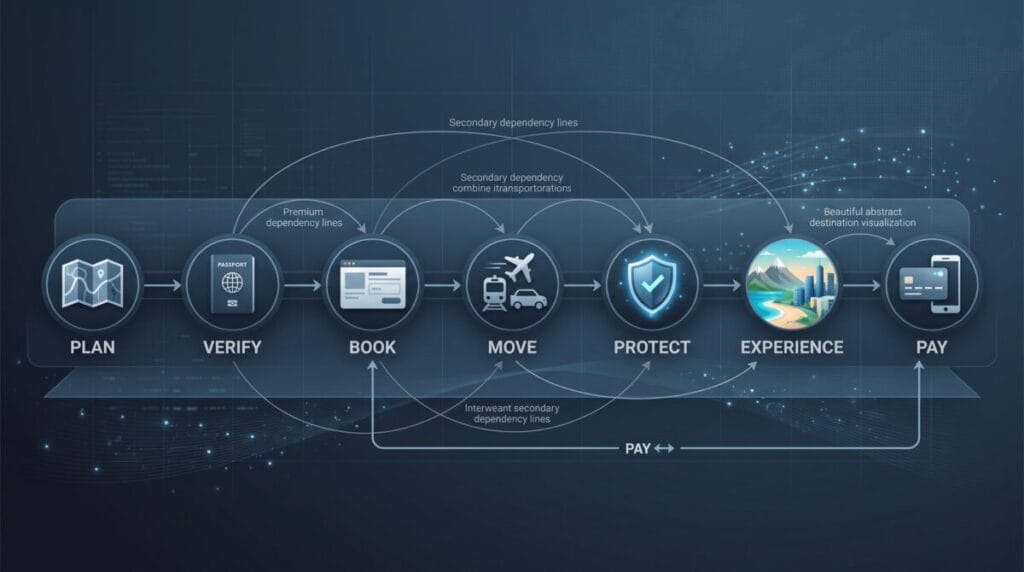
Run the trip through five layers:
Layer 1 — Base Price
What is the initial fare, room rate, rental rate, transport fare, activity price, or service price?
Layer 2 — Required Cost
What must be paid to complete the intended transaction?
Examples can include:
- mandatory lodging fees;
- required taxes or government charges;
- mandatory service components;
- minimum booking quantities.
Layer 3 — Traveler-Specific Add-Ons
What does this traveler actually need?
- checked bag;
- seat selection;
- additional driver;
- specific data allowance;
- airport transfer;
- flexibility;
- equipment or extras.
Layer 4 — Payment Layer
What happens when the charge crosses currencies or payment systems?
- foreign transaction fee;
- DCC;
- ATM fee;
- exchange-rate conversion;
- card-specific surcharge where permitted.
Layer 5 — Post-Purchase Exposure
What can create cost after the booking?
- cancellation/change terms;
- fuel or late-return conditions;
- overage;
- automatic renewal;
- damage or security-deposit exposure;
- missed connections or disruption.
Only after those layers are aligned is the traveler comparing like with like.
Travel Cost Leakage Decision Matrix
| Decision | Weak Comparison | Better Comparison |
|---|---|---|
| Flight | Base fare vs base fare | Total fare plus the baggage, seat, and flexibility this traveler actually needs |
| Hotel | Nightly headline rate | Comparable mandatory total for the full stay, then optional extras separately |
| Foreign payment | Home-currency amount alone | Conversion rate + disclosed markup + card-specific fee terms |
| Rental car | Daily rate | Required trip configuration including location, fuel, driver, protection, and return terms |
| Connectivity | Plan price | Price for the required countries, duration, data, speed, and tethering conditions |
Five Questions to Ask Before Paying
The fastest useful version of the audit is:
- What is mandatory?
- What am I choosing voluntarily?
- Am I comparing the same configuration?
- What does the payment method add?
- What can still create cost after checkout?
If those five questions are answered, most ordinary travel-cost leakage becomes visible before the transaction rather than after it.
Related ToolRelief Travel Decision Surfaces
This report explains the cost mechanisms. The following ToolRelief surfaces handle the next decision without turning this research article into a product ranking:
- Travel Payment, Money Transfer & Card Tools — evaluate the payment layer after identifying FX, DCC, and card-fee exposure.
- Hotel Booking & Accommodation Comparison — compare lodging once mandatory-price presentation and booking terms are understood.
- Car Rental Comparison for Travelers — compare rental routes after normalizing the actual trip configuration.
- Travel eSIM Plans & Roaming Alternatives — compare connectivity structures without relying on an invented average savings figure.
- Verified Travel Deals & Partner Offers — a secondary end-of-journey option when the traveler is ready to inspect current commercial routes.
Commercial & Editorial Disclosure
ToolRelief is an independent decision platform. ToolRelief may earn compensation from partner links on separate Travel decision surfaces. Those relationships do not determine the data, regulatory conclusions, calculations, or cost-leakage framework in this report.
This report does not rank payment cards, hotels, airlines, eSIM providers, rental companies, or travel deals.
The preferred journey is:
Research → ToolRelief decision surface → external provider only when relevant.
Methodology and Limitations
Produced by ToolRelief. Last verified September 1, 2026.
This report combines current government financial data, current federal pricing rules, payment-network guidance, card-issuer fee guidance, and ToolRelief analytical synthesis.
ToolRelief did not conduct a proprietary traveler survey and does not claim to have measured average leakage across all trips.
Source Hierarchy
- U.S. government and regulatory sources;
- primary airline financial data from BTS;
- FTC and DOT regulatory guidance;
- GAO analysis of federal aviation regulation and airline competition;
- payment-network guidance;
- current card-issuer guidance where a government dataset does not define market fee ranges;
- the ToolRelief Travel research dossier as a research map, subject to current primary-source correction.
How the Numerical Examples Were Built
The foreign-transaction-fee and DCC examples are explicitly illustrative.
Each calculation states:
- the transaction amount;
- the assumed fee or markup;
- the formula;
- the resulting cost.
No illustrative result is presented as a market average or guaranteed saving.
Important Limitations
- The $7.4 billion baggage figure is airline revenue across the BTS reporting population, not average baggage spending per traveler.
- The FTC's 53-million-hour and $11-billion figures are modeled regulatory estimates, not measured post-rule outcomes.
- The historical DOT $543 million and $365–484 million figures describe modeled effects of the now-vacated 2024 ancillary-fee rule and are not current realized savings.
- The 1%–3% foreign transaction fee range is broad consumer guidance from major card issuers; an individual card agreement controls the actual fee.
- No universal DCC markup percentage is used in this report.
- No average eSIM, roaming, car-rental, or total-trip leakage number is claimed because the available evidence does not support one.
- Fee rules and product terms vary by jurisdiction. The federal regulatory sections above describe the United States unless another jurisdiction is explicitly stated.
Primary and Authoritative Sources
- U.S. Bureau of Transportation Statistics — 2025 Scheduled Passenger Airline Financial Results
- U.S. Department of Transportation — Increasing Flexibility on Disclosure of Airline Ancillary Fees, 2026 Final Rule
- U.S. Department of Transportation — Aviation Consumer Protection Final and Proposed Rules
- U.S. Government Accountability Office — 2024 Review of DOT Ancillary-Fee Disclosure Rule and Economic Modeling
- U.S. Government Accountability Office — Airline Competition and Ancillary-Fee Analysis, 2026
- Federal Trade Commission — Rule on Unfair or Deceptive Fees: Frequently Asked Questions
- Federal Trade Commission — Final Rule and Regulatory Impact Estimate
- Visa — Dynamic Currency Conversion Consumer Guidance
- Chase — Foreign Transaction Fee Guidance
Bottom Line
Travel cost leakage is not one hidden-fee statistic.
It is the accumulation of cost layers that are easy to leave outside the first comparison.
In 2025, U.S. scheduled passenger airlines reported approximately $7.4 billion in baggage-fee revenue. In lodging, federal pricing rules now require covered businesses to bring mandatory fees into the upfront total price—but those rules do not eliminate the fees themselves.
International payments add another decision layer. A foreign transaction fee is different from an exchange rate, and both are different from dynamic currency conversion.
Car rental and connectivity add still more variables, but the available evidence does not justify inventing one universal leakage percentage for them.
The practical rule is therefore simple:
Normalize the total transaction before comparing the price: base cost, mandatory charges, traveler-specific extras, payment costs, and post-purchase exposure.
Once those layers are visible, the cheapest headline price has to prove that it is also the better total-cost decision.