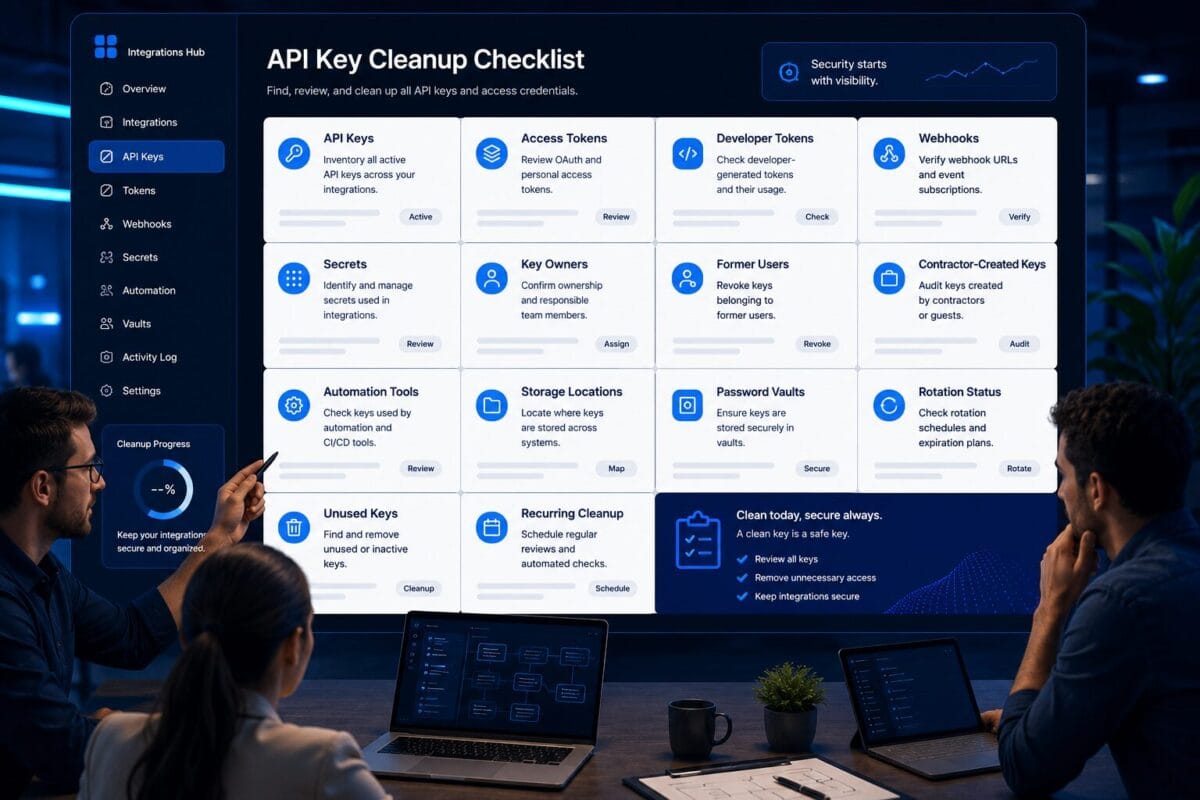
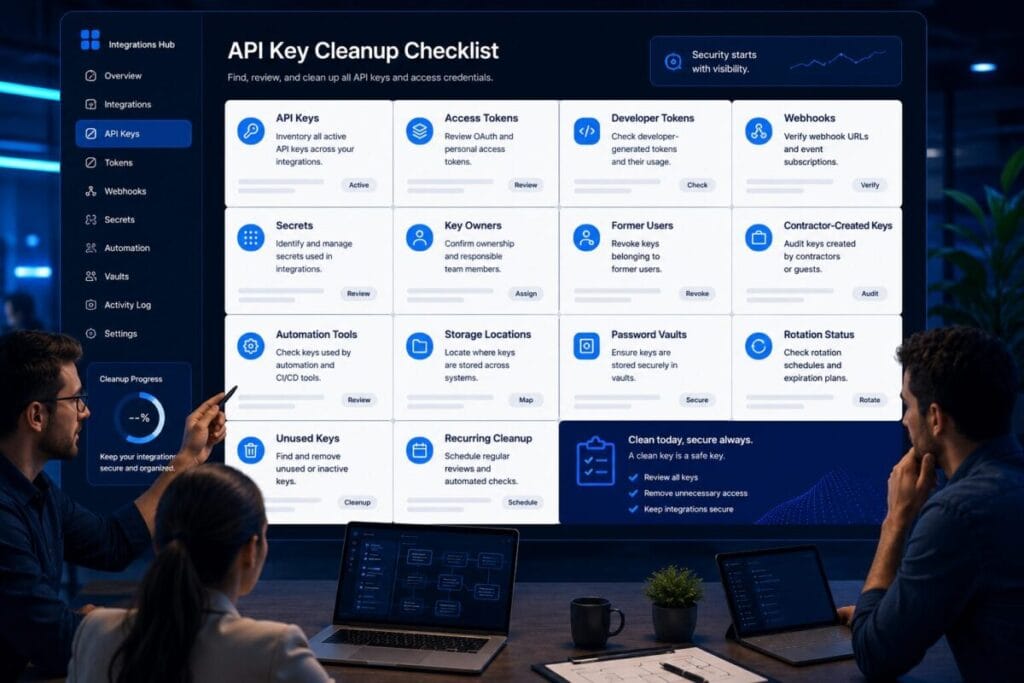
API Key Cleanup Checklist
Quick Navigation ✔
ToggleUse this API key cleanup checklist before creating more integrations, automations, tokens, webhooks, scripts, or technical access paths.
API keys, tokens, webhooks, and secrets can keep access alive after users leave or projects end. A former employee, contractor, agency user, vendor, developer, or consultant may no longer appear in a user list, but a key, token, webhook, or automation credential they created may still be active.
Decision Snapshot
Review key owners, creators, access level, storage location, former-user keys, contractor-created keys, webhooks, tokens, rotation decisions, and unused access.
The goal is not to delete every key. The goal is to know what exists, who owns it, what it can access, whether it is still used, and whether it should be kept, rotated, revoked, or reviewed later.
Review existing keys before creating more integrations, automations, tokens, webhooks, or scripts.
Keys, tokens, secrets, and webhooks can stay active after users leave or projects end.
Check who created each key, who owns it now, where it is stored, and what it can access.
Keep, rotate, revoke, transfer ownership, or schedule follow-up review.
Who Should Use This API Key Cleanup Checklist
This API key cleanup checklist is for small teams, remote teams, lean operators, solo founders, small businesses, agencies, and internal managers that use SaaS tools, automations, integrations, scripts, developer tokens, webhooks, secrets, and password vaults without a recurring cleanup process.
Teams with technical access paths
Use it if your team has API keys, access tokens, developer tokens, webhook URLs, API secrets, automation credentials, or scripts connected to SaaS tools.
Teams with former-user technical access
Use it when former employees, contractors, agencies, vendors, developers, or consultants may have created keys, tokens, webhooks, or automation credentials.
Teams without recurring cleanup
Use it when keys are stored in password vaults, documents, scripts, automation tools, or project notes without a clear owner or review date.
This is not a buying guide. It is not an API security platform article. It is not a vendor roundup. It is a token and secret cleanup asset for small teams that need to understand which API keys, tokens, webhooks, and automation credentials still have access to their SaaS tools and workflows.
The API Key Cleanup Checklist
The purpose of this API key cleanup checklist is to make technical access visible. A normal SaaS access review asks who can log in. A stronger API access review asks what keys exist, who created them, where they are stored, what they can access, and whether they should be kept, rotated, revoked, transferred, or reviewed later.
API Key Cleanup Checklist: List All API Keys and Tokens
API key cleanup checklist inventory items
- [ ] List all API keys and tokens.
- [ ] List access tokens.
- [ ] List developer tokens.
- [ ] List service keys.
- [ ] List webhook credentials.
- [ ] List API secrets.
- [ ] List integration credentials.
- [ ] List automation credentials.
- [ ] List keys used by scripts.
- [ ] List keys used by reporting connectors.
- [ ] List keys used by CRM, finance, analytics, or marketing tools.
- [ ] List keys stored in password managers.
- [ ] List keys stored in internal documents.
- [ ] Mark keys with unknown ownership.
- [ ] Mark keys that have not been reviewed recently.
Why it matters
You cannot clean up API keys that nobody has listed. Small teams often review user accounts and OAuth apps but miss technical credentials that continue running in the background.
What small teams often miss
Small teams often miss old test keys, developer tokens from old projects, webhook URLs, keys stored in docs, keys stored in password vaults, keys used in scripts, keys inside automation tools, and keys nobody wants to remove because nobody knows what they do.
Next action
Create an API key inventory with key or token, tool, creator, owner, access level, storage location, current use, action decision, and review date.
Identify Who Created Each API Key
Checklist items for API key creators and owners
- [ ] Identify who created each API key.
- [ ] Identify who approved each key.
- [ ] Identify who currently owns each key.
- [ ] Identify whether the creator still works with the team.
- [ ] Identify whether the key was created by an employee, contractor, agency, vendor, consultant, or admin.
- [ ] Identify whether the key was created for a temporary project.
- [ ] Identify whether the key was created during migration, setup, testing, or support work.
- [ ] Identify whether the business need still exists.
- [ ] Assign a current internal owner where needed.
- [ ] Mark keys with unknown creators for review.
Why it matters
Creator history helps the team understand why a key exists. A key created by a former employee, old contractor, agency user, or unknown admin may still be needed, but it should not remain active without a current owner and clear business reason.
What small teams often miss
Small teams often treat API keys as invisible plumbing. Someone creates a key during setup, testing, migration, support, reporting, or automation work. The task ends, the person leaves, and the key remains active.
Next action
For every API key, answer: “Who owns this key now?” If nobody owns it, put it into a review, rotation, or removal queue.
Identify What Each Key Can Access
Checklist items for API access level review
- [ ] Identify what each key can access.
- [ ] Identify keys with read access.
- [ ] Identify keys with write access.
- [ ] Identify keys with delete access.
- [ ] Identify keys with export access.
- [ ] Identify keys with admin-level access.
- [ ] Identify keys that can access customer data.
- [ ] Identify keys that can access CRM records.
- [ ] Identify keys that can access billing or finance data.
- [ ] Identify keys that can access analytics or reports.
- [ ] Identify keys that can access internal documentation.
- [ ] Identify keys that can trigger workflows or automations.
- [ ] Identify keys with access broader than the business need.
- [ ] Mark broad-access keys for review.
Why it matters
The key name is not enough. Access level matters more. A key may look like a small technical detail but still allow a script, app, connector, or automation to read, write, export, update, or delete important data.
What small teams often miss
Small teams often assume API keys are low-risk because they are technical. But a key may allow access to customer records, billing data, files, CRM data, reports, automation workflows, user records, internal documentation, project data, analytics exports, or admin-level settings.
Next action
For each key, document the highest-impact access it has. If the access is broader than the business need, review whether the key should be limited, rotated, revoked, or replaced.
Review Keys Created by Former Users
Checklist items for former-user API key cleanup
- [ ] Identify keys created by former employees.
- [ ] Identify keys created by former admins.
- [ ] Identify keys created by former developers.
- [ ] Identify keys created by former contractors.
- [ ] Identify keys created by former agency users.
- [ ] Identify keys created by old vendor support users.
- [ ] Identify keys created during old projects.
- [ ] Identify keys created during migration or setup work.
- [ ] Check whether each key still works after the user left.
- [ ] Check whether each key has a current owner.
- [ ] Remove unused keys.
- [ ] Rotate keys that may still be known by former users.
- [ ] Transfer ownership where the key is still needed.
- [ ] Document the decision to keep, rotate, revoke, or review later.
Why it matters
API keys can outlive the people who created them. A former employee may be removed from the SaaS tool, but the key they created may still be active.
What small teams often miss
Small teams often remove the user but forget the key. They may complete offboarding, transfer files, and still leave behind API keys, tokens, webhooks, scripts, or automation credentials created by the person who left.
Next action
During every offboarding review, ask what API keys, tokens, webhooks, secrets, scripts, or automation credentials the person created or knew.
Review Keys Created by Contractors or Agencies
Checklist items for contractor and agency API key cleanup
- [ ] Identify keys created by contractors.
- [ ] Identify keys created by agencies.
- [ ] Identify keys created by freelancers.
- [ ] Identify keys created by vendors or consultants.
- [ ] Identify whether the external work is still active.
- [ ] Identify whether the key is still needed.
- [ ] Identify whether the key has an internal owner.
- [ ] Identify what data or system the key can access.
- [ ] Identify whether the key is used inside an automation, script, integration, or webhook.
- [ ] Remove keys that are no longer needed.
- [ ] Rotate keys that may be known by external users.
- [ ] Transfer ownership of needed keys to an internal owner.
- [ ] Document the business reason for keeping any contractor-created key.
Why it matters
Contractor and agency-created keys can create long-term technical access paths. If nobody reviews the key after external work ends, it may stay active longer than intended.
What small teams often miss
Small teams often remove contractor user accounts but not contractor-created technical credentials. They may remove the contractor from the workspace while leaving their key, script, webhook, or automation active.
Next action
For every external user offboarding event, review API keys, tokens, webhooks, and automation credentials created by that user or group.
Review Keys Stored in Password Managers, Docs, Scripts, and Automation Tools
Checklist items for API key storage cleanup
- [ ] Review API keys stored in password manager vaults.
- [ ] Review API keys stored in shared folders or collections.
- [ ] Review API keys stored in internal documents.
- [ ] Review API keys stored in spreadsheets.
- [ ] Review API keys stored in scripts.
- [ ] Review API keys stored in automation tools.
- [ ] Review API keys stored in environment files.
- [ ] Review API keys stored in project boards or notes.
- [ ] Review API keys stored in developer handoff documents.
- [ ] Identify who can view each stored key.
- [ ] Identify whether former users still had access to the storage location.
- [ ] Move keys out of weak storage locations where possible.
- [ ] Rotate keys that may have been overexposed.
- [ ] Document the approved storage location for active keys.
Why it matters
Storage location determines who may have seen or copied a key. A key may be active and necessary, but if it was stored in a shared document, old script, broad password vault, or contractor handoff note, the team may need to rotate it or move it to a better-controlled location.
What small teams often miss
Small teams often review whether a key is active but not where it lives. A key may exist in a shared document, spreadsheet, script, password vault, project board, automation tool, old handoff note, environment file, contractor workspace, or developer machine backup.
Next action
For every active key, document the approved storage location. If the key was stored somewhere too broadly accessible, decide whether to rotate it.
Review Webhooks and Developer Tokens
Checklist items for webhooks and developer tokens
- [ ] List webhook URLs.
- [ ] List developer tokens.
- [ ] List callback URLs.
- [ ] List service tokens.
- [ ] List integration tokens.
- [ ] Identify who created each webhook or token.
- [ ] Identify what data each webhook sends or receives.
- [ ] Identify whether each webhook is still used.
- [ ] Identify whether each webhook has a current owner.
- [ ] Identify whether the webhook connects to an old tool or project.
- [ ] Remove unused webhooks.
- [ ] Rotate or replace developer tokens where needed.
- [ ] Document active webhooks and token owners.
Why it matters
Not all technical access looks like an API key. Webhooks, developer tokens, service tokens, and callback URLs can move data between tools or trigger workflows.
What small teams often miss
Small teams often miss webhooks because they do not appear in the same place as user accounts or connected apps. A webhook can continue sending or receiving data even after the person who created it leaves.
Next action
Create a webhook and token register with webhook or token, tool, creator, owner, data flow, current use, action decision, and review date.
Remove Unused or Unknown API Keys
Checklist items for unused API key cleanup
- [ ] Remove unused API keys.
- [ ] Remove keys with no owner.
- [ ] Remove keys with unknown business need.
- [ ] Remove duplicate keys.
- [ ] Remove test keys from old projects.
- [ ] Remove keys created by former users if no longer needed.
- [ ] Remove keys created by former contractors if no longer needed.
- [ ] Remove keys tied to inactive integrations.
- [ ] Remove keys tied to abandoned automations.
- [ ] Remove keys with broad access and unclear purpose.
- [ ] Revoke unused tokens.
- [ ] Remove inactive webhooks.
- [ ] Document what was removed and when.
Why it matters
The goal is not to remove every key. Useful keys can stay. The problem is unused, unknown, ownerless, duplicate, or over-permissioned technical access.
What small teams often miss
Small teams often keep unknown keys because they are afraid of breaking something. That caution is understandable, but unknown keys should not stay unknown forever.
Next action
Sort every key into one of five decisions: keep, rotate, transfer owner, revoke, or review later.
Rotate Keys That May Be Exposed or Ownerless
Checklist items for API key rotation decisions
- [ ] Rotate keys that may be known by former users.
- [ ] Rotate keys that may be known by contractors or agencies.
- [ ] Rotate keys stored in overly broad password vaults.
- [ ] Rotate keys stored in shared documents.
- [ ] Rotate keys stored in old scripts or notes.
- [ ] Rotate keys copied during migration or support work.
- [ ] Rotate keys with unclear storage history.
- [ ] Rotate keys with broad access that still need to remain active.
- [ ] Rotate keys after ownership transfer where appropriate.
- [ ] Confirm dependent workflows still work after rotation.
- [ ] Document the rotation date and new owner.
Why it matters
Sometimes a key should not be deleted immediately because it supports an active workflow. In those cases, rotation may be safer than simple removal.
What small teams often miss
Small teams often think the choice is only keep or delete. There is a third option: rotate.
Next action
For every active but questionable key, decide whether it can be revoked immediately or should be rotated first. Do not rotate without checking dependent workflows.
Assign Owners to Active Keys
Checklist items for active API key ownership
- [ ] Assign an owner to every active API key.
- [ ] Assign a backup owner for critical keys.
- [ ] Confirm the owner understands what the key does.
- [ ] Confirm the owner understands what the key can access.
- [ ] Confirm the owner knows where the key is stored.
- [ ] Confirm the owner can rotate or revoke the key if needed.
- [ ] Assign an internal owner for contractor-created keys.
- [ ] Assign an internal owner for agency-created keys.
- [ ] Assign an internal owner for automation keys.
- [ ] Document the next review date.
Why it matters
Active keys need accountability. A key can be useful and still create exposure if nobody owns it.
What small teams often miss
Small teams often treat API keys as belonging to the tool, not to a person or process. Every active key should have a responsible owner who understands its purpose, access level, storage location, and cleanup path.
Next action
No active key should remain approved without an owner and review date. If a key is important enough to keep, it is important enough to own.
Document Business Need and Review Date
Checklist items for API key documentation
- [ ] Document the business need for each active key.
- [ ] Document the key owner.
- [ ] Document the key creator if known.
- [ ] Document the connected tool.
- [ ] Document the access level.
- [ ] Document the data or system the key can access.
- [ ] Document the storage location.
- [ ] Document whether the key was created by a former user.
- [ ] Document whether the key was created by a contractor or agency.
- [ ] Document the decision: keep, rotate, revoke, transfer, or review later.
- [ ] Document the next review date.
Why it matters
Documentation prevents API keys from becoming permanent mysteries. A key that looks confusing today will look more confusing six months from now if nobody documents why it exists, who owns it, what it can access, and when it should be reviewed.
What small teams often miss
Small teams often review a key once but do not record the decision. That means the same key becomes a mystery again during the next cleanup.
Next action
For every active key, write: “This key exists for ____; owner is ____; access level is ____; storage location is ____; next review date is ____.”
Set a Recurring API Key Cleanup Cadence
Checklist items for recurring API key cleanup
- [ ] Set a recurring API key cleanup cadence.
- [ ] Review API keys monthly or quarterly for critical SaaS tools.
- [ ] Review keys after employee offboarding.
- [ ] Review keys after contractor or agency offboarding.
- [ ] Review keys before creating more integrations.
- [ ] Review keys before major SaaS migrations.
- [ ] Review keys after role changes.
- [ ] Review keys after billing or workspace ownership changes.
- [ ] Review keys before connecting new automation tools.
- [ ] Review webhooks and tokens on the same cadence.
- [ ] Document removals, rotations, transfers, and continued approvals.
- [ ] Schedule the next cleanup before closing the current one.
Why it matters
API key exposure changes over time. New keys are created, users leave, contractors create scripts, agencies build reporting workflows, automations get added, tokens expire or stay active, and webhooks continue sending data.
What small teams often miss
Small teams often review API keys only after something breaks or during a rushed offboarding event. A lighter recurring review is easier than a large emergency cleanup later.
Next action
Set a recurring cleanup schedule for critical SaaS tools. For many small teams, monthly or quarterly cleanup is enough.
API Key Exposure Score
Use this score to decide whether API key exposure is controlled or needs cleanup. A low score does not mean every API key is dangerous. It means technical access is not clear enough yet.
0 = Not reviewed
The area has not been reviewed, ownership is unclear, or technical access is unknown.
1 = Partially controlled
The area has been reviewed, but gaps, exceptions, ownerless keys, or unclear storage locations remain.
2 = Reviewed / controlled
The area is reviewed, documented, owned, and controlled enough for current operations.
Score: 0 / 1 / 2
Score: 0 / 1 / 2
Score: 0 / 1 / 2
Score: 0 / 1 / 2
Score: 0 / 1 / 2
Score: 0 / 1 / 2
Score: 0 / 1 / 2
Score: 0 / 1 / 2
Score: 0 / 1 / 2
Score: 0 / 1 / 2
16–20
API key exposure is controlled. Keys, owners, access levels, storage locations, webhooks, tokens, and recurring cleanup are clear enough for current operations.
9–15
API key exposure needs cleanup. Some review work is done, but gaps remain before creating more keys.
0–8
High API key exposure; review before creating more keys. Pause new technical access paths until basic visibility and ownership are reviewed.
When API Key Access Is High Risk
API key access is higher risk when a key has broad permissions, no owner, unknown business need, unclear storage history, or access tied to former users or external collaborators.
High-risk does not always mean the key should be deleted immediately. It means the key should not remain unreviewed.
What to Remove Before Creating More API Keys
Before creating more API keys, tokens, webhooks, automations, or technical access paths, review what should be removed first.
Do not create more technical access inside an unclear environment. First identify what exists, what it can access, who owns it, where it is stored, and whether it should stay.
Former Employee API Key Cleanup Checklist
Use this section when an employee leaves, changes roles, or no longer owns technical access.
- [ ] List API keys created by the former employee.
- [ ] List access tokens created by the former employee.
- [ ] List developer tokens created by the former employee.
- [ ] List webhooks created by the former employee.
- [ ] List API secrets known to the former employee.
- [ ] List automation credentials created by the former employee.
- [ ] List scripts that use keys created by the former employee.
- [ ] List reporting connectors owned by the former employee.
- [ ] Review what each key or token can access.
- [ ] Confirm whether each key is still needed.
- [ ] Transfer ownership of needed keys.
- [ ] Revoke unused keys.
- [ ] Revoke unused tokens.
- [ ] Rotate keys or secrets if needed.
- [ ] Replace personal credentials inside active workflows.
- [ ] Document the new owner and review date.
- [ ] Schedule a follow-up technical access review.
Former employee key cleanup should be part of SaaS offboarding. Removing the user account is not always enough if the person created API keys, tokens, webhooks, scripts, secrets, or automation credentials.
Contractor and Agency API Key Cleanup Checklist
Use this section when a contractor, freelancer, agency user, vendor, consultant, or external collaborator created keys, tokens, scripts, webhooks, or automation credentials.
- [ ] List API keys created by the contractor or agency.
- [ ] List developer tokens created for the project.
- [ ] List webhooks created by the external user.
- [ ] List automation credentials created by the external user.
- [ ] List scripts or connectors created for the project.
- [ ] List API secrets shared with the external user.
- [ ] Confirm whether the project is still active.
- [ ] Confirm whether each key is still needed.
- [ ] Confirm whether each key has an internal owner.
- [ ] Confirm what each key can access.
- [ ] Remove keys that are no longer needed.
- [ ] Transfer ownership of needed keys.
- [ ] Revoke unused tokens or webhooks.
- [ ] Rotate keys that may still be known by the external user.
- [ ] Replace contractor credentials inside active workflows.
- [ ] Review other keys created by the same agency or vendor.
- [ ] Document the removal, rotation, or transfer decision.
- [ ] Schedule a follow-up review.
Contractor and agency-created keys should be reviewed even when the user account has already been removed. The technical access path may remain after the person leaves.
Service Categories Mentioned in This Checklist
This section is not a ranking and not a vendor list. These are service categories that may appear during a practical API key cleanup and technical access review.
Password Managers
Examples only: 1Password, Bitwarden.
This category appears because API secrets, shared credentials, recovery credentials, developer tokens, and admin passwords may be stored inside password manager vaults.
ZTNA / Zero Trust Access Platforms
Examples only: Cloudflare Zero Trust, Twingate.
This category may appear when some API admin workflows, private apps, or app-level access paths are controlled through identity-aware policies or app-level access rules.
Business VPN / Managed VPN Platforms
Example only: NordLayer.
This category may appear when scripts, admin workflows, private apps, or internal tools still depend on controlled remote or private access.
Hardware Security Keys
Example only: YubiKey.
This category may appear when API key creation, admin access, or high-risk technical access ownership depends on stronger MFA.
SaaS Access Review / API Ownership Workflow
No vendor pitch needed now.
This category appears because API key cleanup is often an ownership and recurring review problem.
Offboarding / API Key Cleanup Workflow
No vendor pitch needed now.
This category appears because former users, contractors, agencies, and old vendors may leave API keys, tokens, webhooks, scripts, and automation credentials behind.
Where This Fits Inside ToolRelief
This asset is part of ToolRelief’s External Service Demand Engine. It supports users who need to review API keys, tokens, webhooks, secrets, scripts, automation credentials, and leftover technical access.
Connected app review
SaaS offboarding
SaaS admin exposure
Contractor access review
Broader remote access cleanup
App-level access readiness
VPN replacement review
Model comparison
Replacement paths
Current VPN review
Security routing
Software trend monitoring
Device context
Parent decision system
Review API Keys Before Creating More Technical Access Paths
Use ToolRelief’s OAuth App Review Checklist and SaaS Admin Offboarding Checklist to decide which API keys, tokens, webhooks, secrets, and automation credentials should be removed, rotated, owned, reviewed, or kept.