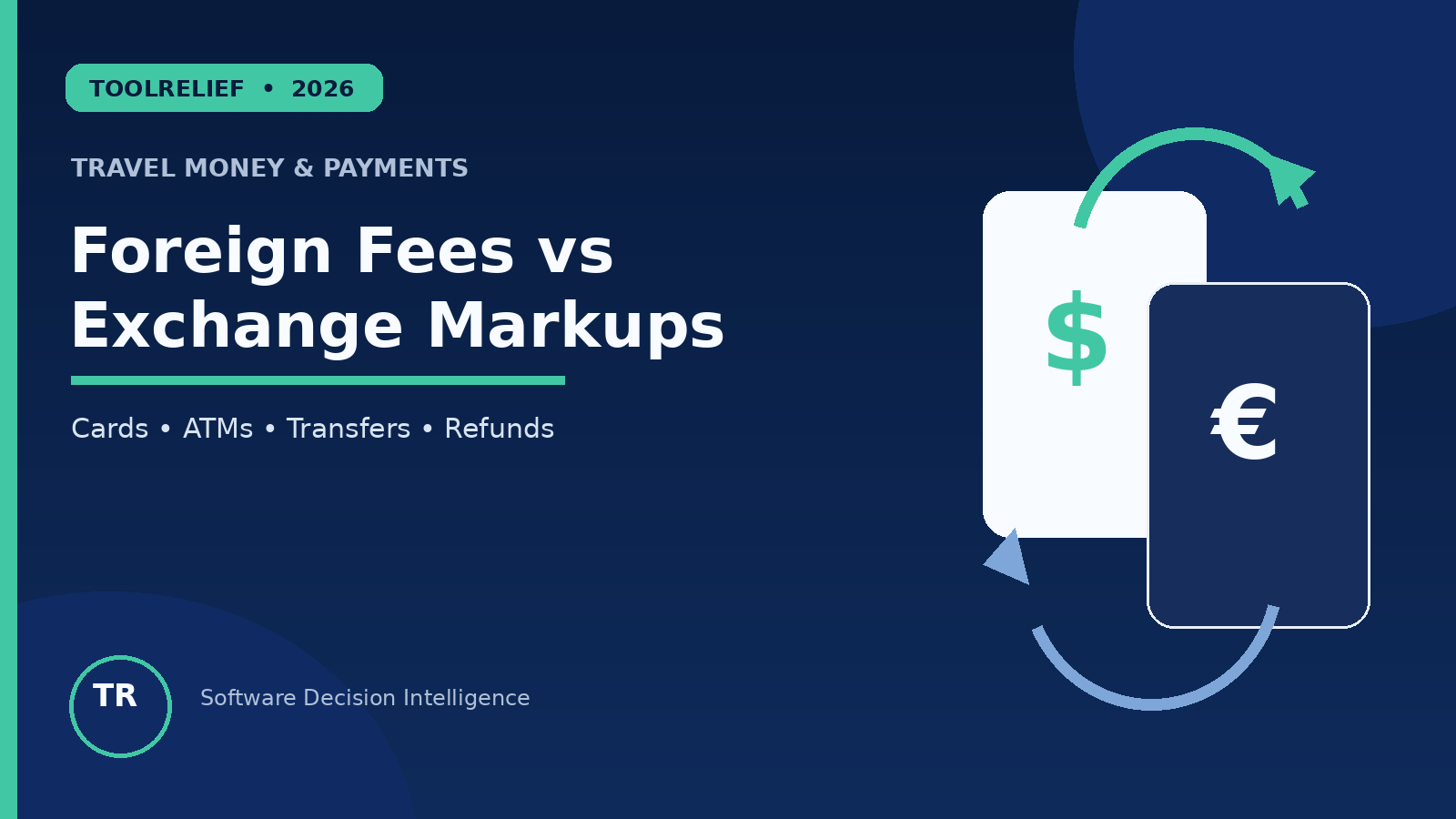
Foreign transaction fees and exchange rate markups are different costs, and either can make an international payment expensive. Travelers should compare the final amount charged or delivered—not rely on a “no fee” claim that may exclude the exchange-rate margin, ATM charge, card funding fee, or receiving-bank deduction.
Foreign transaction fee
A foreign transaction fee is a charge applied under the card or account agreement to certain cross-border, foreign-merchant, or foreign-currency transactions. The exact trigger and percentage depend on the issuer and product. A purchase can sometimes be treated as international even when the traveler pays in a familiar currency, depending on how the merchant and issuer process it.
Check the card agreement and pricing disclosure. Do not assume a rewards card, premium card, debit card, or digital wallet automatically removes the fee.
Exchange rate markup
An exchange rate markup is the difference between a reference market or network rate and the rate used for the transaction. A provider can advertise no transfer fee while earning revenue through the exchange rate. The practical measure is how much source currency leaves the account and how much destination currency reaches the recipient or merchant.
The pay in local currency vs home currency choice separates issuer conversion from dynamic currency conversion and its markup.
Compare quotes at the same time because market rates move. Use the same amount, funding method, and payout route.
Dynamic currency conversion
Dynamic currency conversion occurs when a merchant or ATM offers to convert the transaction into the cardholder’s home currency. The offered rate and fees are controlled by the conversion arrangement, not necessarily the card issuer. Paying in home currency can feel clearer but may produce a worse conversion than paying in local currency.
Read the screen carefully, keep the receipt, and confirm the selected currency before authorizing. A card’s foreign transaction fee may still apply depending on the agreement and transaction processing.
ATM and cash costs
- ATM operator fee.
- Issuer out-of-network or international ATM fee.
- Cash-advance classification and interest for some credit-card withdrawals.
- Exchange-rate margin or dynamic currency conversion.
- Daily limits and multiple-withdrawal costs.
Review the total cash cost and use trusted ATMs. Keep a separate backup payment route rather than relying on one card or wallet.
Money transfer costs
For international transfers, record the upfront fee, exchange rate, card or bank funding charge, receiving deductions, taxes where applicable, delivery time, and final recipient amount. Some protections and disclosures depend on the route, provider, account, and jurisdiction.
Use the Travel Payment, Money Transfer and Card Tools hub to compare eligible routes. ToolRelief may earn a commission from approved provider links.
A simple comparison worksheet
| Field | Card purchase | ATM | Money transfer |
|---|---|---|---|
| Source amount | Statement amount | Account debit | Amount paid |
| Destination amount | Merchant local amount | Cash received | Recipient receives |
| Visible fees | Issuer or merchant charges | Operator and issuer fees | Transfer and funding fees |
| Rate used | Network, issuer, or DCC rate | ATM conversion route | Provider quote |
| Other risk | Deposit hold or refund conversion | Cash-advance treatment | Receiving deduction or delay |
Compare the final outcome, support options, eligibility, and error procedures—not cost alone.
Travel payment controls
- Check issuer and provider terms before departure.
- Enable transaction alerts and know how to freeze the account.
- Carry a second lawful payment method separately.
- Do not keep the full travel budget in one prepaid or wallet account.
- Save receipts, quotes, and transaction references.
- Verify recipient details through a separate trusted channel before sending money.
Related ToolRelief guides: booking without a credit card, virtual cards, and prepaid travel cards.
Calculate the effective cost with one worked method
Use the same base amount and compare what leaves the payer’s account or what reaches the recipient. For a card purchase, record the merchant amount in local currency, the network or issuer conversion amount, the foreign transaction fee, and any merchant conversion charge. For a transfer, record the amount funded, all fees, the quoted exchange rate, and the final amount delivered.
Effective cost percentage can be estimated as the difference between a neutral reference conversion and the final charged or delivered value, divided by the neutral reference value. The reference is only a comparison benchmark; the rate actually available to a consumer can differ by network, provider, time, funding method, and payout route.
Account for deposits, refunds, and delayed conversion
Hotels, rental companies, and some transport providers may place a deposit or authorization hold. The hold can reduce available credit even when it is not a completed charge. A later refund may be converted at a different rate from the original purchase, creating a gain or loss even when the merchant refunds the full local-currency amount.
Before relying on one payment method, verify deposit acceptance, physical-card requirements, refund timing, cash-advance treatment, offline terminal support, and who handles disputes. Keep a separate backup payment method and enough available credit for overlapping holds.
Frequently asked questions
Is a no-foreign-transaction-fee card always cheapest?
No. The exchange rate, annual fee, ATM charges, merchant conversion, rewards value, and account terms can change the total cost.
Should travelers choose local currency or home currency?
Review the offered conversion and card terms. Merchant or ATM conversion into home currency may use a different rate and fee structure than local-currency processing.
How should money-transfer providers be compared?
Use the same amount, currencies, time, funding method, and payout route; compare the final amount received and all disclosed charges.
Can a virtual card replace a physical card?
Not reliably for every hotel, rental desk, deposit, offline terminal, or identity check. Verify merchant requirements and carry a suitable backup.
Compare the complete payment route—not one advertised fee
Review cards, transfers, virtual payment options, prepaid tools, deposit requirements, and backup methods before departure.
Sources and verification
Reviewed July 29, 2026. Requirements, prices, product availability, and legal protections can change. Verify current terms with the official provider or authority before acting.
Last Updated on July 30, 2026