Last verified: 2026-08-01
TOOLRELIEF DECISION INTELLIGENCE
- Decision
- Use Debit Card vs Credit Card for Travel Bookings to compare the documented alternatives and understand the costs, constraints, and trade-offs that materially affect the choice.
- Evidence Basis
- Comparative analysis of the capabilities, costs, constraints, limitations, and trade-offs documented for the options evaluated on this page.
- Best Used For
- Shortlisting alternatives and identifying the trade-offs that materially affect the final choice.
- Decision Boundary
- Travel availability, fares, schedules, entry rules, eligibility, and provider terms can change. Verify time-sensitive details with the relevant official or provider source before acting.
debit card vs credit card for travel is the decision this guide resolves. Travel bookings can create large preauthorizations, deposits, delayed refunds, and cross-border disputes. A debit card draws against available bank funds. A credit card uses a credit line and can preserve cash flow, but fees, limits, interest, and benefit rules still matter.
For hotels, rental cars, and high-value reservations, a suitable credit card often protects available cash from holds. Use debit when the provider accepts it, the hold is understood, and the account can absorb the temporary reduction safely.
debit card vs credit card for travel — the short decision
For hotels, rental cars, and high-value reservations, a suitable credit card often protects available cash from holds. Use debit when the provider accepts it, the hold is understood, and the account can absorb the temporary reduction safely.
Affiliate disclosure: ToolRelief is an independent publisher, not the seller or service provider. Some links may be affiliate links, which can earn ToolRelief a commission without changing your price. We evaluate the decision factors, limits, and evidence before presenting a commercial action.
Compare Travel Payment Options
Model authorization holds before choosing a card
Hotels and rental companies can place a temporary hold above the expected charge for incidentals or security. On a debit card, that can reduce the funds available for other trip expenses.
Ask the provider for the estimated amount, release timing, and whether the final charge replaces the hold. Keep a cash-flow buffer until the hold disappears.
Compare fraud and error procedures
U.S. debit-card protections and reporting deadlines operate under electronic transfer rules, while credit-card billing errors use a different process. Prompt notice is important in both cases.
The practical control is to monitor transactions, keep receipts, lock a lost card, and contact the issuer immediately. Do not assume all card products or countries apply identical procedures.
Check acceptance and booking conditions
Some providers accept debit only with additional identification, a return itinerary, a higher deposit, or a credit check. Others require a credit card for incidentals even if the stay or rental was prepaid.
Read the location-specific policy, not only the brand’s general page. Airport and local rental locations can differ.
Value benefits only when they activate
Credit cards may include travel protections, rewards, or purchase benefits, but coverage can require charging all or part of the trip to the card and meeting policy conditions.
A benefit is not a substitute for reading the guide. Compare limits, covered travelers, exclusions, claim documents, and whether separate insurance is still needed.
Carry a resilient payment plan
Use cards from more than one network or issuer when practical, separate the backup card, and keep issuer contact details. Ensure limits and travel controls support the expected purchases.
Avoid using a card with a low available balance for a large hotel or vehicle hold. For debit, keep essential bill money in a separate account when possible.
Travel card decision factors
| Factor | Debit card | Credit card |
|---|---|---|
| Authorization hold | Reduces available bank funds | Reduces available credit |
| Cash flow | Payment leaves the account quickly | Payment follows billing cycle; interest may apply |
| Acceptance | May face provider restrictions | Often preferred for hotels and rental cars |
| Unauthorized transactions | Electronic transfer reporting procedures | Credit billing and unauthorized-charge procedures |
| Travel benefits | Varies by account | May include benefits subject to activation and exclusions |
| Budget control | Direct account impact | Requires disciplined repayment |
A practical example
A hotel expects a $400 incidental hold. Using debit would leave too little available cash for the rest of the trip. A credit card with sufficient available credit keeps bank funds accessible. The traveler still verifies the hold, pays the statement in full, and keeps a debit card as backup.
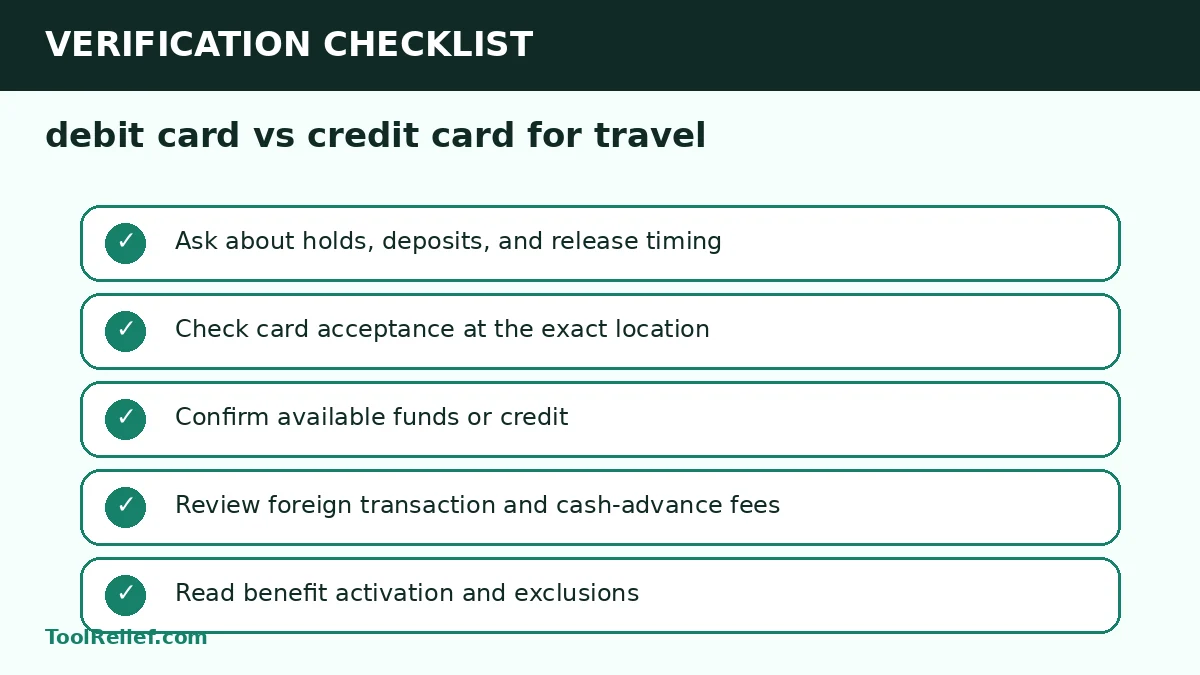
Pre-purchase checklist
- Ask about holds, deposits, and release timing
- Check card acceptance at the exact location
- Confirm available funds or credit
- Review foreign transaction and cash-advance fees
- Read benefit activation and exclusions
- Enable alerts and keep receipts
- Carry a separate backup payment method
- Report errors or unauthorized charges promptly
Use a minimum evidence standard
A strong debit card vs credit card for travel decision uses three levels of evidence. First, confirm the provider or seller statement that governs the transaction. Second, verify the operational detail at the exact checkout, account, property, location, or policy level. Third, preserve independent evidence such as the receipt, confirmation, screenshot, or issuer record. A general marketing page cannot replace transaction-specific terms.
When two options remain close, prefer the one with clearer ownership and reversibility. Clear ownership means the buyer knows who can change, support, cancel, refund, or correct the transaction. Reversibility means the financial and operational cost of a mistake is limited. This standard prevents a small displayed saving from transferring a much larger unresolved risk to the buyer.
Document the decision before checkout
Create a compact decision record for debit card vs credit card for travel. Save the date, selected option, final price, applicable terms, seller or provider, cancellation or refund deadline, and the evidence that supports the choice. A record is especially important when a promotion, currency, policy, or inventory condition can change after the transaction.
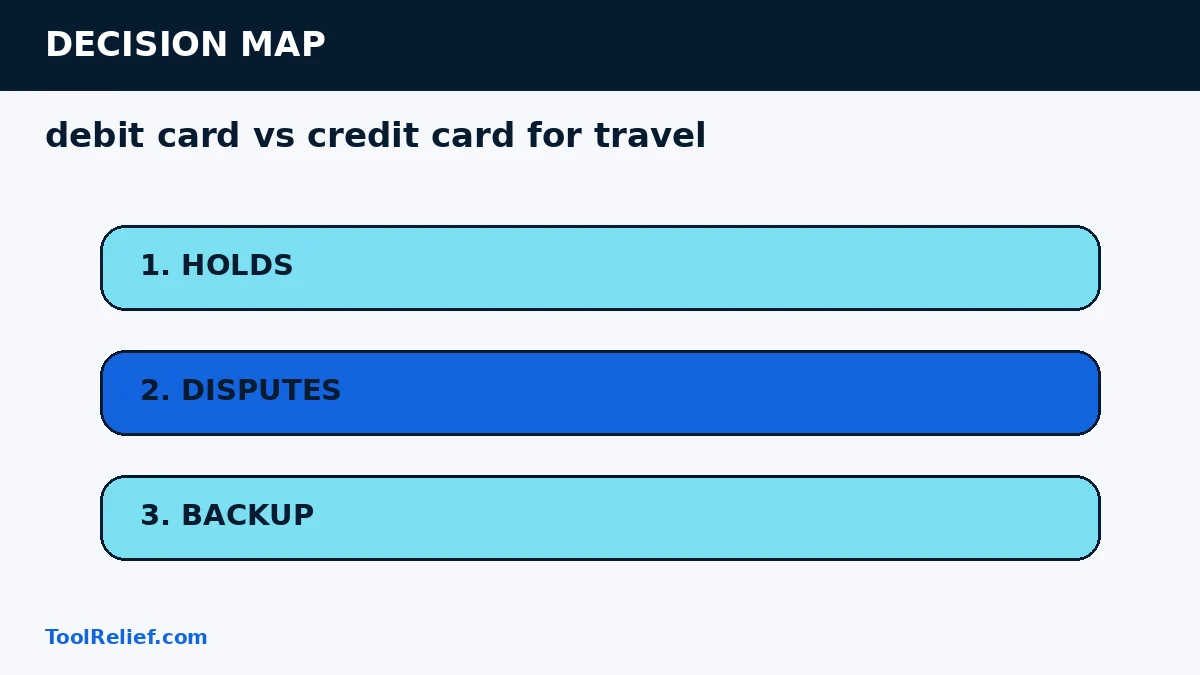
Reject the option when any critical condition remains unverified: holds, disputes, or backup. The goal is not to eliminate every uncertainty; it is to identify which party owns the risk and whether the expected value justifies accepting it.
Review the decision after the transaction
After purchase or booking, compare the confirmation with the decision record. Verify the charged amount, product or service configuration, dates, names, currency, renewal or cancellation settings, and support contact. Correct a mismatch immediately while the checkout evidence is fresh and any cancellation or refund window remains open.
Schedule a later review when the obligation continues. For software, review renewal, usage, seats, and update rights. For travel, review schedule changes, payment status, deadlines, and policy updates. This closes the loop: the debit card vs credit card for travel decision is not complete until the delivered transaction matches what was approved.
Related ToolRelief decision guides
Frequently asked questions
Can a hotel place a hold on a debit card?
Yes. The hold can reduce available bank funds until the provider and bank release it.
Is a credit card required for every rental car?
No, but acceptance and deposit rules vary by company and location and can be stricter for debit.
Do credit-card travel benefits apply automatically?
Not always. Coverage can require eligible purchases and compliance with detailed terms.
Sources and verification
Decision: Recheck the current price, terms, eligibility, and provider responsibilities at the final checkout. The debit card vs credit card for travel framework is designed to make the commercial decision auditable rather than automatic.
Last Updated on August 1, 2026