
Last verified: 2026-08-01
TOOLRELIEF DECISION INTELLIGENCE
- Decision
- Use Refundable vs Non-Refundable Travel Bookings: When Flexibility Is Worth More to compare the documented alternatives and understand the costs, constraints, and trade-offs that materially affect the choice.
- Evidence Basis
- Comparative analysis of the capabilities, costs, constraints, limitations, and trade-offs documented for the options evaluated on this page.
- Best Used For
- Shortlisting alternatives and identifying the trade-offs that materially affect the final choice.
- Decision Boundary
- Travel availability, fares, schedules, entry rules, eligibility, and provider terms can change. Verify time-sensitive details with the relevant official or provider source before acting.
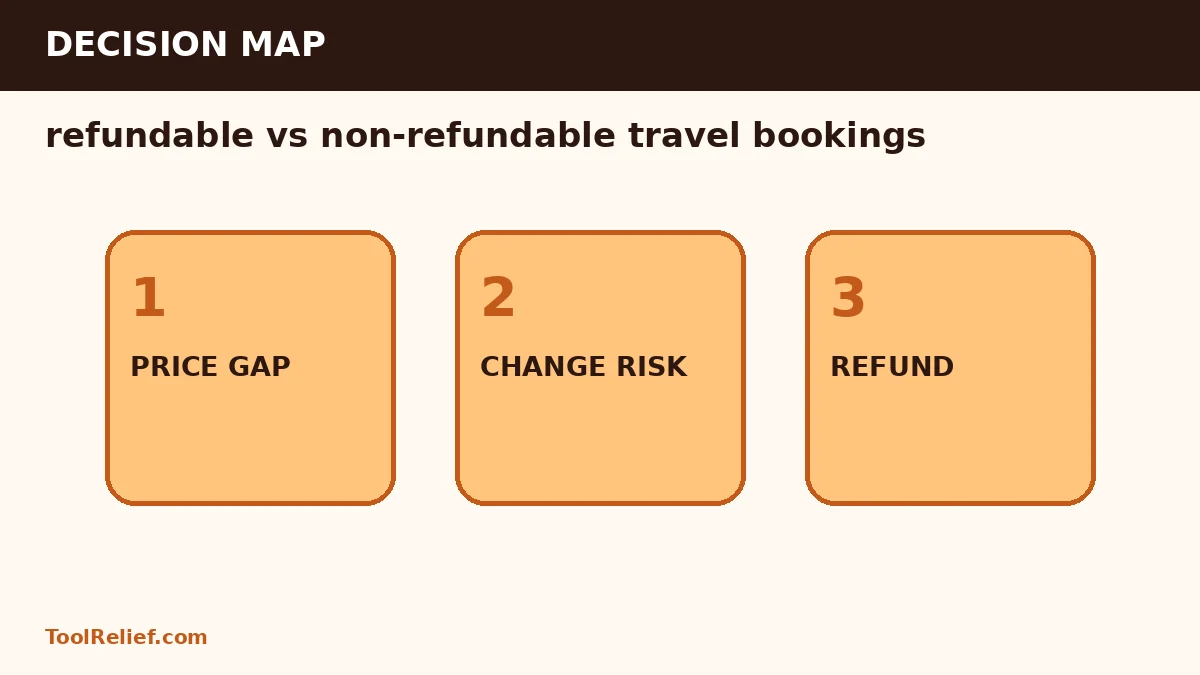
refundable vs non-refundable travel bookings is the decision this guide resolves. A refundable booking is not automatically safer, and a non-refundable rate is not automatically cheaper. The decision depends on the price gap, the probability and cost of change, the exact deadline, refund speed, and whether insurance covers the reason that concerns you.
Pay for flexibility when the expected cost of change plus cash-flow risk exceeds the price premium, or when a critical trip variable remains unresolved.
refundable vs non-refundable travel bookings — the short decision
Pay for flexibility when the expected cost of change plus cash-flow risk exceeds the price premium, or when a critical trip variable remains unresolved.
Affiliate disclosure: ToolRelief is an independent publisher, not the seller or service provider. Some links may be affiliate links, which can earn ToolRelief a commission without changing your price. We evaluate the decision factors, limits, and evidence before presenting a commercial action.
Compare Flexible Hotel Options
Define what “refundable” actually means
Refundable can mean free cancellation before a specific local deadline, partial refund, credit only, or refund excluding taxes and fees. Changes may follow different rules from cancellation.
Record the deadline in the property or provider's local time and confirm whether the payment has already been collected.
Calculate the flexibility premium
Subtract the non-refundable total from the refundable total for the same product and conditions. That difference is the price of the option to cancel or change.
Compare the premium with the amount at risk, not the full trip budget. A $40 premium protecting a $600 room can be rational; a $300 premium protecting one low-risk night may not be.
Estimate the probability and reason for change
Consider visa uncertainty, work approval, health, weather sensitivity, event confirmation, dependent travelers, and route dependencies. Use a realistic probability rather than general anxiety.
Then check whether the feared reason is covered by insurance. Standard cancellation coverage usually requires a covered reason; personal preference may not qualify.
Account for refund timing and cash flow
A policy can approve cancellation while the refund still takes days or weeks. The traveler may need funds to rebook before the original payment returns.
Credit vouchers reduce immediate loss but can create expiration, route, or provider lock-in. Value a credit below cash unless you have a clear future use.
Use mixed flexibility across the itinerary
Not every segment needs the same risk level. Keep uncertain dates flexible and use non-refundable pricing for stable, replaceable components.
A mixed strategy often costs less than making the entire trip refundable while preserving flexibility at the points that control the route.
Flexibility decision model
| Factor | Favors refundable | Favors non-refundable |
|---|---|---|
| Price gap | Small relative to amount at risk | Large premium for a stable booking |
| Change probability | Unresolved visa, leave, health, or event | Dates and travelers are confirmed |
| Route dependency | Booking controls several later reservations | Component is replaceable and independent |
| Refund form | Cash with clear timeline | Credit only or slow uncertain process |
| Insurance | Reason is not covered or policy not purchased | Covered reason and limits are sufficient |
A practical example
A traveler is waiting for work approval and considers a five-night hotel. The flexible rate costs $55 more and protects $700 until three days before arrival. The approval uncertainty is material, so the option value is stronger than saving $55. Later, once approval arrives, the remaining stable components can use stricter rates.
Pre-purchase checklist
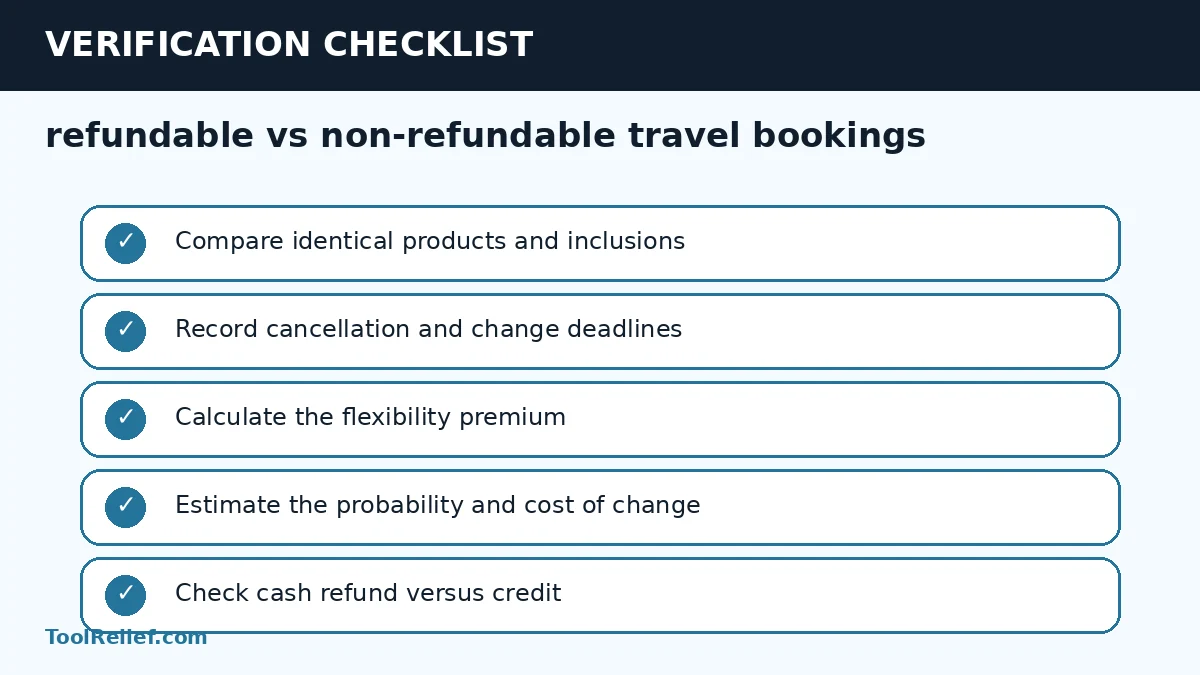
- Compare identical products and inclusions
- Record cancellation and change deadlines
- Calculate the flexibility premium
- Estimate the probability and cost of change
- Check cash refund versus credit
- Review insurance covered reasons
- Protect the itinerary anchors first
- Save the rate terms at purchase
Use a minimum evidence standard
A strong refundable vs non-refundable travel bookings decision uses three levels of evidence. First, confirm the provider or seller statement that governs the transaction. Second, verify the operational detail at the exact checkout, account, property, location, or policy level. Third, preserve independent evidence such as the receipt, confirmation, screenshot, or issuer record. A general marketing page cannot replace transaction-specific terms.
When two options remain close, prefer the one with clearer ownership and reversibility. Clear ownership means the buyer knows who can change, support, cancel, refund, or correct the transaction. Reversibility means the financial and operational cost of a mistake is limited. This standard prevents a small displayed saving from transferring a much larger unresolved risk to the buyer.
Document the decision before checkout
Create a compact decision record for refundable vs non-refundable travel bookings. Save the date, selected option, final price, applicable terms, seller or provider, cancellation or refund deadline, and the evidence that supports the choice. A record is especially important when a promotion, currency, policy, or inventory condition can change after the transaction.
Reject the option when any critical condition remains unverified: price gap, change risk, or refund. The goal is not to eliminate every uncertainty; it is to identify which party owns the risk and whether the expected value justifies accepting it.
Review the decision after the transaction
After purchase or booking, compare the confirmation with the decision record. Verify the charged amount, product or service configuration, dates, names, currency, renewal or cancellation settings, and support contact. Correct a mismatch immediately while the checkout evidence is fresh and any cancellation or refund window remains open.
Schedule a later review when the obligation continues. For software, review renewal, usage, seats, and update rights. For travel, review schedule changes, payment status, deadlines, and policy updates. This closes the loop: the refundable vs non-refundable travel bookings decision is not complete until the delivered transaction matches what was approved.
Related ToolRelief decision guides
Frequently asked questions
Does refundable always mean fully refundable?
No. Check the deadline, refund form, fees, taxes, and whether changes follow separate terms.
How can the refundable rate premium be evaluated?
Compare the price difference with the amount at risk, the probability of change, and the cost of rebooking.
Can travel insurance replace a refundable rate?
Not completely. Standard policies generally require covered reasons and have exclusions and limits.
Sources and verification
Decision: Recheck the current price, terms, eligibility, and provider responsibilities at the final checkout. The refundable vs non-refundable travel bookings framework is designed to make the commercial decision auditable rather than automatic.
Last Updated on August 1, 2026