Last verified: 2026-08-01
TOOLRELIEF DECISION INTELLIGENCE
- Decision
- Use Pay in Local Currency vs Home Currency Abroad: Avoid Dynamic Currency Conversion to compare the documented alternatives and understand the costs, constraints, and trade-offs that materially affect the choice.
- Evidence Basis
- Comparative analysis of the capabilities, costs, constraints, limitations, and trade-offs documented for the options evaluated on this page.
- Best Used For
- Shortlisting alternatives and identifying the trade-offs that materially affect the final choice.
- Decision Boundary
- Travel availability, fares, schedules, entry rules, eligibility, and provider terms can change. Verify time-sensitive details with the relevant official or provider source before acting.
pay in local currency vs home currency is the decision this guide resolves. When a terminal or checkout offers your home currency, it is usually presenting dynamic currency conversion. The convenience of recognizing the amount can include a merchant or service-provider exchange rate and markup. Paying in local currency generally leaves conversion to the card network and issuer.
Review both options and your card terms, but in most ordinary card purchases the safer default is to decline dynamic currency conversion and choose the local transaction currency.
pay in local currency vs home currency — the short decision
Review both options and your card terms, but in most ordinary card purchases the safer default is to decline dynamic currency conversion and choose the local transaction currency.
Affiliate disclosure: ToolRelief is an independent publisher, not the seller or service provider. Some links may be affiliate links, which can earn ToolRelief a commission without changing your price. We evaluate the decision factors, limits, and evidence before presenting a commercial action.
Review Travel Payment Decision Tools
Recognize a DCC offer
DCC displays the price in the cardholder’s home or billing currency and should show the exchange rate and any markup or fees. It can appear at shops, hotels, online checkouts, and ATMs.
The local-currency option is the currency of the merchant or withdrawal. Do not confuse the terminal language or card billing currency with the transaction currency.
Compare the two conversion paths
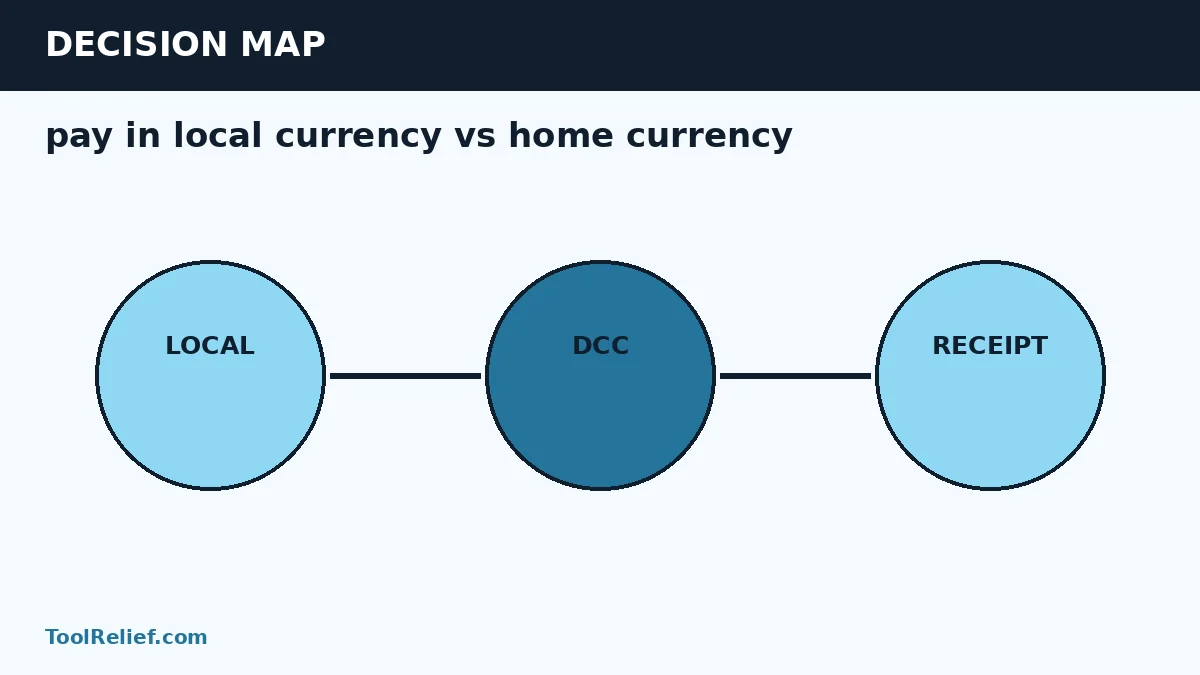
With local currency, the card network and issuer convert the transaction, and the issuer may add a foreign transaction fee. With DCC, the merchant-side provider sets the displayed home-currency conversion, while issuer fees may still apply depending on the card.
Compare the disclosed DCC rate with an indicative network rate and your card’s fee schedule. A familiar number is not proof of a lower cost.
Keep control at hotels, ATMs, and online checkouts
At hotels, make the currency choice explicit at authorization and final settlement because a preauthorization can differ from the final charge. At an ATM, distinguish the withdrawal currency from the conversion offer.
Online, inspect the order summary after changing currency. Some sites also change the underlying price or payment processor, so compare final totals.
Document an unwanted conversion
Keep the receipt showing the selected currency, amount, exchange rate, and markup. If the merchant processed a different currency without your choice, contact the issuer promptly and preserve the evidence.
Visa states that cardholders must be offered the opportunity to process an international transaction in local currency. Card-network and issuer procedures still apply to any dispute.
Use one practical travel rule
Before tapping or entering a PIN, read the currency. Choose intentionally, reject any screen you do not understand, and ask the merchant to reverse an incorrect selection before completing the sale.
The rule is not to accept or reject every conversion blindly; it is to compare transparent costs. In routine cases, local currency is the cleaner baseline.
Currency choice comparison
| Path | Rate set by | Possible extra cost | Evidence to keep |
|---|---|---|---|
| Local currency | Card network and issuer | Issuer foreign transaction fee | Local amount and receipt |
| Home currency through DCC | Merchant-side DCC provider | DCC markup plus possible issuer fees | Home amount, rate, markup, and choice |
| ATM conversion | ATM or DCC provider if accepted | Conversion markup and ATM fees | Withdrawal currency and conversion screen |
A practical example
A restaurant terminal offers 92 euros or 104 U.S. dollars. The home-currency option uses a visible conversion premium. The traveler’s card has no foreign transaction fee, so choosing euros lets the network and issuer perform the conversion and avoids the DCC markup.
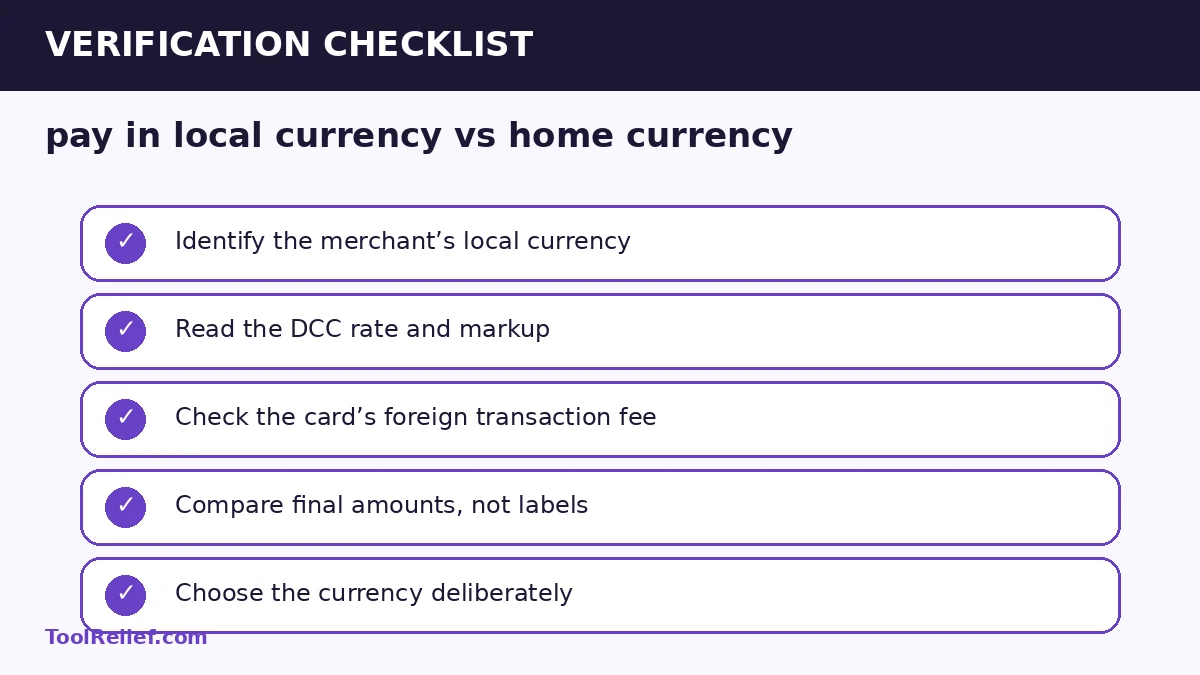
Pre-purchase checklist
- Identify the merchant’s local currency
- Read the DCC rate and markup
- Check the card’s foreign transaction fee
- Compare final amounts, not labels
- Choose the currency deliberately
- Confirm the receipt matches the choice
- Keep evidence for hotels and large purchases
- Contact the issuer promptly for unauthorized conversion
Use a minimum evidence standard
A strong pay in local currency vs home currency decision uses three levels of evidence. First, confirm the provider or seller statement that governs the transaction. Second, verify the operational detail at the exact checkout, account, property, location, or policy level. Third, preserve independent evidence such as the receipt, confirmation, screenshot, or issuer record. A general marketing page cannot replace transaction-specific terms.
When two options remain close, prefer the one with clearer ownership and reversibility. Clear ownership means the buyer knows who can change, support, cancel, refund, or correct the transaction. Reversibility means the financial and operational cost of a mistake is limited. This standard prevents a small displayed saving from transferring a much larger unresolved risk to the buyer.
Document the decision before checkout
Create a compact decision record for pay in local currency vs home currency. Save the date, selected option, final price, applicable terms, seller or provider, cancellation or refund deadline, and the evidence that supports the choice. A record is especially important when a promotion, currency, policy, or inventory condition can change after the transaction.
Reject the option when any critical condition remains unverified: local, dcc, or receipt. The goal is not to eliminate every uncertainty; it is to identify which party owns the risk and whether the expected value justifies accepting it.
Review the decision after the transaction
After purchase or booking, compare the confirmation with the decision record. Verify the charged amount, product or service configuration, dates, names, currency, renewal or cancellation settings, and support contact. Correct a mismatch immediately while the checkout evidence is fresh and any cancellation or refund window remains open.
Schedule a later review when the obligation continues. For software, review renewal, usage, seats, and update rights. For travel, review schedule changes, payment status, deadlines, and policy updates. This closes the loop: the pay in local currency vs home currency decision is not complete until the delivered transaction matches what was approved.
Related ToolRelief decision guides
Frequently asked questions
What is dynamic currency conversion?
It is an offer to convert a foreign purchase or withdrawal into the cardholder’s home currency at the point of sale or ATM.
Does paying in local currency eliminate all fees?
No. The card issuer may still charge a foreign transaction fee, so card terms should be checked.
What should be kept after choosing a currency?
Keep the receipt showing the transaction currency, amount, and any displayed conversion information.
Sources and verification
Decision: Recheck the current price, terms, eligibility, and provider responsibilities at the final checkout. The pay in local currency vs home currency framework is designed to make the commercial decision auditable rather than automatic.
Last Updated on August 1, 2026