SaaS Price Increases 2026: The Software Hike & Tier Tracker
Quick Navigation ✔
TOOLRELIEF DECISION INTELLIGENCE
- Decision
- Use SaaS Price Increases 2026: The Software Hike & Tier Tracker to evaluate the software or technology question investigated on this page before taking the next material action.
- Evidence Basis
- Documented product information, published evidence, comparative analysis, direct observation, and clearly labeled models where applicable.
- Best Used For
- Reducing uncertainty before taking the next material action.
- Decision Boundary
- This page provides independent decision support rather than a guaranteed outcome. Product capabilities, pricing, third-party terms, and operating conditions can change.
35+ Platforms Raising Rates, Bundling AI, and Sunsetting Legacy Plans
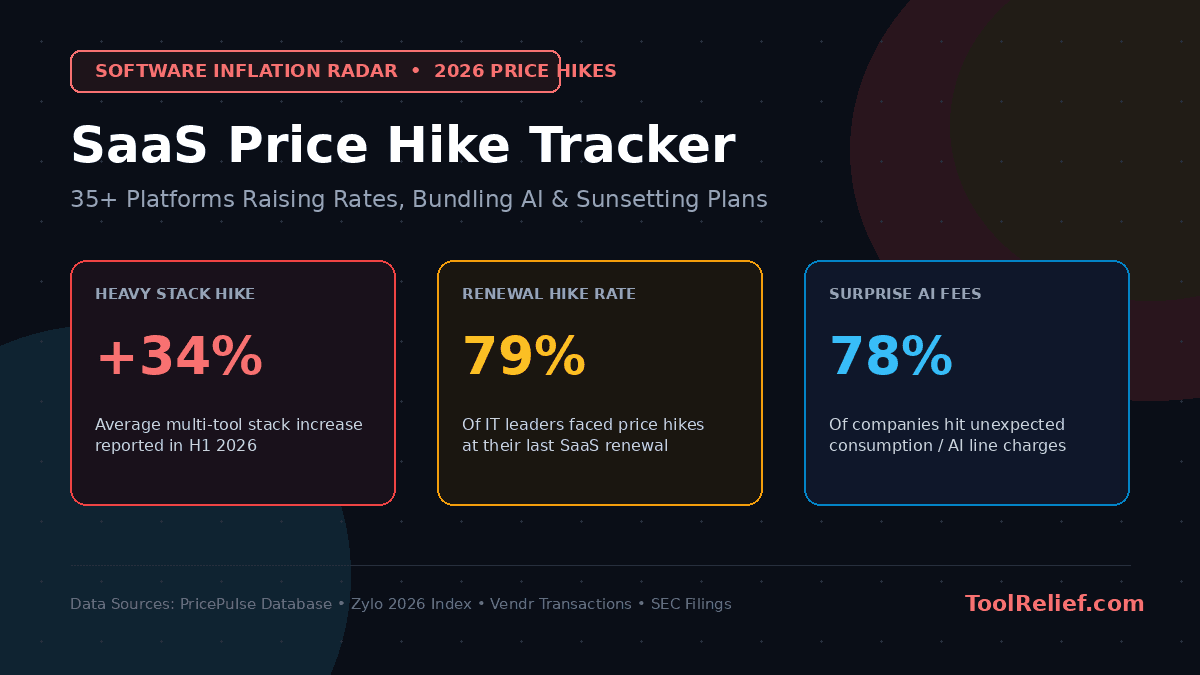
Quick Executive Summary (2026 SaaS Price Increases): Enterprise software inflation is running at 2x to 10x general consumer CPI. In 2026, 79% of IT leaders faced price hikes at renewal, while heavy multi-tool stacks saw an average 34% surge in annual expenditure driven by mandatory AI feature bundling, credit metering shifts, and the systematic elimination of grandfathered pricing tiers.
September 2026 SaaS Pricing Changes
Three pricing developments now deserve immediate attention from software buyers: Atlassian is introducing a separate usage-based layer across selected cloud capabilities, Microsoft is adding a billing premium to certain annual CSP software subscriptions, and Kommo's new Base and Advanced pricing is now live for new customers. These updates are tracked separately from the historical 2026 pricing evidence below so the original benchmark dataset remains intact.
Atlassian — Usage-Based Pricing Layer Arrives December 3
Atlassian is expanding usage-based pricing across selected AI and platform capabilities. The model sits alongside existing subscriptions and introduces metered usage for capabilities including Rovo credits, Automation steps, AI agent resolutions, and other supported meters. Atlassian states that usage-based billing takes effect on December 3, 2026 for most meters, although timing can vary by capability and billing cadence.
Decision impact: Buyers should model both the fixed subscription and the potential consumption layer. Included allowances may cover normal usage, but organizations that exceed them can incur additional usage charges unless administrators configure limits or disable extra usage.
Source: Atlassian Usage-Based Pricing · Atlassian Jira Enterprise vs ServiceNow
Microsoft — 5% Uplift on Certain Annual CSP Software Subscriptions
Microsoft announced a 5% cost-of-capital uplift for annual-term Cloud Solution Provider (CSP) software subscriptions that are billed monthly. The change takes effect on October 1, 2026. Microsoft specifically cites software such as SQL Server, Windows Server, Client Access Licenses, and System Center.
Existing annual-term CSP software subscriptions billed monthly receive the uplift when they renew on or after October 1. Microsoft says there is no change to annual billing or month-to-month subscriptions.
Decision impact: Teams using eligible CSP software should compare the value of monthly payment flexibility against the additional 5% cost before renewal.
Source: Microsoft Partner Center — August 2026 Announcements
Kommo — Base and Advanced Price Increase Now Live
Effective September 1, 2026, Kommo increased pricing for new customers on its Base and Advanced plans. Base moved from $15 to $25 per user/month, while Advanced moved from $25 to $35 per user/month.
- Base: approximately +66.7%
- Advanced: +40%
Existing customers can retain their current pricing while remaining on their existing plan. Kommo states that switching plans after September 1 subjects customers to the updated rates.
Decision impact: New buyers should recalculate annual CRM cost by seat count before adopting Kommo, while existing customers should evaluate the pricing consequence before changing plans.
Source: Kommo Pricing Update
ToolRelief decision layer: Before accepting a higher software bill, evaluate renewal exposure with the SaaS Renewal Risk Calculator, review negotiation leverage in SaaS Contract Negotiation, and check current market opportunities through Commercial Opportunity Intelligence.
1. Executive Summary & The 2026 Software Inflation Index
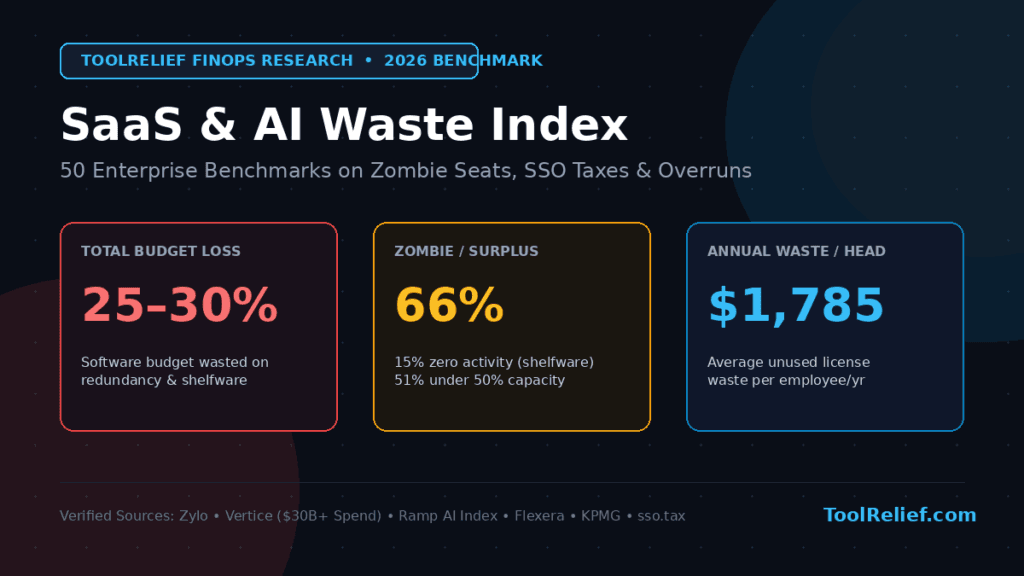
A mid-market company running a standard 40–60 employee SaaS stack that paid ~$84,000/year in 2024 is now paying between $112,000 and $123,000/year in 2026—a 34% jump. This expansion is documented across The ToolRelief System and our flagship research on 2026 SaaS Waste Statistics.
| Inflation & Pricing Metric | 2026 Benchmark | Industry Source |
|---|---|---|
| Median YoY SaaS price increase | ~7.8% | Stripo Research — SaaS Pricing Trends 2026 |
| IT leaders hit with renewal price hikes | 79% | Zylo 2026 Index |
| Unexpected consumption / AI-related charges | 78% | Zylo 2026 Index |
| SaaS vendors charging separately or bundling AI | 73% | Stripo Pricing Survey 2026 |
| Design & Dev-tool category average hike | +57% | PricePulse SaaS History Database |
| Average notice window before price hikes take effect | 41 Days | PricePulse Database |
To benchmark how these price shifts impact your operational budget, evaluate your current footprint using the SaaS Cost Benchmark Tool and the AI Subscription Waste Calculator.
2. The Master 2026 Price Hike Tracker: 35+ Platforms
Category 1: Workspaces, PM & Collaboration
| Vendor | Old Price / Model | New 2026 Price / Model | % Change | Mechanism |
|---|---|---|---|---|
| Notion | Plus $8 · Team $15/mo | Plus $10 · Team $18/mo | +25% / +20% | Silent pricing-page update in March 2026 without email notice. |
| Asana | Pre-2026 Advanced tier | Repriced March 2026 | ~+23% | Tier restructuring across Advanced plans. |
| monday.com | Pre-2026 Pro pricing | Repriced Feb 2026 | ~+18% | Broad tier increase across Work OS line. |
| Atlassian (Jira/Confluence) | Pre-Oct cloud pricing | Cloud list increase + Rovo | ~+15% | List increase + 25 Rovo AI credits bundled with metered overage. |
| ClickUp | Pre-2026 tiers | Repriced Feb 2026 | ~+58% | Tier restructure. Compare options in Notion vs ClickUp Enterprise. |
| Linear | Free tier unlimited <250 | Scale tier added; free capped at 10 | ~+60% effective | Gating GitHub/Slack integrations behind Business+ plans. |
| Slack | Pro ~$7.25/user/mo | Business+ $15/user/mo | ~2x Multiplier | Gating unlimited integrations and governance behind Business+. |
| Airtable | 1,200 records / no expiry | 1,000 records / 6-mo expiry | Shrinkflation | Shrinking free tier capacity to force upgrades. Replace with Tools That Replace Multiple Apps. |
Category 2: CRM, Sales & Client Operations
| Vendor | Old Price / Model | New 2026 Price / Model | % Change | Mechanism |
|---|---|---|---|---|
| Salesforce | Pre-hike Enterprise/Unlimited | +6% on Enterprise Editions | +6% base + AI | List hike + Agentforce sold as consumption credits. See Salesforce vs HubSpot Enterprise. |
| HubSpot Breeze | 100 flat credits/conv | $0.50/resolved conv · $1/lead | Outcome billing | Converting fixed seat costs into open-ended usage liabilities. |
| Zendesk AI | Automated touch model | $1.50–$2.00 / Verified Resolution | Model restructure | Redefining billable units ahead of enterprise renewal cycles. |
| Intercom | Essential $39/seat/mo | Essential $47/seat/mo | +20% | Direct seat price increase justified by bundled AI features. |
| Pipedrive | Entry list $14/user/mo | $150–$300/mo real bill (5 users) | 2–4x effective | API token rate-limiting throttling integrations without add-ons. |
Category 3: Cloud Infrastructure, Data & DevOps
| Vendor | Old Price / Model | New 2026 Price / Model | % Change | Mechanism |
|---|---|---|---|---|
| GitHub Copilot | Flat seats: Business $19 · Ent $39 | Price frozen; metered credits applied | ~+90–100% effective | Converting flat subscriptions into rapidly consumed credit caps. |
| Datadog | Pre-hike host rates | Repriced host & APM units | ~+40% | Base host increase + custom metrics and trace indexing overages. |
| Snowflake | Compute credit billing | Cortex AI credit multiplier | Consumption surge | Cortex AI multiplying credit burn. Compare in Snowflake vs Databricks. |
| MongoDB Atlas | Standard cluster billing | Vector search consumption | Consumption surge | AI vector-search expanding cluster footprint. Benchmark in Enterprise SaaS Pricing 2026. |
Category 4: Creative, Media & AI Workflows
| Vendor | Old Price / Model | New 2026 Price / Model | % Change | Mechanism |
|---|---|---|---|---|
| Adobe Creative Cloud | All Apps ~$54.99/mo | +$5 Indiv · +$10/seat Teams | +9% to +12.5% | Direct list hike explicitly citing bundled Adobe Firefly generative AI. |
| Adobe Enterprise (ETLA) | Prior contract terms | 2026 ETLA renewal pricing | +12% to +25% | Multi-stage rollouts across Acrobat Standard and core enterprise agreements. |
| Figma | Pre-hike per-editor rate | Repriced editor tiers | ~+67% | One of the steepest moves in design SaaS tracked in PricePulse. |
| Canva | Pro ~$12.99/mo | Pro ~$24.99/mo · Teams up 300% | +92% to +300% | Doubling consumer Pro and aggressively raising enterprise tiers. |
| ChatGPT Enterprise | Custom quoting | ~$60/user/mo (150-seat min) | $108k/yr floor | Opaque pricing with heavy minimum seat floor commitments. |
Category 5: Identity, Security & Middleware
| Vendor | Old Price / Model | New 2026 Price / Model | % Change | Mechanism |
|---|---|---|---|---|
| 1Password | Indiv $35.88 · Family $59.88/yr | Indiv $47.88 · Family $71.88/yr | +33% / +20% | List hike. EU accounts auto-cancel if users don't explicitly opt in. |
| Bitwarden | Premium $9.99/year | Premium $19.80/year | ~+98% | Doubling premium price in Jan 2026 (first increase in a decade). |
| Zapier | Pre-hike Starter / Pro | Starter +$5 · Pro +$10 | ~+20% to +30% | Flat dollar hike. Explore cost-saving alternatives in Zapier vs Make.com. |
| Okta & Cisco Duo | Opaque custom quoting | SSO Tax & MFA Bundles | Opaque | Identity surcharges. See research on SaaS SSO Tax and Okta vs Ping Identity. |
3. The 3 Dark Patterns Driving 2026 SaaS Inflation
1. Forced AI Feature Bundling
The single largest driver of SaaS cost increases in 2026 is forced AI bundling. Vendors that previously sold a stable core tool now require customers to upgrade to an "AI-enhanced" tier regardless of user interest. Atlassian Rovo credits, Salesforce Agentforce, and GitHub Copilot credit metering illustrate how AI is converted into a mandatory base-cost escalator.
2. The Death of Grandfathered Plans
Legacy pricing once preserved for loyal customers is being systematically eliminated. Adobe closed legacy 20GB plans to renewals. 1Password instituted coercive opt-ins where silence triggers subscription termination. Airtable reduced free tier record limits and added workspace expiration clocks to force paid migrations.
3. The 40%–60% Monthly-Billing Penalty
Annual plans retain roughly 92% of customers after 12 months versus 68% for monthly plans. Consequently, 75% of enterprise SaaS vendors now default pricing pages to annual commitments, imposing an effective 20% to 60% penalty on teams requiring monthly billing flexibility.
4. The 4-Step Vendor Defense Playbook
- Start the Renewal Clock 90 Days Out: Vendors that announce price increases will negotiate if contacted 30–60 days before the new price takes effect. Track your renewal schedule with our SaaS Waste Audit Tool.
- Audit Deployed Usage Before Accepting Any Bundle: Conduct a 90-day active-seat audit by SKU. Across benchmarked enterprise renewals, bundled tiers mask 10%–20% of unused seats. Reclaim dormant licenses using the Unused SaaS License Cost Calculator.
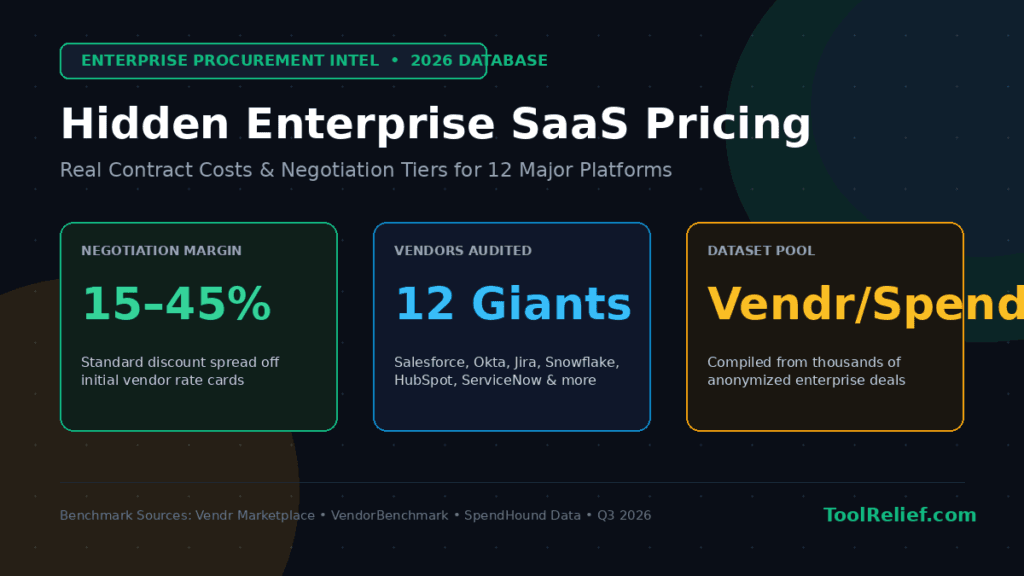
- Bring a Written Competitor Quote: Submitting a verified, written alternative quote (e.g., Make.com against Zapier, or Entra ID against Okta) consistently shifts vendor renewal pricing by 6–11 percentage points.
- Lock Multi-Year Rates & Negotiate AI Opt-Outs: Ensure multi-year agreements contain explicit fixed-rate language to prevent repricing at future list rates, and negotiate split SKUs to adopt AI on your own timeline. Follow our Hidden SaaS Waste Playbook.
What to Do After a SaaS Price Increase
A price increase does not automatically mean you should renew, cancel, or switch. The next step depends on whether the new cost is justified by actual usage, contract flexibility, available alternatives, and current market conditions.
Use the next decision layer that matches your situation:
- Check current market opportunities: Review Commercial Opportunity Intelligence for current buyer-facing signals and relevant software alternatives.
- Negotiate before committing: Use the SaaS Contract Negotiation framework to evaluate price protection, usage terms, renewal exposure, and exit flexibility.
- Decide whether timing matters: Use Best Time to Buy Software when the choice is whether to act now or wait for a stronger buying window.
- Measure renewal exposure: Run the SaaS Renewal Risk Calculator before accepting a higher renewal price.
For enterprise buyers, the strongest response to a price increase is usually not a single tactic. It is a combination of usage evidence, pricing benchmarks, negotiation leverage, alternative vendors, and a clear understanding of the cost of switching versus staying.
Frequently Asked Questions (FAQ)
Can vendors raise prices mid-contract on fixed annual agreements?
Generally no. A signed fixed-term contract locks your rate through the term unless an explicit annual escalation clause is present. The primary exposure occurs at renewal when uncontracted list price hikes take effect.
Do companies have to accept mandatory AI feature bundles?
Not automatically. Procurement teams should explicitly request split-SKU pricing or AI opt-out clauses to avoid paying for unneeded generative AI features.
How much should finance leaders budget for 2026 SaaS renewals?
A 10%–15% buffer is recommended for standard stacks, increasing to 25%–35% for stacks heavily reliant on design, automation, and project management tools.
Where can teams calculate potential savings from stack consolidation?
Use our interactive SaaS ROI Calculator to calculate net savings from replacing redundant applications.