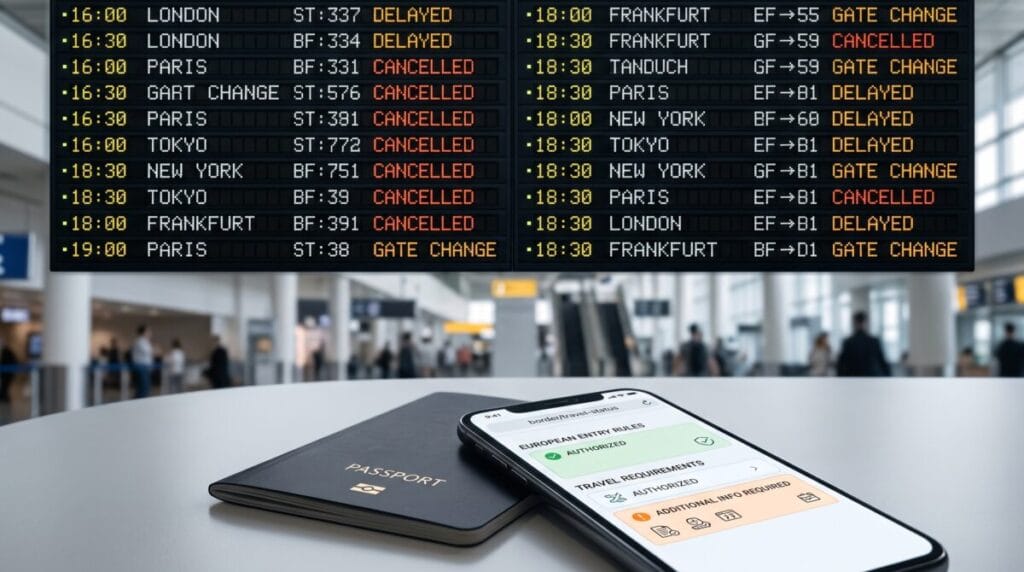
Last verified: September 1, 2026
The Travel Decision Stack
Quick Navigation ✔
ToggleThe Travel Decision Stack is a framework for understanding why trip decisions should not be treated as independent booking tasks.
Your destination affects entry requirements. Entry requirements affect how much non-refundable commitment is sensible. Your arrival airport changes transfer options. Your flight schedule changes the reliability of a timed activity. Separate rail tickets can change missed-connection protection. Your payment setup changes the final cost of bookings made in another currency.
These are not seven isolated choices.
They are dependencies.
A travel decision is stronger when the assumptions it depends on have already been verified.
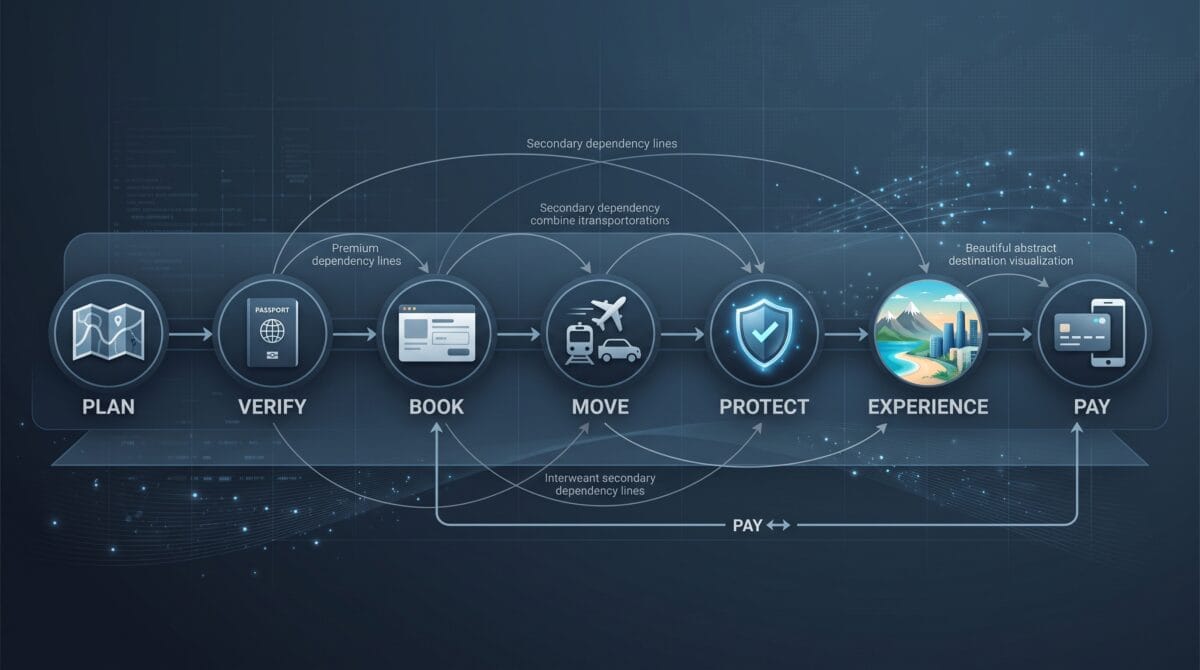
ToolRelief organizes those dependencies into seven layers:
PLAN → VERIFY → BOOK → MOVE → PROTECT → EXPERIENCE → PAY
This is not a universal checklist and it does not mean every traveler must literally purchase products in that exact sequence. It is a decision model: each layer asks what must be known before a later commitment becomes safe, comparable, or useful.
The Smart Trip Planner helps execute the planning task. The Travel Decision Stack explains why the decisions depend on one another in the first place.
What Should You Book First for a Trip?
There is no universally correct first booking.
The better first move is to identify the decisions that can invalidate everything booked after them.
For an international trip, those constraints can include:
- entry eligibility;
- passport validity;
- visa or authorization requirements;
- fixed travel dates;
- non-negotiable events;
- arrival and departure geography;
- connection feasibility;
- and how much financial commitment can safely become non-refundable.
A flight may be the first purchase on one trip.
On another trip, verifying entry requirements or the feasibility of an airport-to-destination transfer should happen before a non-refundable airfare becomes a commitment.
The Travel Decision Stack therefore asks a different question from a typical trip-planning checklist:
What earlier decision changes the quality, cost, flexibility, or risk of the decision I am about to make?
Why Travel Decisions Need a Dependency Model
Travel products are often presented as separate categories:
- flights;
- hotels;
- trains;
- airport transfers;
- cars;
- insurance;
- activities;
- connectivity;
- payments.
But the traveler experiences them as one system.
A 10:30 p.m. airport arrival changes the practical value of a hotel located far from that airport.
A non-refundable tour at 9:00 a.m. can become fragile when it follows a late-night international arrival.
A separate-ticket rail connection can have different recovery rights from a through-ticket.
A destination change can alter entry requirements, airport choices, currency exposure, insurance assumptions, and ground transportation at the same time.
The booking itself may be perfectly valid while the system around the booking is weak.
That is why the framework operates in layers.
PLAN — Define the Trip Before Optimizing It
PLAN owns the shape of the trip.
It does not choose every provider.
Its job is to establish the boundaries that later decisions must satisfy.
The relevant questions include:
- Which countries and cities are actually part of the trip?
- Which dates are fixed and which are flexible?
- Which event or location is the anchor?
- Which airports or stations are realistically usable?
- How many movements between destinations are being created?
- Where is schedule slack necessary?
- Which parts of the trip would be expensive to change?
The Cheapest Flight Can Change the Geometry of the Entire Trip
A lower airfare to a distant airport can create a more expensive or fragile trip if it adds:
- a long airport transfer;
- a late-night arrival problem;
- an additional hotel night;
- a rental-car requirement;
- a missed public-transport window;
- or a tight connection to another booked service.
This does not mean the farther airport is wrong.
It means the airfare cannot be evaluated independently from the movement it creates.
This is the first dependency:
PLAN → MOVE
When the itinerary itself is still unresolved, ToolRelief's Smart Trip Planner is the execution layer.
For destination and booking research before committing, the Travel Guides & Booking Decision Resources provide supporting context.
VERIFY — Remove Constraints Before Committing
VERIFY asks whether the trip you planned can actually happen under the conditions you are assuming.
For international travel, that can involve:
- entry rules;
- visa status;
- travel authorization;
- passport validity;
- transit requirements;
- border systems;
- carrier documentation requirements;
- or destination-specific rules.
Why VERIFY Comes Before Irreversible Commitment
Europe in 2026 provides a useful real-world example.
The EU Entry/Exit System, or EES, began progressive operation in October 2025 and became fully operational across Schengen external border crossing points on April 10, 2026.
ETIAS is different.
As of September 1, 2026, the official European Union ETIAS system is not yet operating and applications are not being collected. The EU currently says ETIAS is planned to start in the last quarter of 2026 and that the specific launch date will be announced in advance.
The practical lesson is larger than those two systems:
A traveler should verify the requirement that actually applies on the travel date—not rely on an outdated article, a future rule, or a commercial website presenting a future authorization as if it were already active.
This creates the dependency:
VERIFY → BOOK
If entry status is uncertain, the risk of committing to inflexible flights, hotels, transfers, or activities can change.
Use ToolRelief's Visa Service & Entry Requirement Tools when the itinerary requires an individual requirement check.
For the wider 2026 context around EES, ETIAS, passenger rights, and disruption, see the Travel Disruption & Protection Benchmark 2026.
BOOK — Commit Only After the Important Assumptions Survive
BOOK is where research becomes financial commitment.
The quality of that commitment depends on what was already resolved.
A booking decision should answer more than:
“Is this available?”
It should also answer:
- What exactly is included?
- What is refundable?
- What can be changed?
- Who is selling it?
- Who is operating it?
- Which other bookings depend on it?
- What happens if the itinerary changes?
Availability Is Not the Same as Fit
A flight can be available but land at the wrong airport for the intended ground-transport plan.
A hotel can be available but have cancellation terms that are too rigid for an uncertain flight.
A train can be bookable as several separate tickets while providing different missed-connection protection from a journey covered by a through-ticket.
An activity can have open inventory while being too close to an international arrival to be robust.
The Travel Booking Friction Report 2026 explains why these product, price, contract, responsibility, and dependency differences recur across booking categories.
One Booking Path Can Change Who Owes the Refund
The U.S. Department of Transportation provides a concrete example of why booking structure matters.
For qualifying cancelled or significantly changed flights to, from, or within the United States, a traveler who chooses not to take the changed trip may be entitled to a refund.
When a ticket was bought through a ticket agent, DOT says the merchant of record can determine which entity is responsible for issuing the airfare refund.
That means the transaction path can become part of the recovery path.
This is another dependency:
BOOK → RECOVERY
For multi-category routing after the trip structure is known, use ToolRelief's Global Travel Booking Engine.
For category-specific decisions:
Compare flight-search routes through the Flight Search & Comparison Tools and accommodation routes through the Hotel Booking & Accommodation Comparison.
MOVE — Test How the Trip Works on the Ground
MOVE asks whether the booked itinerary can actually be connected in the real world.
This layer begins where booking-page abstractions stop.
A traveler may know:
- the airport;
- the hotel;
- the train;
- and the next activity;
but still not know whether the sequence works.
Arrival Airport → Transfer Decision
The arrival airport changes:
- transfer distance;
- late-night options;
- public-transport availability;
- vehicle requirements;
- pickup logistics;
- and how much delay the itinerary can absorb.
So:
BOOK → MOVE
is not merely chronological.
The original flight decision defines the ground-transport problem.
Use ToolRelief's Airport Transfer Booking Options when that specific arrival dependency needs to be resolved.
Rail Ticket Structure → Connection Protection
EU rail passenger rights provide an even clearer dependency.
Current European Union guidance says that passengers traveling on a through-ticket can have specific rights after a missed connection, including rerouting or reimbursement depending on the circumstances.
For individual tickets, the same through-ticket rights do not automatically apply, although separate arrangements between railway companies can exist.
The itinerary can look identical on a map while the protection structure differs.
Therefore:
HOW YOU BOOK → WHAT HAPPENS IF YOU MISS THE CONNECTION
That is dependency logic in its purest form.
For the booking decision itself, use ToolRelief's Ground Transport, Train & Bus Booking.
When a Car Changes the Entire Trip
A rental car can solve movement constraints while creating new ones:
- parking;
- pickup and return windows;
- driver eligibility;
- cross-border permissions;
- fuel requirements;
- deposits;
- and dependence on road access.
The right question is therefore not simply “Do I need a car?”
It is:
Does this itinerary become stronger or more fragile when a car is inserted into it?
Use the Car Rental Comparison for Travelers once that dependency is understood.
PROTECT — Protect the Dependencies, Not Just the Reservation
PROTECT is not synonymous with buying insurance.
Protection begins by identifying which failure would create the largest downstream consequence.
Consider an itinerary containing:
Flight → Transfer → Hotel → Train → Timed Activity
If the first flight arrives late, the traveler may face more than one problem:
- the transfer may expire;
- hotel arrival may move outside the expected window;
- the next day's rail connection may become tighter;
- a prepaid activity may become less realistic;
- new transport may need to be purchased.
The original disruption and the downstream economic losses are not necessarily governed by one protection mechanism.
Passenger rights, carrier assistance, refund rights, insurance benefits, provider cancellation terms, and the traveler's own flexibility can each apply differently.
Protection Depends on What Was Booked Before It
A flexible itinerary and a rigid itinerary do not have the same protection need.
Neither do:
- a nonstop trip and a self-connected trip;
- a fully refundable hotel and a non-refundable hotel;
- a through-ticket rail journey and separate rail contracts;
- a trip with major prepaid activities and one with almost none.
This creates:
BOOK + MOVE → PROTECT
For product-level insurance evaluation, use ToolRelief's Travel Insurance Comparison.
If disruption is already happening and the traveler needs an operational next-step layer, use the Travel Relief SOS Radar.
Connectivity Can Also Be a Protection Dependency
Connectivity is often treated as a convenience purchase.
On some trips it is also operational infrastructure.
A traveler may need data access for:
- airline disruption notifications;
- digital boarding passes;
- rail updates;
- transfer-driver communication;
- maps;
- two-factor authentication;
- or accommodation access instructions.
The importance of connectivity therefore depends on the trip's operating model.
ToolRelief's Travel eSIM Plans & Roaming Alternatives handles the product comparison after that dependency is clear.
EXPERIENCE — Fit Activities Around the Real Itinerary
EXPERIENCE should consume itinerary capacity, not pretend that capacity is unlimited.
A tour or timed admission is downstream from:
- arrival reliability;
- local movement;
- check-in timing;
- border processing;
- rest;
- and previous activities.
The activity's availability therefore does not prove that the itinerary can support it.
Why the First Day Is Often a Dependency Problem
A traveler arriving internationally may need to pass through border control, collect baggage, transfer into the city, check in, and recover from a time-zone change before reaching a timed attraction.
Every additional fixed commitment reduces recovery room if an upstream event slips.
The decision relationship becomes:
MOVE + PROTECT → EXPERIENCE
That does not mean travelers should avoid advance bookings.
It means the value of advance booking depends on:
- scarcity;
- cancellation flexibility;
- arrival confidence;
- travel time;
- and the cost of failure.
When the itinerary can support the commitment, use ToolRelief's Tours, Activities & Experience Booking for the next decision.
PAY — Evaluate the Transaction, Not Only the Price
PAY is placed last in the framework because the payment decision should evaluate the transaction already defined by the previous layers.
That does not mean payment is literally chosen only at the end.
Payment considerations can influence booking from the beginning.
The point is that a traveler cannot evaluate the financial path correctly until the underlying product is clear.
$500 Is Not Always the Same $500
The final economic result can depend on:
- transaction currency;
- foreign transaction fees;
- dynamic currency conversion;
- mandatory charges;
- payment timing;
- refund currency;
- deposit requirements;
- and the difference between refundable and non-refundable pricing.
That means:
BOOK → PAY
but also:
PAYMENT CONSTRAINTS → BOOKING QUALITY
The relationship is partly bidirectional.
The Travel Cost Leakage Report 2026 explains the cost mechanics behind baggage fees, mandatory lodging charges, foreign transaction fees, and dynamic currency conversion.
For actual payment-path evaluation, use ToolRelief's Travel Payment, Money Transfer & Card Tools.
The Travel Decision Stack Dependency Matrix
This is the core ToolRelief framework.
| Earlier Decision | Later Decision It Changes | Why the Dependency Exists | Typical Failure if Ignored |
|---|---|---|---|
| Destination / itinerary shape | Entry verification | Different countries and transit points can create different document requirements | A financially committed itinerary is built before eligibility is confirmed |
| Entry verification | Flight / hotel commitment | Unresolved authorization or visa status changes the risk of non-refundable bookings | Money is committed before a core travel constraint is resolved |
| Arrival airport | Airport transfer / car / ground transport | Airport geography and arrival time define the movement problem | A cheap flight creates an expensive or impractical transfer |
| Flight timing | Hotel / transfer / activity timing | Downstream reservations consume the slack left by the flight schedule | One delay breaks multiple separate bookings |
| Fare flexibility | Protection strategy | Refundability and change rights determine how much risk remains to insure or self-absorb | The traveler pays to protect a risk already handled elsewhere—or leaves an uncovered gap |
| Rail ticket structure | Missed-connection recovery | Through-ticket status can change passenger rights after a missed connection | An itinerary that looks unified is legally several separate journeys |
| Ground-transport design | Activities | Movement time determines how much reliable activity capacity remains | Timed experiences are booked into unrealistic transfer windows |
| Prepaid activities | Protection requirements | Additional non-refundable commitments increase downstream financial exposure | A minor transport disruption becomes a larger financial loss |
| Connectivity requirement | Operational recovery | Digital tickets, maps, updates, authentication, and provider communication may depend on data access | The traveler has rights or alternatives but cannot access them efficiently |
| Transaction currency / payment path | Final trip cost | FX, DCC, issuer terms, and mandatory charges can change the final amount | The lowest visible price is not the lowest actual transaction cost |
The matrix shows why ToolRelief does not treat Travel as eighteen unrelated pages.
The value of each decision surface increases when the upstream assumptions have already been resolved.
How One Weak Decision Can Propagate Through a Trip
Consider a hypothetical traveler who finds an unusually cheap international flight.
The flight lands at a secondary airport at 11:20 p.m.
The traveler books it first because airfare appears to be the largest cost.
Only afterward does the traveler discover:
- the last practical public-transport connection leaves before the scheduled arrival;
- a private transfer substantially changes the total arrival cost;
- the selected hotel has restricted late check-in;
- the next morning's prepaid activity is non-refundable;
- and the itinerary has almost no recovery time if the flight is delayed.
Nothing in this example requires the flight price to have been deceptive.
The problem is that the flight was optimized before its dependencies were priced and tested.
The chain is:
Cheap Flight
→ Late Arrival
→ Limited Ground Transport
→ Higher Transfer Cost
→ Fragile Hotel Arrival
→ Fragile Morning Activity
→ Higher Disruption Exposure
This is the central idea behind the Travel Decision Stack:
Local optimization can make the total trip worse.
A Different Trip Can Require a Different Sequence
The framework is intentionally not a rigid checklist.
A domestic weekend trip may have almost no entry-verification layer.
A multi-country international trip may make VERIFY the highest-risk layer.
A road trip can elevate MOVE before accommodation selection.
A trip centered on a scarce event may require the EXPERIENCE anchor to be defined during PLAN before transport is booked around it.
A business traveler with fixed meetings may have almost no date flexibility but significant flexibility in airlines or hotels.
The seven layers stay useful because the dependency question remains the same:
Which decision constrains the others on this specific trip?
PLAN → VERIFY → BOOK → MOVE → PROTECT → EXPERIENCE → PAY
The sequence can now be read as seven different questions:
PLAN
What trip are we actually trying to make work?
VERIFY
Which assumptions must be true before we commit money?
BOOK
Which commitments now have enough information behind them?
MOVE
Can the booked itinerary physically connect in the available time?
PROTECT
Which failure points create financial or operational exposure?
EXPERIENCE
How much fixed activity can the real itinerary reliably support?
PAY
What is the final economic cost of the transaction we have actually chosen?
How to Use the Travel Decision Stack Without Turning It Into a Checklist
Do not mechanically complete seven boxes.
Instead, when making any significant travel decision, move one step backward and ask what it depends on.
Before booking a flight:
What must be verified?
Before choosing an airport transfer:
What does the arrival flight make possible?
Before buying insurance:
What exposure did the existing bookings already create?
Before booking a timed activity:
How reliable are the movements that precede it?
Before paying in another currency:
What is the true transaction and what does the payment path add?
This turns trip planning from a collection of product searches into a dependency-aware decision process.
The Three Research Layers Behind the Stack
The Travel Decision Stack is intentionally the final research asset in this four-part series because its reasoning depends on the three evidence layers built before it.
1. Disruption Changes the Value of Flexibility
The Travel Disruption & Protection Benchmark 2026 establishes the passenger-rights, border-system, and disruption context.
Its role in this framework is to answer:
What happens when the planned journey does not operate as expected?
2. Cost Leakage Changes What “Cheapest” Means
The Travel Cost Leakage Report 2026 establishes why base prices, mandatory charges, payment costs, and post-purchase exposure must be separated.
Its role is to answer:
What is the trip actually costing after the transaction layers are normalized?
3. Booking Friction Changes What “Same Product” Means
The Travel Booking Friction Report 2026 establishes why product, price, contract, responsibility, and dependency vary across booking categories.
Its role is to answer:
Are the options being compared actually equivalent?
The Stack Connects the Three
The Travel Decision Stack asks:
In what order do those facts need to influence the trip?
That is why this framework exists separately from the Smart Trip Planner and separately from each individual booking surface.
Commercial & Editorial Disclosure
ToolRelief is an independent decision platform. ToolRelief may earn compensation from partner relationships on separate Travel decision surfaces.
Those relationships do not determine the dependency framework, regulatory examples, or research conclusions presented here.
The Travel Decision Stack contains no direct affiliate recommendation and does not rank booking providers.
The intended architecture is:
Research → ToolRelief decision surface → external provider only when relevant.
Methodology, Limitations, and Sources
Produced by ToolRelief. Last verified September 1, 2026.
The Travel Decision Stack is an original ToolRelief analytical framework built by connecting evidence and decision consequences across the preceding Travel research reports and current primary-source travel guidance.
ToolRelief did not conduct a proprietary traveler survey and did not derive the seven stages from a statistical model.
The framework is qualitative and relational:
PLAN → VERIFY → BOOK → MOVE → PROTECT → EXPERIENCE → PAY
Its purpose is to expose dependencies that are often hidden when travel categories are evaluated separately.
How the Framework Was Built
ToolRelief reviewed the decision relationships established in three evidence areas:
- disruption and protection — passenger rights, border systems, and recovery;
- cost leakage — fees, transaction layers, and total-cost normalization;
- booking friction — product, contract, distribution, responsibility, and connection structure.
The framework then asks whether an earlier decision materially changes the cost, feasibility, flexibility, or risk of a later one.
Only relationships that survive that test are treated as dependencies.
Primary-Source Examples Used
- European Commission documentation confirming that the Entry/Exit System became fully operational on April 10, 2026.
- Official European Union ETIAS guidance confirming that ETIAS is not operating as of this verification date and is currently planned for the last quarter of 2026.
- EU rail passenger-right guidance showing the importance of through-ticket status for missed-connection protection.
- U.S. Department of Transportation refund guidance showing how cancellation, significant changes, travel choice, and merchant-of-record status can affect the refund path.
Limitations
- The Travel Decision Stack is a decision framework, not a statistical model.
- It does not claim that every trip must follow the seven stages in a rigid chronological order.
- The dominant dependency varies by trip type.
- Visa, entry, refund, passenger-right, insurance, and contract rules remain jurisdiction- and itinerary-specific.
- External travel rules can change after publication and should be rechecked before a traveler acts.
- A link to a ToolRelief decision surface does not imply that a commercial provider is necessary for every traveler.
Authoritative External References
- European Commission — Entry/Exit System
- European Union — Official ETIAS Status
- European Union — Rail Passenger Rights
- European Commission — One Journey, One Ticket, Full Rights
- U.S. Department of Transportation — Airline Refund Rights
Bottom Line
The Travel Decision Stack does not tell every traveler to book the same thing first.
It establishes a more useful rule:
Do not make a downstream commitment until the upstream assumption that controls it is strong enough.
PLAN defines the trip.
VERIFY tests whether its assumptions are valid.
BOOK creates commitments.
MOVE tests whether those commitments connect in the real world.
PROTECT identifies what can break and who carries the risk.
EXPERIENCE fits activities into the capacity the itinerary actually has.
PAY measures the economic result of the transaction rather than the headline price alone.
The sequence is not valuable because seven is a magic number.
It is valuable because travel decisions propagate.
A stronger early decision makes the later decisions easier. A weak early decision can make every downstream choice more expensive, less flexible, or harder to recover.
That is the difference between booking individual travel products and designing a trip that works as a system.