Last verified: 2026-08-01
TOOLRELIEF DECISION INTELLIGENCE
- Decision
- Use Affiliate Network vs Direct Partnership: Tracking, Payments, Control, and Scale to compare the documented alternatives and understand the costs, constraints, and trade-offs that materially affect the choice.
- Evidence Basis
- Comparative analysis of the capabilities, costs, constraints, limitations, and trade-offs documented for the options evaluated on this page.
- Best Used For
- Shortlisting alternatives and identifying the trade-offs that materially affect the final choice.
- Decision Boundary
- A listed commercial route is not automatically a recommendation. Pricing, availability, eligibility, commissions, promotions, and provider terms can change and should be verified before commitment.
affiliate network vs direct partnership is the decision this guide resolves. An affiliate network provides shared infrastructure for program discovery, tracking, reporting, compliance, and payment operations. A direct partnership connects the publisher and brand without the same intermediary layer and can create closer communication, custom terms, or bespoke integration. Neither model is automatically more profitable; the difference is the value created after operating cost, risk, and control are included.
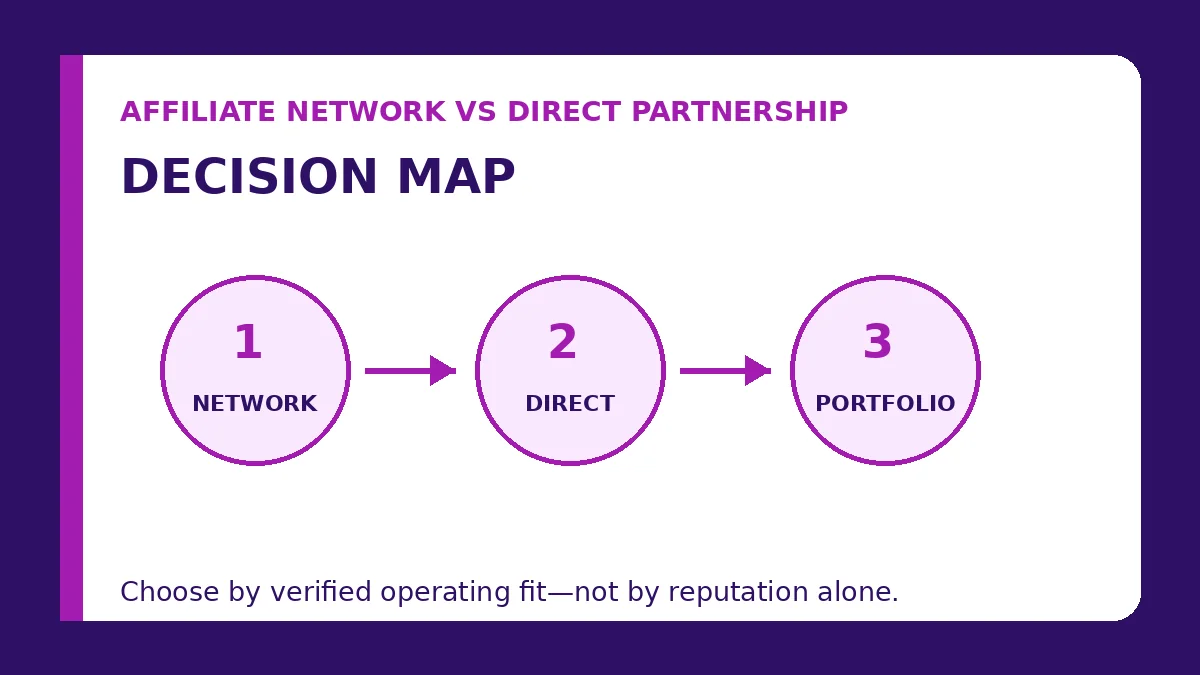
Use a network when consolidation, standardized operations, broad discovery, and lower administrative cost are the priority. Use a direct partnership when strategic alignment, scale, data, support, or negotiable economics justify separate contracts and systems. Build a portfolio in which each relationship has one primary route.
affiliate network vs direct partnership — the short decision
Use a network when consolidation, standardized operations, broad discovery, and lower administrative cost are the priority. Use a direct partnership when strategic alignment, scale, data, support, or negotiable economics justify separate contracts and systems. Build a portfolio in which each relationship has one primary route.
Affiliate disclosure: ToolRelief is an independent publisher, not the network, advertiser, seller, or payment provider. Some partner relationships may compensate ToolRelief without changing the visitor’s price. Platform access, approvals, program terms, tracking, and payments remain controlled by the respective provider.
Design a Balanced Partnership Portfolio
Compare discovery and relationship ownership
Networks reduce search and onboarding friction by placing many programs in one operating environment.
For this affiliate network vs direct partnership, direct partnerships require individual business development but can create a closer relationship and clearer strategic ownership.
Compare contracts and commercial terms
Network programs provide platform and advertiser terms that can simplify standard participation.
Direct deals can support custom commission structures, sponsorship, content packages, data exchange, or service-level expectations.
Compare tracking and attribution
Networks provide shared tracking infrastructure, link formats, and reports across participating advertisers.
For this affiliate network vs direct partnership, direct partnerships can use bespoke links, first-party data, server integrations, or custom attribution—but the parties own implementation quality.
Compare reporting and reconciliation
Network reporting standardizes parts of transaction and payment administration.
Direct reporting can be deeper or more tailored, but publishers must normalize data and investigate discrepancies themselves.
Compare payment and counterparty risk
Networks can consolidate payment operations and apply compliance processes.
For this affiliate network vs direct partnership, direct partnerships expose the publisher to separate invoicing, tax, currency, credit, and collection risk for each partner.
Choose by strategic value and scale
Networks fit broad portfolios and lean teams.
Direct partnerships fit high-value relationships where custom economics or collaboration exceed the additional operating cost.
Affiliate Network vs Direct Partnership decision matrix
Use this affiliate network vs direct partnership matrix to compare operating evidence rather than choosing from reputation or a headline commission alone.
| Criterion | Option A advantage | Option B advantage |
|---|---|---|
| Operating factor | Affiliate-network advantage | Direct-partnership advantage |
| Discovery | Many programs in one environment | Targeted strategic outreach |
| Contracts | Standardized program participation | Custom negotiated terms |
| Tracking | Shared platform infrastructure | Bespoke or first-party integration |
| Payments | Consolidated platform operations | Direct invoicing and commercial control |
| Best fit | Broad diversified publisher portfolio | High-value strategic relationship |
Practical operating example
A publisher uses networks for dozens of standard affiliate relationships because consolidated links and payments reduce overhead. It negotiates a direct partnership with a software brand only after the content, qualified leads, and conversion history prove strategic value. The direct relationship is an upgrade justified by evidence, not a default preference.
The example shows why affiliate network vs direct partnership should be decided through fit, governance, and approved outcomes rather than a generic winner label.
affiliate network vs direct partnership verification checklist
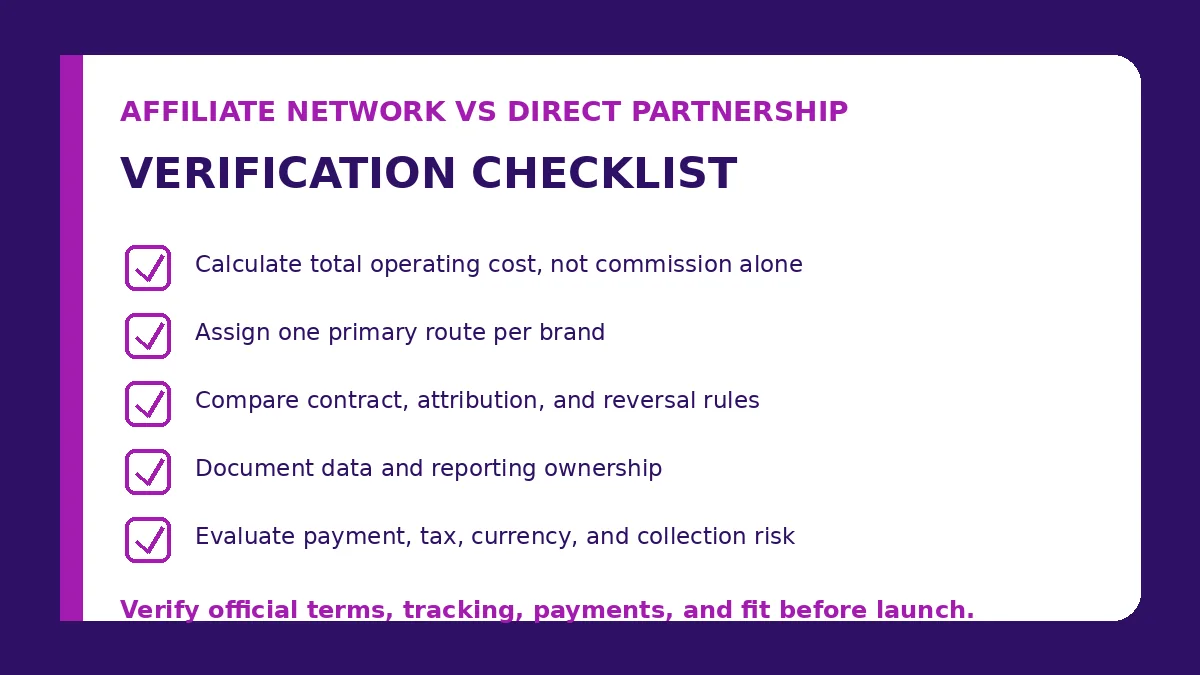
- Calculate total operating cost, not commission alone
- Assign one primary route per brand
- Compare contract, attribution, and reversal rules
- Document data and reporting ownership
- Evaluate payment, tax, currency, and collection risk
- Set volume or strategic thresholds for direct deals
- Review the portfolio quarterly for duplication
Complete the affiliate network vs direct partnership checklist before adding links, forecasting revenue, or treating a dashboard status as an approved commercial result.
Continue the decision
- Compare two network operating models
- Compare regional campaign networks
- Apply the model to travel partnerships
Frequently asked questions
Are direct affiliate partnerships always more profitable?
No. Higher nominal terms can be offset by integration, reporting, invoicing, payment, compliance, and collection costs.
Why use an affiliate network?
Networks can consolidate discovery, tracking, reporting, compliance, and payment operations across many programs.
When should a publisher pursue a direct deal?
When audience fit, traffic, conversion evidence, strategic value, data, or collaboration potential justifies separate negotiation and operations.
Can the same brand be used through both routes?
Avoid uncontrolled duplication. Choose one primary route, document attribution and terms, and use a fallback only when the rules allow it.
Operating record and review cadence
A production decision for affiliate network vs direct partnership should leave an auditable record, not only a published recommendation. The record should state the current account or program status, target audience and GEO, permitted traffic, commercial action, destination, tracking identifier, approval evidence, last verification date, payment readiness, fallback route, and owner. The first review should test compare discovery and relationship ownership; the second should confirm compare contracts and commercial terms; and the recurring review should revisit choose by strategic value and scale. This sequence makes changes visible before they become broken links, misleading claims, or unreconciled revenue.
Use the operational checklist as a change-control document. Start with “Calculate total operating cost, not commission alone,” confirm “Document data and reporting ownership,” and close the cycle with “Review the portfolio quarterly for duplication.” Record why a platform or relationship was selected, what evidence would trigger a switch, and which metric represents an approved commercial outcome. For affiliate network vs direct partnership, that discipline is more valuable than adding extra programs or tools because it protects editorial trust, measurement quality, and cash-flow accuracy as the portfolio grows.
Operating governance for affiliate network vs direct partnership
Assign named owners for program selection, application status, contract or campaign terms, link health, tracking labels, reporting, payment reconciliation, and quarterly review. A network account becomes operational infrastructure only when those responsibilities are explicit. Without ownership, expired links, changed terms, inactive programs, and unreconciled commissions accumulate faster than useful revenue.
Maintain a compact register containing platform, advertiser or program, status, target GEO, permitted traffic, destination, tracking method, approval evidence, last verified date, payment state, primary article, fallback, and responsible owner. This governance layer keeps the affiliate network vs direct partnership decision auditable and prevents a growing affiliate portfolio from becoming a collection of unmanaged links.
Sources and verification
Verification rule: Recheck official platform documentation, account eligibility, program terms, payment requirements, and destination behavior before implementing any recommendation from this affiliate network vs direct partnership.
Last Updated on August 1, 2026