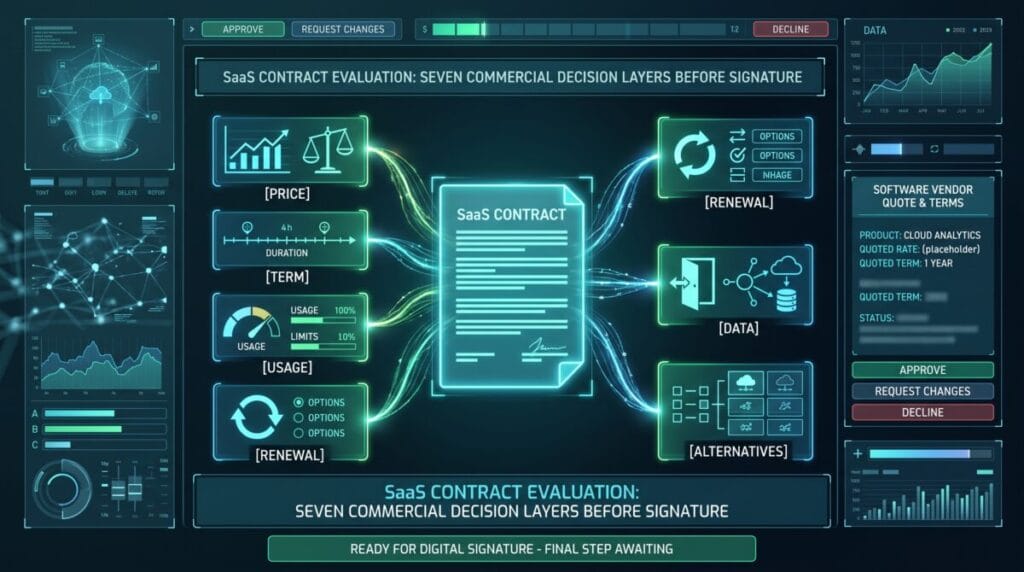
SaaS billing dark patterns are interface or process choices that can make it harder to understand price, avoid an unwanted upgrade, reduce seats, cancel, or compare the true cost of a subscription. Not every confusing screen is unlawful, and contract rules differ by jurisdiction, but every organization should document billing decisions and verify them before renewal.
Auto-renewal and notice controls
- Is the renewal date visible in the account and contract?
- Does the subscription renew monthly, annually, or for another fixed term?
- What notice period and delivery channel are required to cancel or reduce?
- Can the vendor change price, features, or plan at renewal?
- Does a trial convert automatically, and is the conversion date documented?
Use the SaaS Auto-Renewal Dark Patterns explainer and the 30-Day Renewal Checklist before the notice window closes.
Cancellation and downgrade friction
Compare the path used to buy with the path required to cancel or downgrade. Record extra calls, forms, approvals, unavailable buttons, repeated retention prompts, delays, and ambiguous confirmation messages. Save screenshots and confirmation references.
Check whether cancelling the service, turning off auto-renewal, deleting the account, and removing data are separate actions. They often have different effects.
Seat and plan pressure
- Minimum-seat commitments that remain after users are removed.
- Automatic seat expansion when invitations, guests, or inactive users are added.
- Features required for security or administration being restricted to higher tiers.
- Downgrade warnings that do not clearly distinguish lost features, retained data, and immediate service impact.
- Annual discounts that hide the cost of unused capacity or reduce flexibility.
Review the SaaS Seat Minimum Trap and SaaS SSO Tax as separate pricing layers.
Usage and AI charges
Usage-based services can create cost after the base subscription is approved. Identify the unit, included allowance, reset period, overage price, alerts, caps, and who can trigger usage. For AI features, distinguish seats, credits, tokens, generations, storage, and API charges.
Require alerts before thresholds, a budget owner, and a documented action when usage rises unexpectedly. Review Usage-Based SaaS Pricing Risks and AI Agent Billing Overruns.
Checkout and invoice clarity
- Does the checkout show the full term, quantity, taxes, currency, and renewal price?
- Are optional add-ons preselected or visually emphasized?
- Does the invoice match the approved order form and active configuration?
- Are credits, prorating, refunds, and effective dates explained?
- Can the organization export invoices and billing history?
Create a defensible renewal record
Store the contract, screenshots, seat count, usage evidence, pricing comparison, decision, approver, cancellation or reduction submission, and vendor confirmation. Verify the next invoice. An internal record prevents ownership changes and vendor account changes from erasing the decision trail.
For a full review, use the SaaS Cost Optimization Tools workflow and the Software License Audit Checklist.
Reconcile the contract, product screen, and invoice
Billing risk often appears in the gap between what was sold, what the product currently shows, and what the invoice charges. Compare the executed order form, pricing page captured at purchase, admin billing screen, usage dashboard, renewal notice, and invoice line by line. Record discrepancies before contacting the vendor so the issue can be described with dates, quantities, and contractual language.
| Evidence | Check | Typical mismatch |
|---|---|---|
| Order form | Term, seats, notice, included features | Minimum commitment differs from admin screen |
| Usage dashboard | Meter definition, delay, credits, limits | Billable event is broader than expected |
| Invoice | Quantity, tax, currency, add-ons, proration | Automatic upgrade or duplicate line item |
| Cancellation record | Date, channel, confirmation, effective end | Request logged but renewal still processed |
Create an escalation record before the renewal deadline
Keep the account owner, billing administrator, procurement contact, support ticket numbers, screenshots, emails, and requested remedy in one record. State whether the desired outcome is correction, credit, downgrade, cancellation, seat reduction, or clarification. Send the request through the contractually approved channel and preserve proof of submission.
Rules and consumer protections vary by jurisdiction and contract type. This checklist is an evidence and decision tool, not legal advice. When the amount or operational risk is material, obtain qualified legal or procurement review before the deadline.
After resolution, update the renewal record with the actual outcome, credit received, revised term, new notice date, and responsible owner. A closed ticket is not enough if the same configuration or contract language can recreate the charge at the next renewal.
Frequently asked questions
What is a SaaS billing dark pattern?
A design or process that can steer, confuse, pressure, or obstruct users when they are purchasing, upgrading, renewing, reducing, or cancelling a subscription.
Is auto-renewal itself a dark pattern?
Not necessarily. Risk increases when the term, price, notice deadline, or cancellation method is unclear or materially harder to use than the purchase path.
What evidence should a company keep?
Contracts, order forms, screenshots, invoices, usage records, notices, support messages, submission timestamps, and confirmation references.
Who should review renewal mechanics?
Finance, procurement, the business owner, and administrators should coordinate; legal or regulatory questions require qualified advice.
Review the billing evidence before the notice window closes
Connect invoice checks with renewal timing, license ownership, usage exposure, and documented cancellation evidence.
Sources and verification
Reviewed July 29, 2026. Requirements, prices, product availability, and legal protections can change. Verify current terms with the official provider or authority before acting.
Last Updated on July 29, 2026