Commercial verdict: YouTube automation software is useful for agencies when it standardizes production, reduces handoffs, and leaves human approval over facts, brand, rights, and publishing. It is a poor purchase when the agency sells “autopilot growth,” delegates account control to an untested tool, or scales generic content faster than it can review it.
The buyer should evaluate the full client-delivery system: brief, research, script, assets, edit, approval, channel access, publishing, reporting, and offboarding. A tool that speeds one stage while creating risk elsewhere is not an agency operating system.
Compare the bundle against your agency production stages and existing software costs.
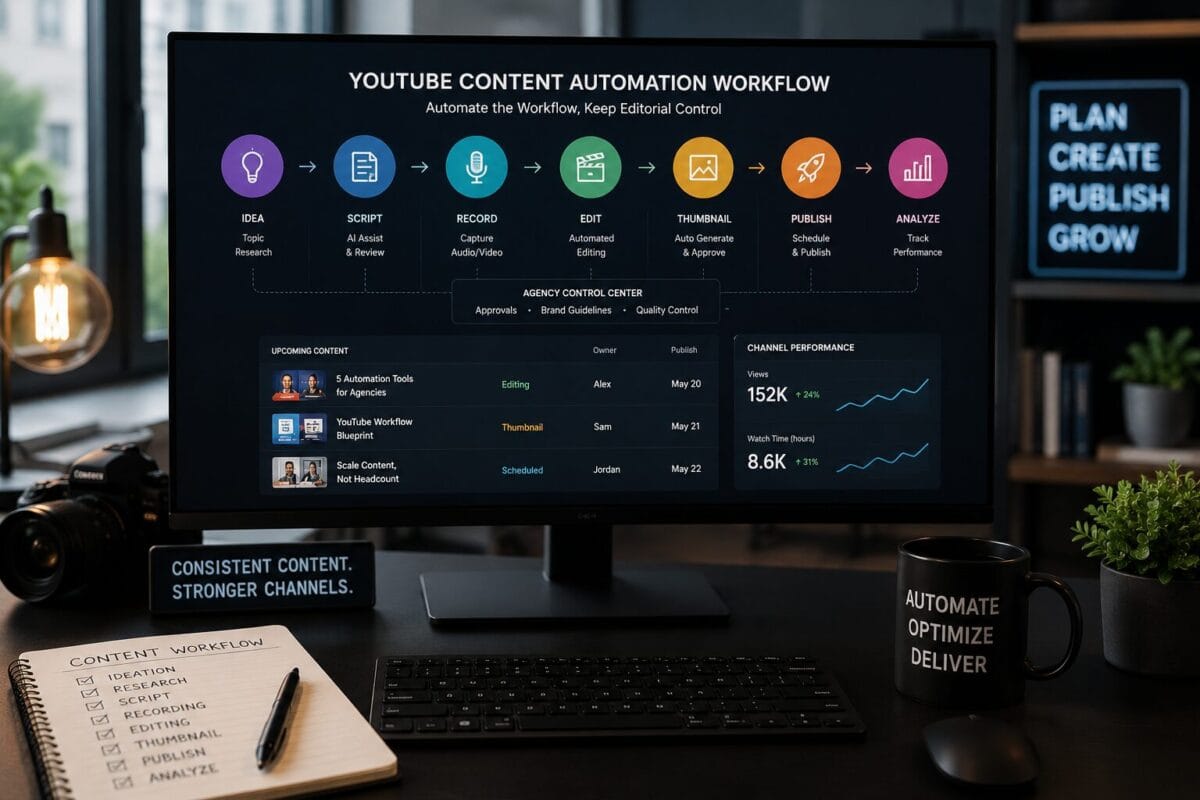
Start with the agency delivery map
| Stage | Required owner | Automation role |
|---|---|---|
| Client brief | Account lead | Structure approved objectives and constraints. |
| Research | Strategist or researcher | Prepare sources and topic evidence. |
| Script | Writer or editor | Generate a draft under an approved outline. |
| Visual and audio | Producer | Create assets with rights and brand review. |
| Edit | Video editor | Assemble, correct, and control pacing. |
| Approval | Client and agency owner | Authorize claims, brand, and final output. |
| Publishing | Authorized channel manager | Upload with minimum permissions and final checks. |
| Reporting | Analyst | Interpret performance without false causation claims. |
Automation should support these owners. It should not make ownership disappear.
Which stages benefit most
Brief and production templates
Structured templates reduce missing information and make handoffs consistent. They are especially valuable when several editors or contractors work across accounts.
First-draft scripting
AI can accelerate an outline or draft when the agency supplies approved sources and a clear audience. A human editor should remain responsible for accuracy, voice, and differentiation.
Repetitive asset preparation
Resizing, formatting, caption preparation, version naming, and project setup can be good automation targets because errors are visible and reversible.
Quality-control checklists
Software can ensure that required reviews occur, but it cannot decide whether a claim is defensible or a creative choice serves the audience.
Stages that require stronger controls
- Final factual and source approval.
- Use of client credentials and channel permissions.
- Synthetic people, voices, or endorsements.
- Copyright, music, stock media, and third-party rights.
- Health, finance, income, legal, political, or other sensitive claims.
- Automatic publishing, commenting, or engagement.
- Performance reporting that implies causation without evidence.
Tube Engine AI as an agency option
Tube Engine AI Bundle is positioned as a multi-step YouTube production workspace. That gives it a plausible fit for agencies seeking consolidation. The bundle should be tested against actual client standards rather than evaluated by the number of included modules.
The Commercial edition is the relevant rights path when the agency needs permission for client delivery. Confirm account limits, team access, output ownership, and whether every included asset can be used in client work.
Bundle economics for an agency
A bundle should be compared with the current stack at the workflow level. List each tool, monthly or annual cost, staff time, and the production stage it supports. Then identify which costs can actually be removed after the pilot.
| Economic question | Evidence required |
|---|---|
| Does it reduce editing time? | Measured time on comparable approved videos. |
| Does it replace subscriptions? | Canceled tools without a quality or reliability loss. |
| Does it increase revision time? | Number and duration of client correction rounds. |
| Does it improve capacity? | More reviewed deliverables per production hour. |
| Does it reduce training? | A documented workflow that new staff can follow. |
| Does it create new costs? | Credits, media, voices, integrations, storage, or support. |
Verify the client-use license before selling a Tube Engine-based service.
Client ownership and access design
The client should own or clearly control the YouTube channel. Agencies should use role-based permissions rather than shared passwords. The contract should identify who owns source files, templates, scripts, generated assets, exports, analytics access, and project archives.
Offboarding checklist
- Transfer approved final files and source material.
- Remove agency users and connected applications.
- Revoke sessions, tokens, and shared links.
- Document scheduled content and outstanding approvals.
- Delete or return client data according to the agreement.
- Confirm who retains templates and reusable agency processes.
Editorial differentiation at scale
Automation tends to push teams toward repeatable patterns. That is useful for operations but dangerous for editorial value. Agencies need a deliberate differentiation layer: original expert input, customer evidence, proprietary analysis, field footage, real demonstrations, or a distinct point of view.
The software can help assemble a video. It cannot decide why the audience should trust this channel instead of a hundred similar channels.
Platform and disclosure risk
YouTube policies, monetization standards, spam controls, copyright systems, and synthetic-media disclosure requirements can change. Agencies should review current guidance for every client category and avoid promising that a particular production method will remain monetizable.
Do not automate engagement in a way that misrepresents genuine viewer or creator behavior. Do not use synthetic media to imply a real person made an endorsement or statement without authorization.
A controlled agency pilot
- Choose one cooperative client and one repeatable content format.
- Record the current production time, tools, costs, and approval steps.
- Produce three videos with the existing stack and three with the candidate workflow.
- Use the same quality, rights, and approval standard for both groups.
- Compare reviewed production time, correction load, client satisfaction, and output quality.
- Decide which modules enter the agency standard and which remain unused.
The pilot should test delivery operations, not attempt to prove a growth guarantee from a small sample.
Vendor evaluation questions
- What modules are included now, and which require separate upgrades?
- What credits, limits, models, storage, or third-party services are required?
- Can teams and multiple client projects be separated?
- What commercial rights apply to outputs and included assets?
- Can projects and files be exported for client handoff?
- What permissions are required for channel connections?
- How are updates, support, refunds, and product discontinuation handled?
Alternatives
A modular agency stack is better when specialist output quality is essential. A traditional editor, writer, and project template remain appropriate for premium accounts. A native YouTube workflow combined with a project-management system can be more transparent. Outsourced production may be more economical when the agency lacks an internal reviewer.
Choose software only where it strengthens repeatability without weakening editorial responsibility.
Build-versus-buy model for an agency production line
An agency should compare YouTube automation software with its current production line, not with an imaginary fully automated channel. Map the monthly video volume, format mix, reviewer count, client variance, source requirements, and revision rate. The product must improve the constrained stage without weakening the stages that already work.
Find the actual bottleneck
Measure waiting time and rework across intake, research, script, recording, editing, thumbnail, metadata, approval, and publishing. If approvals cause the delay, a faster script generator will not solve the system. If research evidence is inconsistent, the agency may need a sourcing standard before any automation purchase.
Calculate coordination cost
Include briefing, file transfer, duplicate entry, reviewer comments, version reconciliation, credential handling, and client communication. A tool that saves drafting time but creates another workspace and export step may increase total production cost. Count the whole process, including the work needed to correct outputs.
Protect channel and client assets
Keep channel ownership, administrator access, source footage, brand files, scripts, approvals, and final exports under the appropriate client or agency account. Limit tool permissions and remove access at offboarding. The agency should be able to continue service if the product becomes unavailable.
Set an automation ceiling
Decide which stages may run with assistance and which require human approval. Claims, sponsorship disclosures, sensitive topics, client positioning, final creative, and publication should have explicit owners. The ceiling prevents efficiency pressure from silently removing accountability.
| Production signal | Buy/expand | Hold/skip |
|---|---|---|
| Bottleneck | Tool directly reduces measured wait or rework | Tool accelerates a non-bottleneck stage |
| Revision | Changes remain traceable and inexpensive | A revision forces a restart |
| Control | Human checkpoints and exports are clear | Publishing or claims become opaque |
| Economics | Replaces measurable labor or tool spend | Value depends on speculative volume |
A 30-day agency pilot
Run the software across a controlled 30-day production sample rather than one showcase video. Include at least two clients or formats if the agency normally serves varied accounts. Keep the existing process available so the team can compare delivery time, revisions, reviewer effort, consistency, and client satisfaction without risking the whole schedule.
At the end of the pilot, separate time saved by the tool from time shifted to correction, setup, or coordination. Review whether the agency could maintain the workflow if the product disappeared. Expand only when the result is repeatable, the asset archive is independent, and the team can explain the quality controls to a client.
- Select representative videos and freeze success criteria.
- Train only the operators involved in the pilot.
- Track rework and review time, not just generation time.
- Collect client-facing issues and internal incidents.
- Approve, redesign, or reject the workflow after the full sample.
Editorial control gate
Claims, final creative, client approval, and publication remain assigned to accountable people.
Final buyer recommendation
YouTube automation software can become useful agency infrastructure when the client brief, rights, review, access, and offboarding system are already defined. Tube Engine AI Bundle is worth a pilot for teams seeking production consolidation. The Commercial edition should be verified before paid client delivery.
Use a six-video comparison pilot and verify commercial rights before standardizing the workflow.
Can an agency promise automated YouTube growth?
No. Production efficiency does not guarantee views, retention, subscribers, monetization, or revenue.
Who should own the client channel?
The client should retain clear ownership and control, with the agency using role-based access where possible.
Is a bundle better than a modular stack?
Only when it reduces total reviewed production effort without lowering quality, rights clarity, or reliability.
What should an agency pilot measure?
Reviewed production time, correction load, output quality, client approval friction, cost replacement, and account risk.
Verification basis
ToolRelief reviewed the official Tube Engine AI product pages and the
corresponding marketplace records before preparing this agency buying guide.
Current features, commercial-use rights, checkout terms, and platform
conditions control if they differ from this draft.
-
Review the official Tube Engine AI Bundle page
-
Review the official Tube Engine AI Commercial offer
-
View the Tube Engine AI Bundle marketplace record on JVZoo
-
View the Tube Engine AI Commercial marketplace record on JVZoo
Last Updated on July 23, 2026