Last verified: 2026-08-01
TOOLRELIEF DECISION INTELLIGENCE
- Decision
- Use Direct Vendor Deal vs Marketplace Deal: Where Should You Buy Software? to compare the documented alternatives and understand the costs, constraints, and trade-offs that materially affect the choice.
- Evidence Basis
- Comparative analysis of the capabilities, costs, constraints, limitations, and trade-offs documented for the options evaluated on this page.
- Best Used For
- Shortlisting alternatives and identifying the trade-offs that materially affect the final choice.
- Decision Boundary
- A listed commercial route is not automatically a recommendation. Pricing, availability, eligibility, commissions, promotions, and provider terms can change and should be verified before commitment.
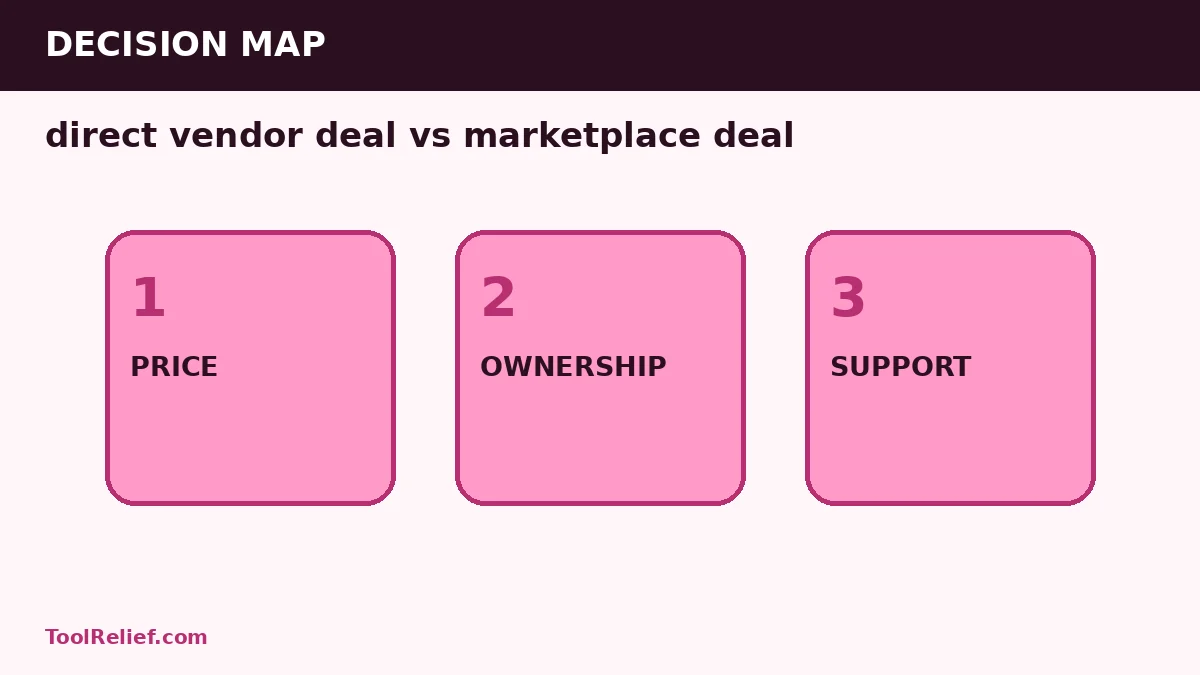
direct vendor deal vs marketplace deal is the decision this guide resolves. The lowest displayed software price does not identify the best purchase channel. A direct vendor may provide clearer product support and account control. A marketplace may simplify billing, tax records, discovery, or centralized procurement. The decisive issue is who owns each obligation after payment.
Buy through the channel that gives the best verified total price while preserving license delivery, refund eligibility, billing visibility, support accountability, and long-term account access.
direct vendor deal vs marketplace deal — the short decision
Buy through the channel that gives the best verified total price while preserving license delivery, refund eligibility, billing visibility, support accountability, and long-term account access.
Affiliate disclosure: ToolRelief is an independent publisher, not the seller or service provider. Some links may be affiliate links, which can earn ToolRelief a commission without changing your price. We evaluate the decision factors, limits, and evidence before presenting a commercial action.
Compare Marketplace and Direct Offers
Identify the seller of record
The seller of record may collect payment, issue the invoice, calculate taxes, and control refunds. The software vendor may still provide technical support, while the marketplace handles commercial disputes.
Record the names shown in the checkout, invoice, license email, and support terms. Do not assume one company owns the whole transaction.
Compare the final price, not the landing-page price
Test taxes, currency, promotional conditions, renewal price, payment fees, and whether the discount applies only to the first term. A marketplace credit can be valuable only if you would use it.
Compare the exact edition, user count, term, and upgrade rights. Similar product names can hide different license scopes.
Trace license delivery and account dependency
Determine whether the key is issued by the vendor, stored in the marketplace account, or activated automatically. Check what happens if the marketplace account is closed or the listing disappears.
For team purchases, verify transfer, reassignment, centralized administration, and whether the vendor recognizes the marketplace purchase in its own portal.
Assign refund and support responsibility
Read both the marketplace terms and the vendor terms. A marketplace may decide payment refunds while the vendor decides whether a product issue qualifies.
Before buying, know which party handles billing, license delivery, technical defects, security incidents, and cancellations. Save both contact paths.
Choose the channel that survives renewal
A first-term discount can be offset by a higher renewal, limited plan changes, or difficult migration to the direct channel. Check whether renewal is automatic and which account controls cancellation.
The best channel remains understandable after the promotion ends. If ownership or renewal is ambiguous, the discount is not fully verified.
Purchase channel comparison
| Factor | Direct vendor | Marketplace |
|---|---|---|
| Price | May include vendor-only coupons or upgrades | May include platform credits or promotions |
| Billing owner | Vendor or its payment processor | Marketplace or platform seller |
| Refund path | Vendor policy | Marketplace policy, sometimes with vendor input |
| Technical support | Usually vendor | Usually vendor; marketplace may route requests |
| Account dependency | Vendor account | Marketplace plus vendor activation may be required |
| Procurement records | Separate invoices | Potentially centralized invoices and tax records |
A practical example
A team finds the same application for $20 less on a marketplace. The marketplace invoice is useful, but the license cannot be reassigned and the renewal price is higher. Direct purchase costs more initially but supports seat transfer and vendor portal management. The operational value outweighs the headline discount.
Pre-purchase checklist
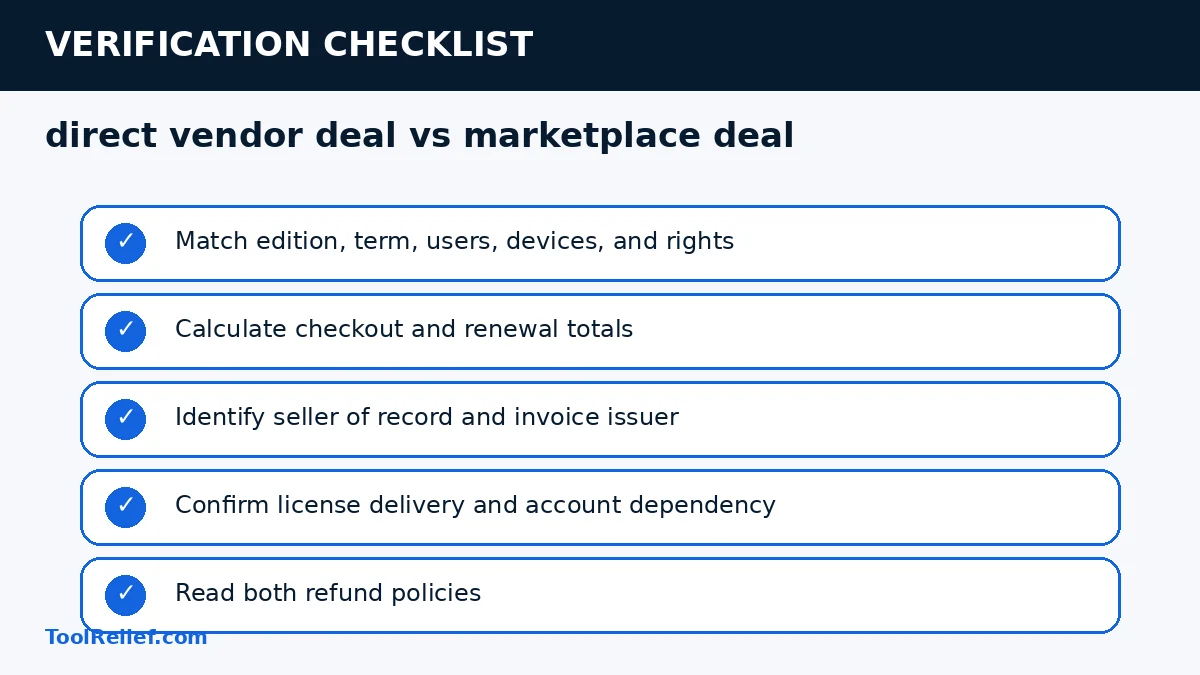
- Match edition, term, users, devices, and rights
- Calculate checkout and renewal totals
- Identify seller of record and invoice issuer
- Confirm license delivery and account dependency
- Read both refund policies
- Map billing and technical support ownership
- Save the promotion and terms
- Choose the channel with the clearest long-term control
Use a minimum evidence standard
A strong direct vendor deal vs marketplace deal decision uses three levels of evidence. First, confirm the provider or seller statement that governs the transaction. Second, verify the operational detail at the exact checkout, account, property, location, or policy level. Third, preserve independent evidence such as the receipt, confirmation, screenshot, or issuer record. A general marketing page cannot replace transaction-specific terms.
When two options remain close, prefer the one with clearer ownership and reversibility. Clear ownership means the buyer knows who can change, support, cancel, refund, or correct the transaction. Reversibility means the financial and operational cost of a mistake is limited. This standard prevents a small displayed saving from transferring a much larger unresolved risk to the buyer.
Document the decision before checkout
Create a compact decision record for direct vendor deal vs marketplace deal. Save the date, selected option, final price, applicable terms, seller or provider, cancellation or refund deadline, and the evidence that supports the choice. A record is especially important when a promotion, currency, policy, or inventory condition can change after the transaction.
Reject the option when any critical condition remains unverified: price, ownership, or support. The goal is not to eliminate every uncertainty; it is to identify which party owns the risk and whether the expected value justifies accepting it.
Review the decision after the transaction
After purchase or booking, compare the confirmation with the decision record. Verify the charged amount, product or service configuration, dates, names, currency, renewal or cancellation settings, and support contact. Correct a mismatch immediately while the checkout evidence is fresh and any cancellation or refund window remains open.
Schedule a later review when the obligation continues. For software, review renewal, usage, seats, and update rights. For travel, review schedule changes, payment status, deadlines, and policy updates. This closes the loop: the direct vendor deal vs marketplace deal decision is not complete until the delivered transaction matches what was approved.
Related ToolRelief decision guides
Frequently asked questions
Is buying directly from the software vendor always safer?
No. Marketplaces can offer useful billing, tax, and procurement controls, but responsibilities must be clear.
Who provides support for a marketplace purchase?
It varies. The marketplace may handle billing while the vendor handles the product, so both terms should be checked.
Can a marketplace license differ from a direct license?
Yes. Edition, transfer rights, upgrade eligibility, and account management can differ by channel.
Sources and verification
Decision: Recheck the current price, terms, eligibility, and provider responsibilities at the final checkout. The direct vendor deal vs marketplace deal framework is designed to make the commercial decision auditable rather than automatic.
Last Updated on August 1, 2026