Last verified: 2026-08-01
TOOLRELIEF DECISION INTELLIGENCE
- Decision
- Use Travel Booking Stack: Flights, Hotels, Transport, Activities, Insurance, and Payments to clarify the travel decision investigated on this page before booking, paying, changing, or protecting the trip.
- Evidence Basis
- Published travel information, documented constraints, provider information, comparative analysis, and decision-oriented research where applicable.
- Best Used For
- Reducing uncertainty before taking the next material action.
- Decision Boundary
- Travel availability, fares, schedules, entry rules, eligibility, and provider terms can change. Verify time-sensitive details with the relevant official or provider source before acting.
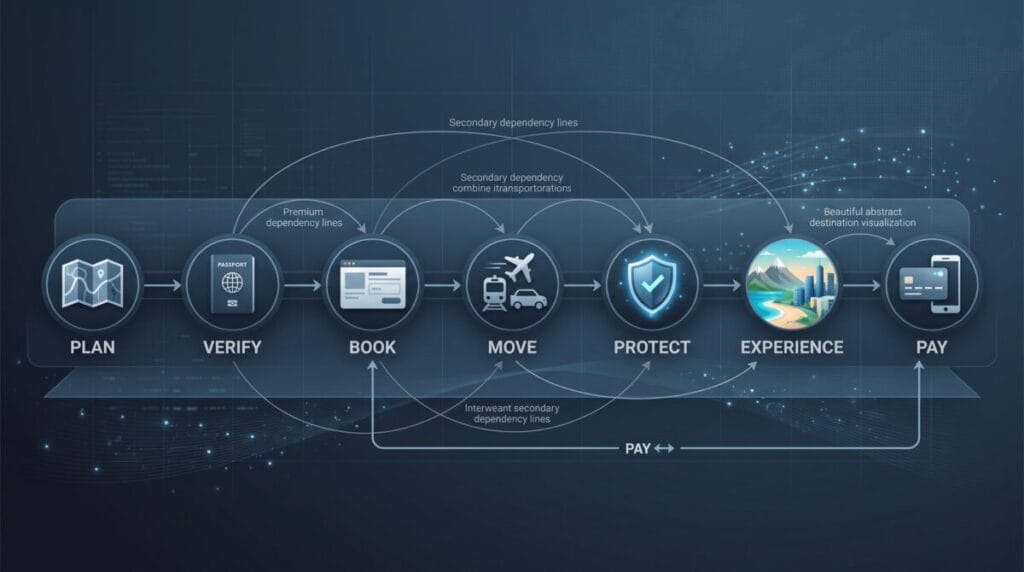
travel booking stack is the decision this guide resolves. A trip is not one booking. It is a dependency system: documents enable travel, flights define arrival, accommodation defines location, transport connects the route, activities consume time, insurance depends on prepaid cost, and payments determine whether every reservation succeeds.
Use one tool or provider per required layer, keep a single itinerary and evidence store, and add a layer only when it resolves a real dependency or risk.
travel booking stack — the short decision
Use one tool or provider per required layer, keep a single itinerary and evidence store, and add a layer only when it resolves a real dependency or risk.
The travel affiliate network vs direct framework helps assign one primary commercial route to each travel category.
Affiliate disclosure: ToolRelief is an independent publisher, not the seller or service provider. Some links may be affiliate links, which can earn ToolRelief a commission without changing your price. We evaluate the decision factors, limits, and evidence before presenting a commercial action.
Build Your Travel Booking Stack
Define the minimum stack before choosing brands
Start with required functions: document verification, itinerary control, flight search, accommodation, ground transport, activities, protection, payments, and connectivity. Not every trip needs a separate provider for every layer.
A stack is lean when each component has a named job and the traveler knows where the authoritative reservation record lives.
Create one itinerary source of truth
Store confirmation numbers, local times, addresses, cancellation deadlines, payment status, and support contacts in one accessible itinerary. Keep offline copies of essential documents.
Do not rely on email search as the only system. Provider apps can sign out, links can expire, and connectivity can fail.
Connect booking layers through dependency checks
A flight change can affect a hotel night, transfer, rail ticket, tour, and insurance cost. Mark these relationships so one change triggers a complete review.
Before paying, check whether the next layer requires a confirmed time, terminal, accommodation address, traveler age, or document number.
Avoid duplicate booking and payment tools
Multiple comparison sites can help discovery, but completing the same reservation path in several apps increases account, notification, and support fragmentation.
Choose one authoritative booking record for each purchase. Use virtual cards or payment tools only when they solve a specific acceptance, control, or security problem.
Design failure and support paths
Record the operating carrier or supplier, the seller, and the party responsible for changes. Marketplace support and provider support may own different parts of the transaction.
Create a compact disruption file with insurance contacts, card issuer numbers, transfer instructions, and the next viable alternative for critical segments.
Travel stack architecture
| Layer | Primary job | Failure question |
|---|---|---|
| Documents and requirements | Confirm legal ability to travel | What changes by nationality, transit, or destination? |
| Itinerary | Single source of dates, deadlines, and contacts | Can it be accessed offline? |
| Flights and stays | Create the route and sleep locations | Who changes or refunds the booking? |
| Transport and activities | Connect and use the itinerary | What buffer protects delays? |
| Insurance | Transfer defined financial risks | What event, person, and cost are actually covered? |
| Payments | Complete and evidence transactions | Which card, currency, and dispute path applies? |
| Connectivity | Keep access to tickets and support | What is the offline fallback? |
A practical example
A traveler has one airline app, two hotel apps, a rail platform, an activity marketplace, an insurance portal, and several confirmation emails. The stack becomes manageable when every reservation is copied into one itinerary with seller, supplier, deadline, payment, and support fields.
Pre-purchase checklist
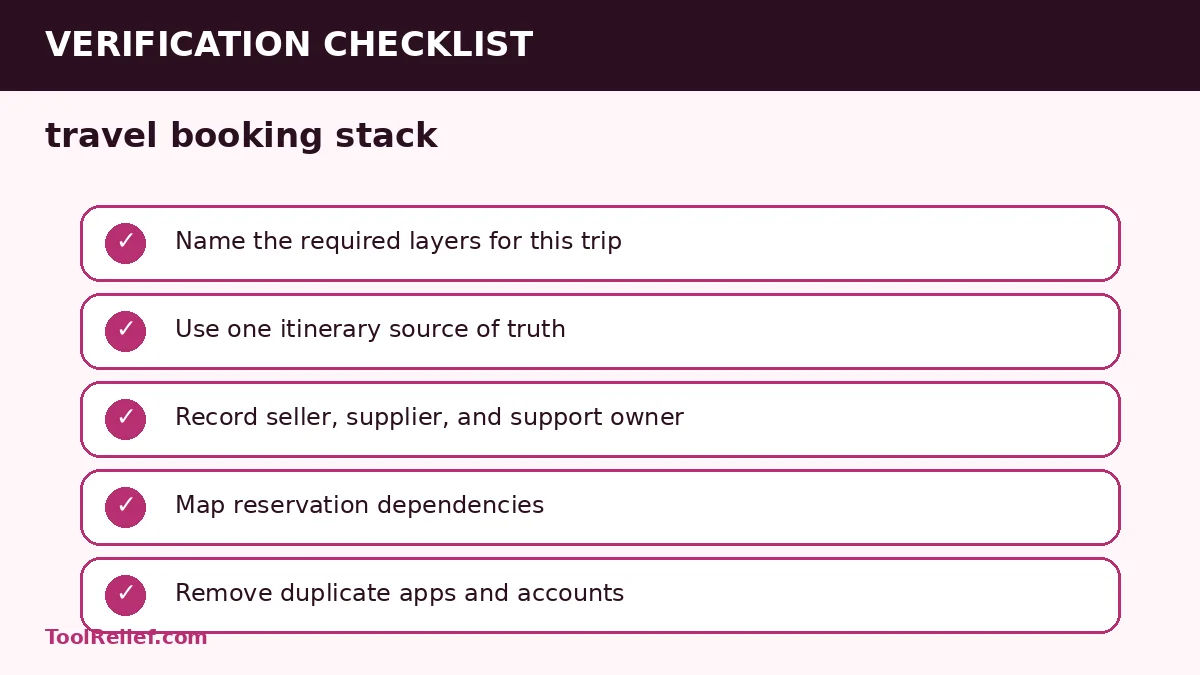
- Name the required layers for this trip
- Use one itinerary source of truth
- Record seller, supplier, and support owner
- Map reservation dependencies
- Remove duplicate apps and accounts
- Save documents and confirmations offline
- Add disruption contacts and alternatives
- Review the stack after any major change
Use a minimum evidence standard
A strong travel booking stack decision uses three levels of evidence. First, confirm the provider or seller statement that governs the transaction. Second, verify the operational detail at the exact checkout, account, property, location, or policy level. Third, preserve independent evidence such as the receipt, confirmation, screenshot, or issuer record. A general marketing page cannot replace transaction-specific terms.
When two options remain close, prefer the one with clearer ownership and reversibility. Clear ownership means the buyer knows who can change, support, cancel, refund, or correct the transaction. Reversibility means the financial and operational cost of a mistake is limited. This standard prevents a small displayed saving from transferring a much larger unresolved risk to the buyer.
Document the decision before checkout
Create a compact decision record for travel booking stack. Save the date, selected option, final price, applicable terms, seller or provider, cancellation or refund deadline, and the evidence that supports the choice. A record is especially important when a promotion, currency, policy, or inventory condition can change after the transaction.
Reject the option when any critical condition remains unverified: book, connect, or protect. The goal is not to eliminate every uncertainty; it is to identify which party owns the risk and whether the expected value justifies accepting it.
Review the decision after the transaction
After purchase or booking, compare the confirmation with the decision record. Verify the charged amount, product or service configuration, dates, names, currency, renewal or cancellation settings, and support contact. Correct a mismatch immediately while the checkout evidence is fresh and any cancellation or refund window remains open.
Schedule a later review when the obligation continues. For software, review renewal, usage, seats, and update rights. For travel, review schedule changes, payment status, deadlines, and policy updates. This closes the loop: the travel booking stack decision is not complete until the delivered transaction matches what was approved.
Related ToolRelief decision guides
Frequently asked questions
How many apps should a travel booking stack use?
Only as many as needed to perform distinct functions. Duplicate discovery and itinerary tools add friction without improving the trip.
What is the most important travel stack component?
A single source of truth for confirmations, deadlines, addresses, payment status, and support ownership.
Should confirmations be stored offline?
Yes. Essential tickets, addresses, and support details should remain accessible without connectivity.
Sources and verification
Decision: Recheck the current price, terms, eligibility, and provider responsibilities at the final checkout. The travel booking stack framework is designed to make the commercial decision auditable rather than automatic.
Last Updated on August 1, 2026