Last verified: 2026-08-01
TOOLRELIEF DECISION INTELLIGENCE
- Decision
- Use Europe Entry/Exit System (EES): What Non-EU Travelers Should Expect to clarify the travel decision investigated on this page before booking, paying, changing, or protecting the trip.
- Evidence Basis
- Published travel information, documented constraints, provider information, comparative analysis, and decision-oriented research where applicable.
- Best Used For
- Reducing uncertainty before taking the next material action.
- Decision Boundary
- Travel availability, fares, schedules, entry rules, eligibility, and provider terms can change. Verify time-sensitive details with the relevant official or provider source before acting.
Europe Entry/Exit System is the decision this guide resolves. The Europe Entry/Exit System is now fully operational at the external border crossing points of participating European countries. The official EU guidance states that full operation began on 10 April 2026 after progressive implementation. The system electronically records short-stay entries and exits for covered non-EU nationals and replaces routine manual passport stamping.
Covered non-EU short-stay travelers should expect travel-document data and personal data to be registered electronically, with biometric capture as part of the border process. Carry the same valid travel document used for the journey, allow extra time, answer border questions, and check official EU guidance for exemptions and country coverage.
Europe Entry/Exit System — the short decision
Covered non-EU short-stay travelers should expect travel-document data and personal data to be registered electronically, with biometric capture as part of the border process. Carry the same valid travel document used for the journey, allow extra time, answer border questions, and check official EU guidance for exemptions and country coverage.
Affiliate disclosure: ToolRelief is an independent publisher, not the seller, booking provider, rail operator, hotel, airline, card issuer, regulator, or government authority. Some partner relationships may compensate ToolRelief without changing the visitor’s price. Terms, eligibility, availability, payment, and fulfillment remain controlled by the provider.
Check Official EES Requirements
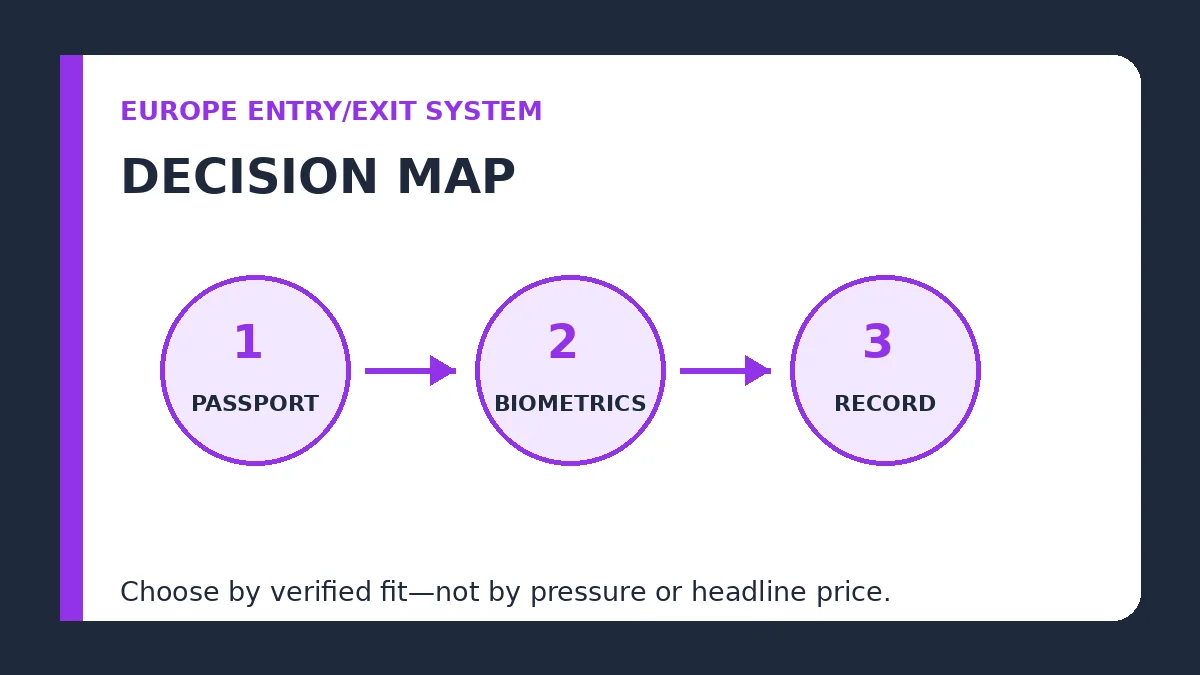
Confirm whether EES applies
The official EU FAQ says EES applies to non-EU nationals traveling for a short stay to a participating country, whether they hold a short-stay visa or are visa-exempt.
For this Europe Entry/Exit System, europe Entry/Exit System coverage is about border registration, not a travel authorization or a replacement for a visa when a visa is required.
Understand the data recorded
The system registers travel-document data, personal data, entry and exit dates, and refusals of entry. Biometric data can include a facial image and fingerprints, subject to the traveler category and official rules.
The purpose is to create an electronic record of border crossings and support calculation of permitted short-stay time.
Prepare for the border process
Use a valid passport or accepted travel document and make sure names and dates match bookings. Follow signs for EES or border-control equipment.
For this Europe Entry/Exit System, first registration can take longer than later crossings because data must be captured and verified. Travelers should not plan an unrealistically tight onward connection.
Manage the 90/180-day limit
EES records do not grant extra stay. Travelers remain responsible for complying with the short-stay allowance and any visa conditions.
Use official tools and your travel records to check remaining days. Do not rely solely on an old passport stamp count after electronic operation.
Separate EES from ETIAS
EES records border movements. ETIAS is a future pre-travel authorization for eligible visa-exempt travelers and is not yet operating as of 1 August 2026.
For this Europe Entry/Exit System, a traveler may eventually encounter both systems, but they solve different steps and should not be described as one application.
Use official information and protect personal data
Use the European Union travel site and border-authority instructions. Avoid unofficial services claiming to register EES travelers in advance for a fee.
Keep copies of travel documents and seek official correction procedures if an entry, exit, or stay calculation appears wrong.
EES traveler preparation
Use this Europe Entry/Exit System matrix to compare the same evidence across every option before acting.
| Question | What to confirm | Action |
|---|---|---|
| Are you covered? | Nationality, visa status, and short-stay purpose | Check official EES scope |
| What data is used? | Travel document, personal and biometric data | Use the same valid document |
| How long can you stay? | 90 days in any 180-day period unless another status applies | Track entries and exits |
| Is ETIAS the same? | No; ETIAS is a separate future authorization | Check each official status separately |
Practical decision example
A visa-exempt traveler enters a participating European country for a two-week trip. At the external border, the passport and personal data are registered and biometric steps are completed. The traveler keeps the same passport for the trip, tracks the electronic stay period, and does not pay an unofficial site that claims to complete EES registration online.
The example shows why Europe Entry/Exit System should be decided through documented evidence and operating fit rather than a headline claim.
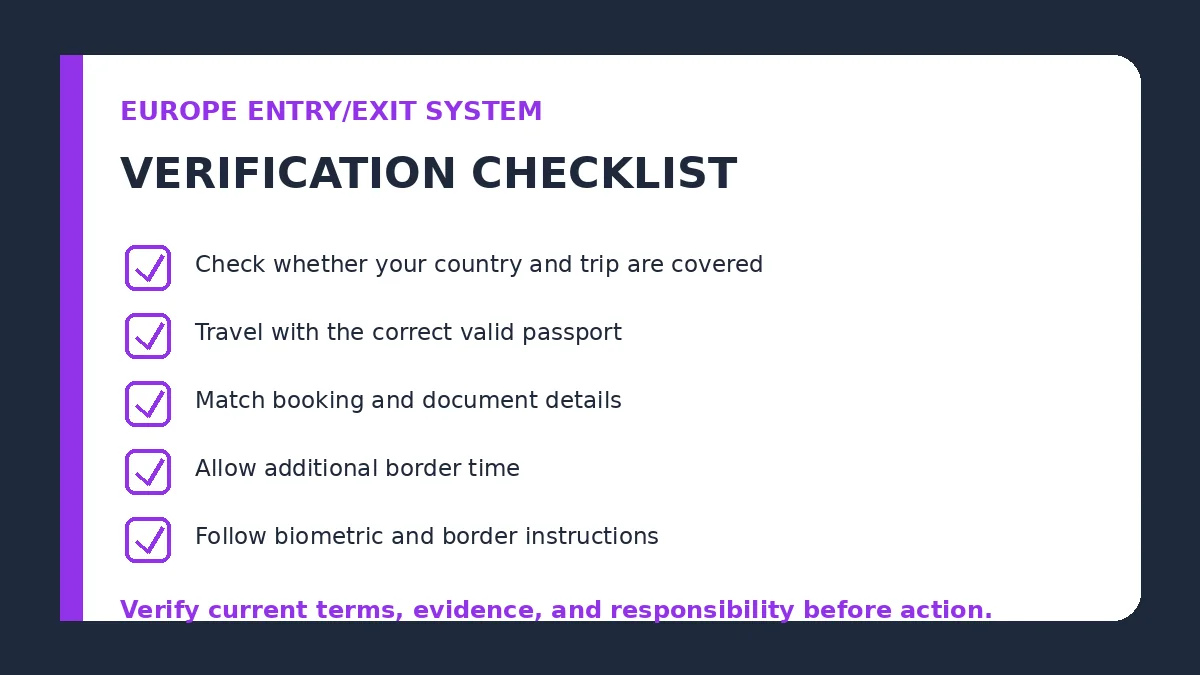
Europe Entry/Exit System verification checklist
- Check whether your country and trip are covered
- Travel with the correct valid passport
- Match booking and document details
- Allow additional border time
- Follow biometric and border instructions
- Track the 90/180-day allowance
- Separate EES from ETIAS
- Use only official EU information
- Keep evidence for correction requests
Complete the Europe Entry/Exit System checklist before checkout, publication, or a change to the operating plan.
Continue the decision
Frequently asked questions
When did EES become fully operational?
The official EU FAQ states that EES became fully operational at participating external border crossing points on 10 April 2026.
Is EES a visa or travel authorization?
No. It is an electronic entry and exit registration system. Visa and future ETIAS requirements are separate.
Will passports still be stamped?
Routine manual stamping is replaced by electronic registration under the fully operational system, subject to official procedures and exceptions.
Does EES change the 90/180-day rule?
No. It records and supports calculation of short stays; travelers must still comply with the applicable limit.
Operating record and review cadence
Keep a compact record for Europe Entry/Exit System containing the decision date, source URLs, evidence captured, selected provider or plan, price and currency where relevant, eligibility and limits, cancellation or change owner, tracking path, last verified date, next review date, and the event that would trigger a new decision. This turns the article into a repeatable operating method rather than a one-time recommendation.
Review the record at the cadence appropriate to the topic. Evergreen licensing and booking decisions can be reviewed quarterly or before renewal. Live offers, travel rules, and launch-status pages require more frequent official-source checks. Remove unsupported precision, keep the permanent URL stable, and update the visible verification date whenever a material claim changes.
Sources and verification
Verification rule: Recheck official terms, current provider instructions, and destination behavior before implementing any recommendation from this Europe Entry/Exit System.
Last Updated on August 1, 2026