Last verified: 2026-08-01
TOOLRELIEF DECISION INTELLIGENCE
- Decision
- Use How to Match a Software Offer to Team Size, Workflow, and Budget to evaluate the software or technology question investigated on this page before taking the next material action.
- Evidence Basis
- Documented product information, published evidence, comparative analysis, direct observation, and clearly labeled models where applicable.
- Best Used For
- Reducing uncertainty before taking the next material action.
- Decision Boundary
- This page provides independent decision support rather than a guaranteed outcome. Product capabilities, pricing, third-party terms, and operating conditions can change.
match a software offer to team size is the decision this guide resolves. A discount is not valuable when the plan is too small, too broad, or licensed in the wrong unit. The buying decision must start with the team’s workflow, active users, devices, must-have features, and acceptable failure cost. Price is evaluated only after the operating requirement is fixed.
Choose the smallest offer that covers the real workflow, active users, required devices, support level, data controls, and growth window. Reject plans that create forced upgrades, unused bundle overlap, or renewal exposure beyond the budget ceiling. Document why the selected offer fits before checkout.
match a software offer to team size — the short decision
Choose the smallest offer that covers the real workflow, active users, required devices, support level, data controls, and growth window. Reject plans that create forced upgrades, unused bundle overlap, or renewal exposure beyond the budget ceiling. Document why the selected offer fits before checkout.
Affiliate disclosure: ToolRelief is an independent publisher, not the seller, booking provider, rail operator, hotel, airline, card issuer, regulator, or government authority. Some partner relationships may compensate ToolRelief without changing the visitor’s price. Terms, eligibility, availability, payment, and fulfillment remain controlled by the provider.
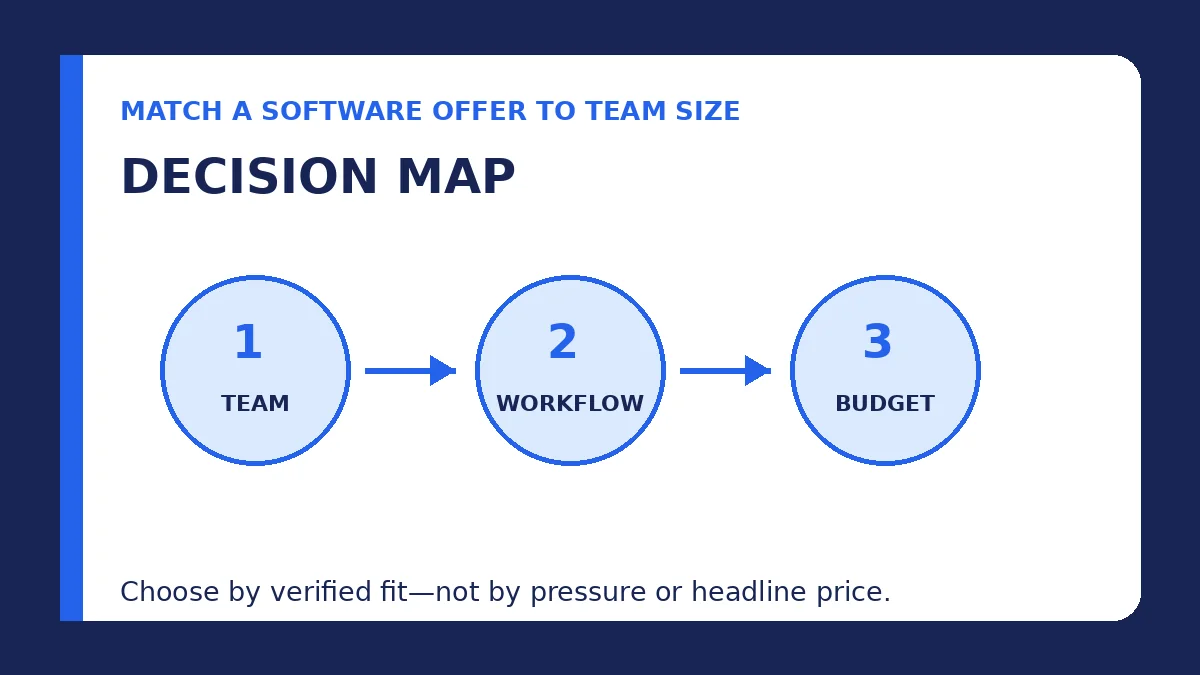
Build a team profile
Count active users, contractors, administrators, shared devices, locations, and expected hiring. Separate people who need full access from occasional reviewers.
For this match a software offer to team size, to match a software offer to team size, use the number of productive users rather than total headcount or a vendor minimum.
Map the workflow dependency
List the tasks the software must support, the systems it connects to, and the consequence of downtime or missing features.
A low-cost plan can be expensive when it removes an export, integration, permission, automation, or security control that the workflow depends on.
Define must-have and optional features
Mark each requirement as mandatory, useful, or decorative. Compare plans against the mandatory list first.
For this match a software offer to team size, do not pay for a large bundle because one optional feature looks impressive. The selected offer should solve the named decision with the least paid overlap.
Choose the correct license model
Check whether pricing is per user, device, usage, workspace, project, or feature tier. Model growth and reassignment.
A five-person team can outgrow a cheap plan quickly if the offer includes only three seats or if guests, devices, and automation are billed separately.
Set a total budget ceiling
Include implementation, migration, add-ons, support, payment fees, tax, renewal price, and the cost of parallel service.
For this match a software offer to team size, use an annual budget and an acceptable increase threshold. A temporary discount should not move the long-term cost above the ceiling.
Create a fit score and exit rule
Score workflow coverage, licensing fit, data portability, support, security, total cost, and renewal risk.
Define what would trigger downgrade, replacement, or renegotiation. A buying record makes the next renewal faster and prevents sunk-cost bias.
Software offer fit matrix
Use this match a software offer to team size matrix to compare the same evidence across every option before acting.
| Dimension | Required evidence | Reject when |
|---|---|---|
| Team size | Active users, roles, guests, and growth range | Minimums or seat caps do not fit |
| Workflow | Must-have tasks and integrations | Critical feature is missing |
| Budget | Full annual and renewal cost | Total cost exceeds ceiling |
| Exit | Export, cancellation, and transition plan | Data or workflow becomes trapped |
Practical decision example
A seven-person consultancy compares a discounted twenty-seat bundle with an eight-seat plan. The bundle includes several unused apps and renews at a higher rate. The smaller plan covers every critical workflow and keeps export rights. The team chooses the lower-overlap offer even though its headline discount is smaller.
The example shows why match a software offer to team size should be decided through documented evidence and operating fit rather than a headline claim.
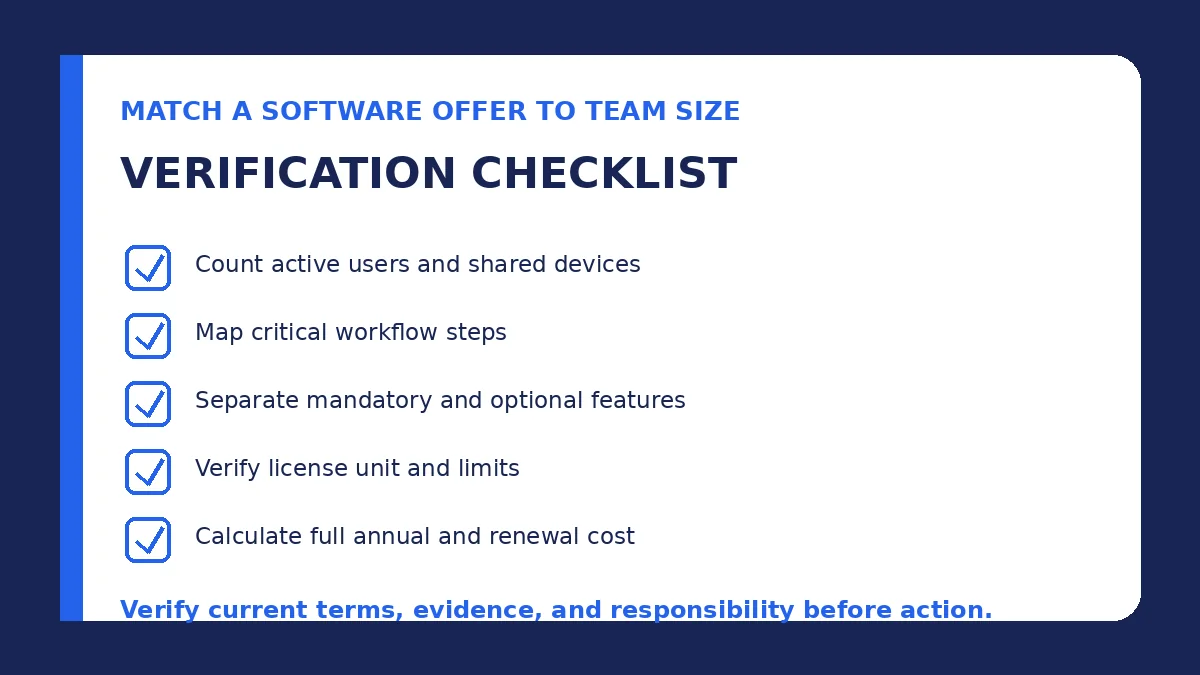
match a software offer to team size verification checklist
- Count active users and shared devices
- Map critical workflow steps
- Separate mandatory and optional features
- Verify license unit and limits
- Calculate full annual and renewal cost
- Check export and cancellation path
- Record a fit score and exit trigger
Complete the match a software offer to team size checklist before checkout, publication, or a change to the operating plan.
Continue the decision
Frequently asked questions
Should I buy extra seats for future growth?
Buy a reasonable growth buffer only when unused seats are affordable and easy to reassign. Avoid large minimums without a hiring plan.
How do I compare bundles with single tools?
Value only the products and rights the team will actually use, then subtract overlap and migration cost.
What belongs in the budget ceiling?
Include subscription, tax, add-ons, support, implementation, migration, payment cost, and renewal pricing.
Why define an exit rule before buying?
It prevents lock-in and makes future renewal decisions evidence-based rather than driven by sunk cost.
Operating record and review cadence
Keep a compact record for match a software offer to team size containing the decision date, source URLs, evidence captured, selected provider or plan, price and currency where relevant, eligibility and limits, cancellation or change owner, tracking path, last verified date, next review date, and the event that would trigger a new decision. This turns the article into a repeatable operating method rather than a one-time recommendation.
Review the record at the cadence appropriate to the topic. Evergreen licensing and booking decisions can be reviewed quarterly or before renewal. Live offers, travel rules, and launch-status pages require more frequent official-source checks. Remove unsupported precision, keep the permanent URL stable, and update the visible verification date whenever a material claim changes.
Sources and verification
- Microsoft licensing resources
- Microsoft 365 Apps licensing guidance
- Stripe usage-based billing documentation
Verification rule: Recheck official terms, current provider instructions, and destination behavior before implementing any recommendation from this match a software offer to team size.
Last Updated on August 1, 2026