Last verified: 2026-08-01
TOOLRELIEF DECISION INTELLIGENCE
- Decision
- Use Per-User vs Per-Device vs Usage-Based Software Licensing to compare the documented alternatives and understand the costs, constraints, and trade-offs that materially affect the choice.
- Evidence Basis
- Comparative analysis of the capabilities, costs, constraints, limitations, and trade-offs documented for the options evaluated on this page.
- Best Used For
- Shortlisting alternatives and identifying the trade-offs that materially affect the final choice.
- Decision Boundary
- The better option depends on the requirements and constraints of the actual use case. Product capabilities, pricing, contracts, implementation conditions, and third-party terms can change.
per-user vs per-device vs usage-based software licensing is the decision this guide resolves. Software pricing is not comparable until the licensed unit is normalized. A named-user plan can cover several devices but charge for inactive staff. A per-device plan can suit shared terminals but become expensive when every employee carries multiple devices. A usage-based plan can look efficient at low volume and become volatile during spikes. This guide turns those models into one operating decision.
Use per-user licensing when people are stable and work across several devices. Use per-device licensing for shared or dedicated equipment with rotating users. Use usage-based licensing when demand is measurable, controllable, and protected by budgets, alerts, and caps. Compare the same workload across all three models before buying.
per-user vs per-device vs usage-based software licensing — the short decision
Use per-user licensing when people are stable and work across several devices. Use per-device licensing for shared or dedicated equipment with rotating users. Use usage-based licensing when demand is measurable, controllable, and protected by budgets, alerts, and caps. Compare the same workload across all three models before buying.
Affiliate disclosure: ToolRelief is an independent publisher, not the seller, booking provider, rail operator, hotel, airline, card issuer, regulator, or government authority. Some partner relationships may compensate ToolRelief without changing the visitor’s price. Terms, eligibility, availability, payment, and fulfillment remain controlled by the provider.
Define the licensed unit before comparing price
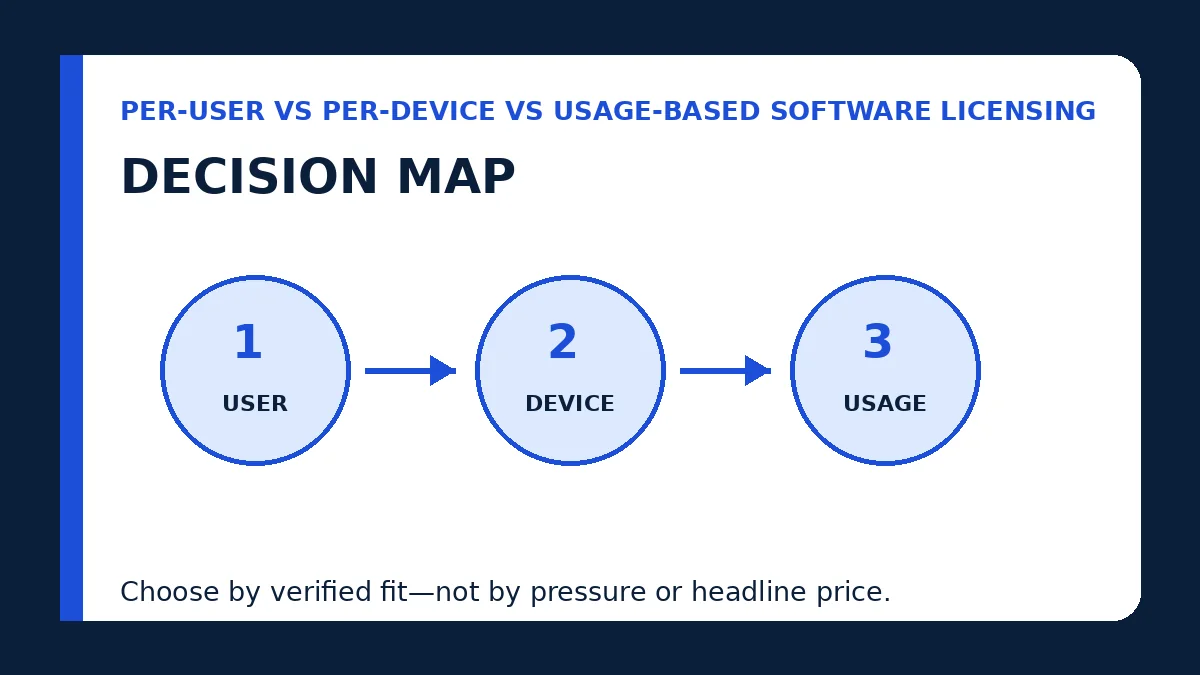
Per-user licensing usually assigns rights to a named person. Per-device licensing assigns rights to a specific endpoint or shared machine. Usage-based licensing meters an event such as transactions, storage, messages, compute, seats consumed, or another measurable unit.
For this per-user vs per-device vs usage-based software licensing, a quoted monthly price is incomplete until the permitted users, devices, environments, and usage boundaries are documented. The licensed unit determines whether growth increases cost gradually, in steps, or unpredictably.
Calculate cost with an active-use denominator
Divide total annual cost by active users, active devices, and the workload that actually creates value. Include minimum commitments, overages, add-ons, support tiers, and tax.
Per-user vs per-device vs usage-based software licensing should be tested under normal, peak, and contraction scenarios. A model that is cheapest today can become the most expensive after hiring, device expansion, or a temporary usage surge.
Check sharing, transfer, and reassignment rules
Named-user plans may prohibit credential sharing. Device plans may restrict transfer frequency or require activation management. Usage plans may meter background jobs that users do not consciously trigger.
For this per-user vs per-device vs usage-based software licensing, document what happens when an employee leaves, a laptop is replaced, a shared device changes location, or a workflow moves to automation. Administrative friction can outweigh a small price difference.
Model volatility and budget control
Usage pricing is strongest when meters are observable and the team can set limits, alerts, and service-level safeguards. It is risky when the billed unit is hard to forecast or when failure to consume stops a critical workflow.
Seat and device plans offer more predictable billing but can create waste through unused allocations. Use a range, not a single estimate, and define the cost level that triggers a plan change.
Match the model to real team patterns
Knowledge workers with several devices often fit named-user licensing. Front desks, kiosks, labs, and shared workstations may fit device licensing. Variable APIs, messaging, compute, or seasonal workloads may fit usage pricing.
For this per-user vs per-device vs usage-based software licensing, hybrid plans require extra care because a base subscription, included allowance, and overage meter can combine three cost structures in one invoice.
Create a license decision record
Record the chosen unit, permitted use, reassignment process, minimum commitment, included allowance, overage rate, budget alert, renewal date, and owner.
Revisit the model when headcount, device count, workflow volume, or automation changes. The correct license model is an operating choice, not a permanent label.
Software licensing decision matrix
Use this per-user vs per-device vs usage-based software licensing matrix to compare the same evidence across every option before acting.
| Factor | Per-user | Per-device | Usage-based |
|---|---|---|---|
| Best fit | Stable named staff using several devices | Shared or dedicated equipment | Variable measurable workloads |
| Budget behavior | Predictable by headcount | Predictable by device count | Variable by consumption |
| Primary waste risk | Inactive or duplicate seats | Idle or replaced devices | Unexpected spikes and hidden meters |
| Control required | User lifecycle management | Asset and activation management | Metering, alerts, caps, and forecasts |
Practical decision example
A twelve-person agency has eighteen laptops and phones, two shared editing stations, and a variable automation workload. Named-user licenses fit collaboration software, device licenses fit the shared stations, and usage pricing fits automation only after alerts and a monthly cap are configured. The lowest-cost portfolio uses more than one licensing model because the operating units are different.
The example shows why per-user vs per-device vs usage-based software licensing should be decided through documented evidence and operating fit rather than a headline claim.
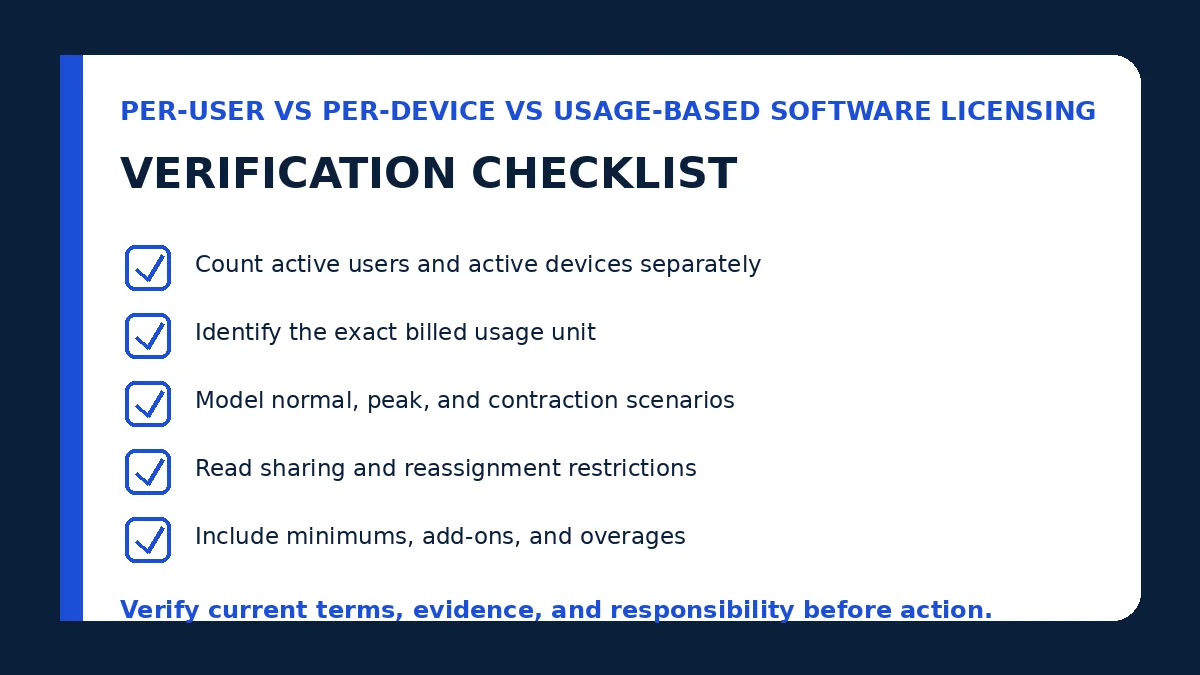
per-user vs per-device vs usage-based software licensing verification checklist
- Count active users and active devices separately
- Identify the exact billed usage unit
- Model normal, peak, and contraction scenarios
- Read sharing and reassignment restrictions
- Include minimums, add-ons, and overages
- Set an owner and budget threshold
- Review the model before renewal
Complete the per-user vs per-device vs usage-based software licensing checklist before checkout, publication, or a change to the operating plan.
Continue the decision
- Check software deal license limits
- Match an offer to team size
- Compare lifetime and subscription economics
Frequently asked questions
Is per-user licensing always better for remote teams?
No. It is useful when named employees use several devices, but shared devices, contractors, and seasonal staff can change the economics.
When is per-device licensing cheaper?
It can be cheaper when many rotating users share a small number of fixed devices and the license terms permit that pattern.
What makes usage-based licensing risky?
Unclear meters, uncontrolled background activity, weak alerts, minimum commitments, and unpredictable peaks can create bill shock.
Can one software stack use several license models?
Yes. Choose the model that matches each workload and manage the portfolio through one renewal and ownership register.
Operating record and review cadence
Keep a compact record for per-user vs per-device vs usage-based software licensing containing the decision date, source URLs, evidence captured, selected provider or plan, price and currency where relevant, eligibility and limits, cancellation or change owner, tracking path, last verified date, next review date, and the event that would trigger a new decision. This turns the article into a repeatable operating method rather than a one-time recommendation.
Review the record at the cadence appropriate to the topic. Evergreen licensing and booking decisions can be reviewed quarterly or before renewal. Live offers, travel rules, and launch-status pages require more frequent official-source checks. Remove unsupported precision, keep the permanent URL stable, and update the visible verification date whenever a material claim changes.
Sources and verification
- Microsoft licensing guides
- Microsoft 365 Apps licensing guidance
- Stripe usage-based billing documentation
Verification rule: Recheck official terms, current provider instructions, and destination behavior before implementing any recommendation from this per-user vs per-device vs usage-based software licensing.
Last Updated on August 1, 2026