Last verified: 2026-08-01
TOOLRELIEF DECISION INTELLIGENCE
- Decision
- Use Renewal Discount vs New Customer Discount: Which Software Price Is Better? to compare the documented alternatives and understand the costs, constraints, and trade-offs that materially affect the choice.
- Evidence Basis
- Comparative analysis of the capabilities, costs, constraints, limitations, and trade-offs documented for the options evaluated on this page.
- Best Used For
- Shortlisting alternatives and identifying the trade-offs that materially affect the final choice.
- Decision Boundary
- The better option depends on the requirements and constraints of the actual use case. Product capabilities, pricing, contracts, implementation conditions, and third-party terms can change.
renewal discount vs new customer discount is the decision this guide resolves. Introductory prices are designed to win a new customer, while renewal prices determine the cost of staying. The headline percentage can hide a large reset after year one, but switching to a new account can also create migration work, lost data, duplicate billing, and eligibility problems. The useful comparison is the effective multi-year cost of each path.
Choose a renewal offer when the retained workflow, data, configuration, and support are worth more than the apparent new-customer saving. Choose a new-customer path only when eligibility is legitimate, migration is practical, and the full transition cost remains lower. Compare at least two years, not only the first invoice.
renewal discount vs new customer discount — the short decision
Choose a renewal offer when the retained workflow, data, configuration, and support are worth more than the apparent new-customer saving. Choose a new-customer path only when eligibility is legitimate, migration is practical, and the full transition cost remains lower. Compare at least two years, not only the first invoice.
Affiliate disclosure: ToolRelief is an independent publisher, not the seller, booking provider, rail operator, hotel, airline, card issuer, regulator, or government authority. Some partner relationships may compensate ToolRelief without changing the visitor’s price. Terms, eligibility, availability, payment, and fulfillment remain controlled by the provider.
Calculate the Real Renewal Cost
Separate introductory price from recurring price
Record the first-term charge, the standard renewal amount, the billing interval, taxes, add-ons, and any price protection. A large first-year discount does not define the long-term contract.
For this renewal discount vs new customer discount, renewal discount vs new customer discount analysis should use a timeline. Mark the price paid today, the next automatic charge, and every point where the vendor can change the plan or remove a promotion.
Verify eligibility and account continuity
New-customer discounts may exclude previous customers, related accounts, existing domains, or reactivated subscriptions. Creating a second account can violate terms or fragment ownership.
Confirm whether data, licenses, credits, history, and integrations transfer. A cheap account that cannot inherit the current workflow is not a comparable replacement.
Add migration and switching costs
Include export work, reconfiguration, downtime, training, parallel subscriptions, lost credits, and the risk that a migration fails.
For this renewal discount vs new customer discount, a renewal offer can be economically stronger even with a higher invoice when switching would consume several staff days or interrupt revenue-producing work.
Test retention offers without relying on them
Some vendors present retention pricing during cancellation or after a support request. Treat that as a possible option, not a guaranteed forecast.
Save the written terms, duration, renewal price, and cancellation status. Never assume that a temporary retention discount will repeat at the next renewal.
Compare the same time horizon
Calculate total cost over twenty-four or thirty-six months, including one-time transition costs and the value of remaining prepaid service.
For this renewal discount vs new customer discount, use best-case, expected, and worst-case scenarios. The most important variable is often the price reset after the introductory term, not the original discount percentage.
Set the renewal decision deadline
Start review before the cancellation notice window closes. Assign an owner, preserve invoices and terms, and choose renew, renegotiate, downgrade, or switch.
The decision should be completed before automatic billing, not after the new charge becomes a refund dispute.
Renewal and new-customer cost matrix
Use this renewal discount vs new customer discount matrix to compare the same evidence across every option before acting.
| Cost element | Renewal path | New-customer path |
|---|---|---|
| Immediate price | Current renewal or retention offer | Introductory price |
| Future price | Standard renewal after offer | Reset after introductory term |
| Operational cost | Low if workflow continues | Migration, setup, and parallel-run cost |
| Eligibility risk | Usually low for existing account | Can be restricted by vendor terms |
Practical decision example
A team can renew a project tool for $900 or open a discounted new account for $600. Moving projects, integrations, permissions, and training would consume twelve staff hours and require one month of overlap. The new account is cheaper on the invoice but more expensive in total, so the team renews and schedules a competitive review before the next term.
The example shows why renewal discount vs new customer discount should be decided through documented evidence and operating fit rather than a headline claim.
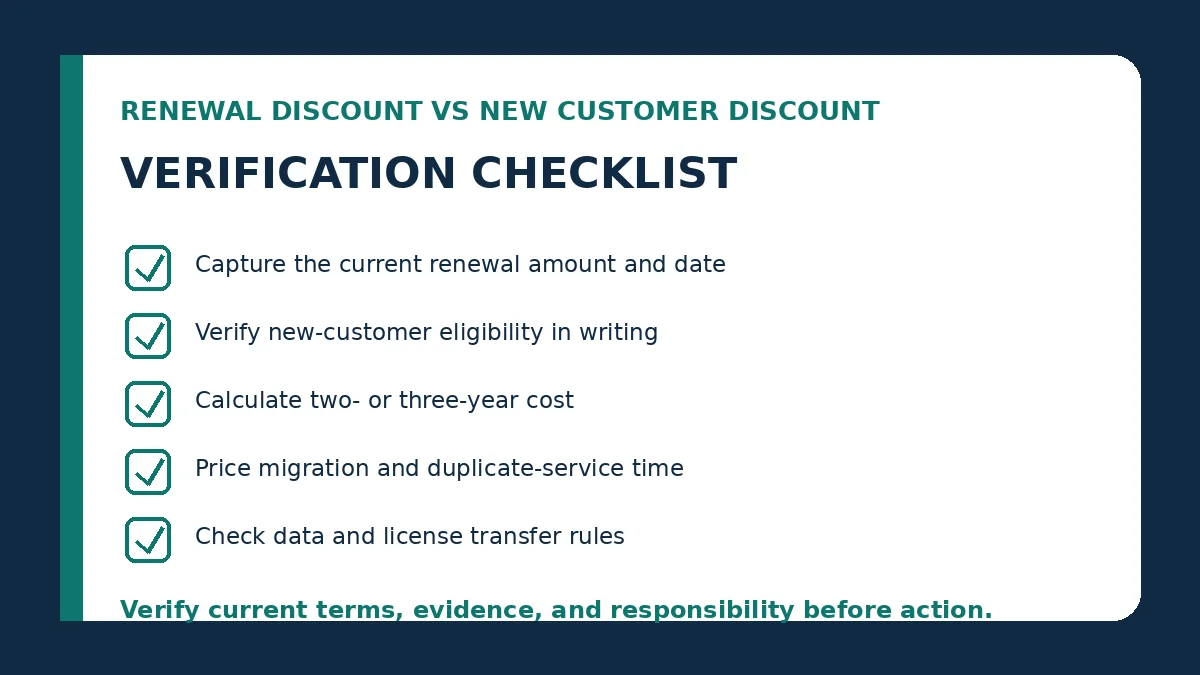
renewal discount vs new customer discount verification checklist
- Capture the current renewal amount and date
- Verify new-customer eligibility in writing
- Calculate two- or three-year cost
- Price migration and duplicate-service time
- Check data and license transfer rules
- Save retention-offer terms
- Decide before the cancellation window closes
Complete the renewal discount vs new customer discount checklist before checkout, publication, or a change to the operating plan.
Continue the decision
Frequently asked questions
Are new-customer discounts available to former customers?
Not always. Eligibility can depend on prior accounts, email domains, payment methods, or vendor-specific rules.
Should I cancel to get a retention offer?
Do not rely on an offer that has not been presented in writing. First protect data, export options, and the cancellation deadline.
How many years should I compare?
Use at least two years when the introductory term resets at the first renewal; longer commitments may require a three-year model.
What is the biggest hidden cost of switching?
Migration labor, parallel subscriptions, lost configuration, and workflow interruption often exceed the visible price difference.
Operating record and review cadence
Keep a compact record for renewal discount vs new customer discount containing the decision date, source URLs, evidence captured, selected provider or plan, price and currency where relevant, eligibility and limits, cancellation or change owner, tracking path, last verified date, next review date, and the event that would trigger a new decision. This turns the article into a repeatable operating method rather than a one-time recommendation.
Review the record at the cadence appropriate to the topic. Evergreen licensing and booking decisions can be reviewed quarterly or before renewal. Live offers, travel rules, and launch-status pages require more frequent official-source checks. Remove unsupported precision, keep the permanent URL stable, and update the visible verification date whenever a material claim changes.
Sources and verification
Verification rule: Recheck official terms, current provider instructions, and destination behavior before implementing any recommendation from this renewal discount vs new customer discount.
Last Updated on August 1, 2026