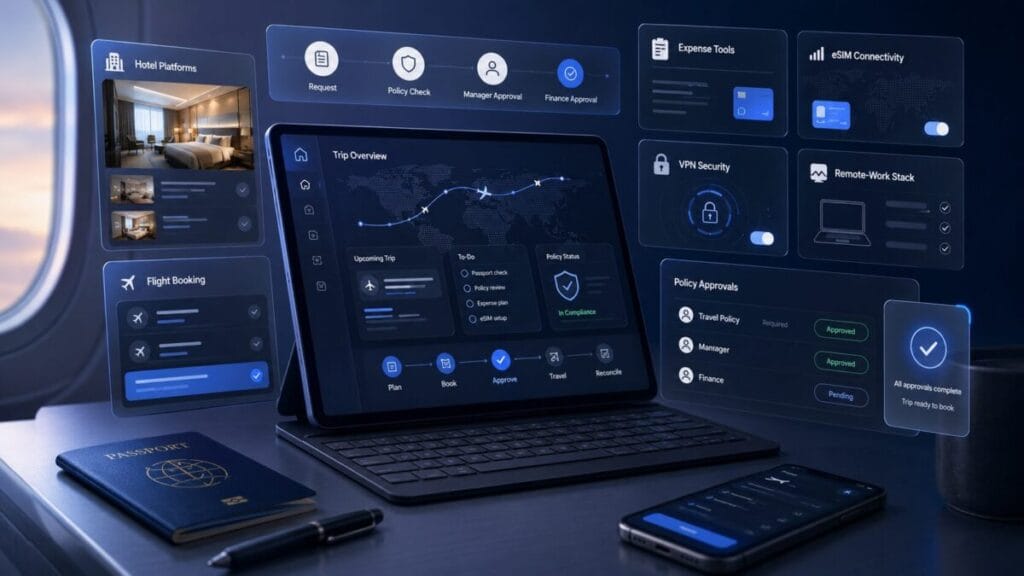
ToolRelief Travel Ops dashboard for business travel apps hotel platforms eSIMs VPNs and expense decisions
TRAVEL OPS

Travel Ops

Business travel is no longer just flights and hotels. It is a software, security, expense, connectivity, and mobility decision stack. Travel Ops helps lean teams decide how travel tools should move money, access, receipts, approvals, and remote work through the business.

Decision Console

Travel Ops Decision Console

Travel Ops does not work like a related-links block. It works like a command console. Pick the pressure point, then route the issue into the right ToolRelief decision lane.

Route

Unknown travel decision

The issue touches cost, security, devices, software, policy, or vendor choice.
Choose

Tool or platform choice

The team is choosing between booking tools, eSIM apps, VPNs, or expense platforms.

Finance

Receipts and cost visibility

Travel cost is scattered across cards, reimbursements, receipts, invoices, and approvals.

Security

Remote access risk

The traveler needs safer account access, VPN review, device readiness, or public Wi-Fi controls.

Monitor

Platform or vendor movement

Travel platforms, VPN tools, eSIM apps, or expense products are changing.

Device

Hardware reliability

The travel setup depends on laptops, phones, chargers, security keys, routers, or travel gear.

VPN

Connectivity and access

A VPN is not a badge. It is a remote-access control layer that should match the trip.

Partner

Decision-stage audience

Travel, expense, VPN, eSIM, and mobility partners should support clear decisions with disclosure.

Positioning

The travel stack is now a software stack

You are not choosing a travel app. You are choosing how money, access, receipts, approvals, identity, connectivity, devices, and mobility move through the stack. Cheap booking is not cheap if cancellation, invoice, or support friction eats the margin.

Cost Layer

Cost control is not just the ticket price

Business travel cost includes booking fees, cancellation rules, loyalty value, expense delays, reimbursement friction, roaming charges, and the time wasted fixing avoidable travel problems.

Access Layer

Security control travels with the worker

Remote work does not stop at the airport. The travel stack needs VPN fit, device readiness, account protection, public Wi-Fi caution, and clear access boundaries.

Workflow Layer

Workflow control decides whether travel scales

Travel becomes operational debt when booking, approval, receipts, connectivity, and finance visibility are spread across disconnected tools and inboxes.

Signal Stream

Travel Stack Signal Stream

These are operating signals, not travel tips. When one keeps appearing, the team may need to change the tool, policy, workflow, vendor, or review rhythm.

Detected

Booking friction

A cheap booking flow can become expensive when support, invoices, or cancellation rules fail the business use case.

Detected

eSIM coverage

Coverage, hotspot support, speed limits, and activation timing should be checked before the trip, not after landing.

Detected

VPN access

A VPN that slows critical work or fails in the wrong region creates security theater instead of security control.

Detected

Expense drag

Receipts, approvals, cards, and reimbursements decide how fast travel cost becomes visible.

Detected

Hotel invoice risk

Stay platforms affect invoice clarity, support, cancellation friction, and whether a trip can be defended as a business cost.

Detected

Device readiness

Laptop, phone, charger, backup connectivity, and security key readiness can decide whether travel work actually works.

Detected

Reimbursement delay

Slow reimbursement creates employee friction and hides cost until the work is already done.

Detected

Travel policy gaps

If approvals live in chat and decisions live in memory, travel cost becomes invisible until it is already spent.

External Service Demand Engine

Travel Ops External Service Demand Engine

Travel Ops tracks external service categories where business travel, remote work, connectivity, access, expense control, and work hardware create real decision pressure for Western teams in 2026.

Demand Lane Connectivity Pressure

Travel eSIM and roaming alternatives

Decision pressure

Travelers need reliable mobile data without roaming shock, public Wi-Fi dependence, failed hotspot support, or last-minute activation problems.

Why it matters in 2026

International business travel and remote-work trips increasingly depend on fast setup, device compatibility, regional coverage, and predictable data access.

External services examples
Airalo Holafly Nomad Saily
Search intent
  • Airalo vs Holafly
  • Nomad vs Saily
  • eSIM vs roaming for business travel
  • best-fit eSIM for Europe travel
Future asset path

comparison / checklist / travel connectivity template / roaming cost guide

Evaluate travel connectivity
Monitored Category Access Risk

Secure travel access — VPN, ZTNA, and account protection

Decision pressure

Travel creates access risk when work depends on hotel Wi-Fi, airport networks, unmanaged devices, SaaS logins, passwords, and region-sensitive workflows.

Why it matters in 2026

Remote-work security decisions now sit between traditional VPNs, Zero Trust access, password managers, MFA, browser exposure, and SaaS identity control.

External services examples
NordLayer Cloudflare Zero Trust Twingate 1Password Bitwarden YubiKey
Search intent
  • VPN vs ZTNA for remote teams
  • business VPN for travel
  • password manager for remote workers
  • YubiKey for small business travel
Future asset path

comparison / risk guide / secure travel checklist / access review template

Review secure access
Decision Pressure Booking + Expense Drag

Business travel management and expense tools

Decision pressure

Business travel breaks down when booking, approvals, cards, receipts, reimbursements, invoices, and reporting live across disconnected systems.

Why it matters in 2026

Lean teams need clearer travel cost visibility before trips become reimbursement drag, policy confusion, approval delay, or finance cleanup work.

External services examples
TravelPerk Navan SAP Concur Expensify Ramp Brex
Search intent
  • TravelPerk vs Navan
  • Concur alternatives for small teams
  • Expensify vs Ramp
  • business travel expense app
Future asset path

comparison / expense checklist / travel policy template / reimbursement friction guide

Check booking friction
Commercial Route Hardware Readiness

Travel-ready work hardware

Decision pressure

Travel work fails when the laptop, phone, charger, dock, webcam, security key, storage, backup connection, or adapter is not ready for the trip.

Why it matters in 2026

Remote work, AI-heavy browser workflows, video calls, client travel, and mobile security make hardware readiness part of the business travel stack.

External services examples
Anker UGREEN CalDigit Logitech YubiKey Samsung portable SSD
Search intent
  • portable monitor for remote work
  • USB-C dock for travel work
  • travel tech checklist for remote workers
  • security key for business travel
Future asset path

checklist / template / hardware comparison / device risk guide

Assess travel-ready hardware
Editorial demand note

ToolRelief may use reader demand, search signals, and category relevance to decide which travel service categories deserve deeper guides, comparison pages, or future sponsor-ready placements. Placement should support reader decisions, not replace them.

INTEL HUB ROUTES

Intel Hub Decision Stream

Move across ToolRelief’s decision routes for software, AI, travel, devices, FinOps, security, hosting, offers, and partner-ready intelligence.

Command Center Intel Hub Route software, AI, travel, device, FinOps, security, and offer decisions from one intelligence layer. Move to Intel Hub Decision Route Software Decision Finder Use this when the next step is unclear and the stack needs a practical decision path. Find the path Travel Stack Travel Ops Review business travel apps, eSIMs, VPNs, expense drag, booking friction, and mobility infrastructure. Review travel ops Signal Layer Tech Radar Track software, AI, pricing, security, vendor, and technology movement as decision signals. Check signals Hardware Layer Device Intel Review smartphones, laptops, accessories, security keys, workspace gear, and travel hardware. Review devices Money Layer FinOps Insights Follow software spend, AI subscription costs, renewal risk, pricing drift, and budget leaks. Follow the money AI Stack AI Tools Hub Review AI tool overlap, stack planning, subscription fatigue, and practical AI decisions. Review AI tools Security Layer Cybersecurity Hub Review access risk, remote work security, vendor trust, and cybersecurity stack decisions. Review security Remote Access VPN Checklist Check whether a VPN still fits travel, remote work, privacy, access, and regional needs. Review VPN fit Hosting Layer VPS Deal Tracker Review VPS hosting choices by workload, cost, reliability, performance, and vendor fit. Review hosting Offer Watch Software Offer Signals Watch offers, bundles, discounts, and plan movement before buying or renewing software. Check offers Trend Watch Software Trends Signals Track software category movement, AI shifts, vendor changes, and decision-relevant trends. Check trends Partner Layer Advertise with ToolRelief Reach decision-stage audiences across software, AI, FinOps, travel, devices, security, and hosting. Explore partnership

Decision Modules

The business travel decision map

Travel Ops breaks the travel stack into decision layers. Each layer should be reviewed by fit, friction, cost visibility, security impact, and whether it earns a place in the operating system.

Search

Booking layer

Planning tools help compare options, but comparison is not the decision. The route, policy, support model, and total workflow still decide fit.

Stay

Stay and invoice layer

Hotel and stay choices affect invoice quality, cancellation friction, loyalty value, support access, location risk, and business-cost defensibility.

Platform

Travel management layer

Centralized travel platforms can reduce chaos when travel volume, approvals, policy, and reporting justify the system. Without that pressure, they may become another workflow.

Finance

Expense visibility layer

Expense tools are not finance decoration. They decide how fast travel cost becomes visible, approved, reimbursed, and reviewed.

Connectivity

Connectivity layer

An eSIM is not a travel hack. It is a connectivity decision shaped by coverage, hotspot support, data limits, activation timing, and region fit.

Security

Remote access layer

VPN and access decisions should match public Wi-Fi exposure, account risk, regional restrictions, performance needs, and the work being done.

Hardware

Device readiness layer

The real travel stack includes laptop, phone, charger, backup connection, VPN, password manager, authenticator, files, receipts, and support workflows.

Policy

Approval and policy layer

If approvals live in chat, receipts live in email, and decisions live in memory, travel cost becomes invisible until it is already spent.

Decision Table

When to use each travel layer

The right layer depends on volume, risk, policy, speed, and how much control the team needs. No single tool fixes a broken travel operating model.

DecisionUse when...Action route
Use direct bookingYou need clearer hotel support, loyalty control, a simple one-off trip, or fewer platform layers. Watch invoice gaps, manual expense handling, and missed policy controls.
Follow cost visibility
Use a travel platformThe team needs centralized booking, approval workflows, reporting, traveler visibility, and policy enforcement. Watch for enterprise process before travel volume justifies it.
Check the decision
Use an eSIMConnectivity risk is real and roaming is too expensive, unclear, or unreliable for the trip. Check coverage, hotspot support, activation timing, speed limits, and device compatibility.
Review device readiness
Use a VPNRemote access, public Wi-Fi, account protection, or region-aware work continuity matters. Watch performance drop, unsupported regions, and overlap with existing security tools.
Review VPN Decisions
Use expense softwareReceipts, reimbursements, card spend, approvals, or reporting create operational drag. Watch seat cost, implementation work, duplicate finance tools, and process bloat.
Follow the money leak
Use a manual workflowTravel volume is low and the team only needs a lightweight checklist, budget owner, and receipt discipline. Watch for breakage when travel frequency, team size, or reimbursement complexity increases.
Move to Intel Hub

Stack Review

What to review before adding another travel tool

Before buying another travel platform, eSIM app, VPN plan, or expense workflow, review the current operating gap. A tool should remove friction, not create a new category of maintenance.

Owner

Who owns the travel decision?

If nobody owns booking policy, expense visibility, VPN usage, or device readiness, the problem is ownership before software.

Money

Where does cost become visible?

If cost only appears after reimbursement, the team is reacting to spend instead of controlling it.

Risk

Which layer creates the most risk?

Booking friction, device weakness, VPN gaps, expense delays, and security exposure should not be treated as the same problem.

Process

Is the tool replacing a broken process?

If the team has no travel policy, no receipt rhythm, and no approval rules, software may organize the mess instead of fixing it.

Adoption

Will the traveler actually use it?

Travel tools fail when they add steps at the exact moment users are tired, mobile, offline, rushed, or dealing with changes.

Overlap

Does it overlap existing software?

Expense platforms, corporate cards, booking tools, accounting software, and travel policies can overlap before anyone notices.

Action Routes

Move from travel friction to the correct decision asset

Each route below moves the reader toward a specific decision action instead of leaving them with passive reading.

VPN

VPN and access control

Use this when the trip depends on safer remote access, public Wi-Fi exposure, regional restrictions, or account protection.

Security

Travel security review

Use this when travel creates account, network, device, permissions, or remote-work security exposure.

Hardware

Hardware and travel reliability

Use this when failures come from laptops, phones, chargers, storage, backup connections, or travel gear.

Finance

Expense and reimbursement drag

Use this when travel cost visibility is delayed by receipts, approvals, reimbursements, cards, or finance workflows.

Radar

Vendor and platform movement

Use this when travel platforms, eSIM tools, VPN plans, expense products, or mobility categories are changing.

System

Unknown travel stack issue

Use this when the issue does not fit neatly into cost, security, device, VPN, booking, or expense categories.

Partner Ready

Travel Ops is built for decision-stage travel and mobility audiences

Travel Ops can support relevant partners across business travel platforms, expense tools, eSIM providers, VPN services, hotel and stay platforms, remote-work infrastructure, cybersecurity tools, and mobility products. The standard is not exposure alone. The placement must help a reader make a clearer travel, security, cost, or workflow decision.

Partnership and sponsorship opportunities should be aligned with editorial fit, reader value, and clear disclosure.

FAQ

Travel Ops FAQ

Is Travel Ops a travel blog?

No. Travel Ops is a business travel decision hub. It focuses on travel software, eSIMs, VPNs, expense tools, booking friction, remote-work travel infrastructure, and cost visibility.

Should every small team use a business travel platform?

No. A travel platform makes sense when travel volume, approvals, reporting, policy control, or reimbursement complexity justify the extra system.

Are eSIMs always better than roaming?

No. eSIMs can be useful, but the decision depends on coverage, device compatibility, hotspot needs, data limits, trip length, and how critical mobile connectivity is to the work.

Why does ToolRelief include travel inside software decision intelligence?

Modern travel depends on software, access, devices, connectivity, security, expenses, and approval workflows. That makes it part of the operating stack, not a separate lifestyle topic.

Final Decision CTA

Do not let travel tools become another unmanaged stack

Use Travel Ops to review booking, expense, eSIM, VPN, hotel, device, and remote-work travel decisions before they become budget leaks, security gaps, reimbursement drag, or workflow debt.

ToolRelief software decision intelligence system logo
ToolRelief System Page Independent Decision Layer

Verified as part of the ToolRelief Software Decision Intelligence System

This page is part of ToolRelief’s software decision intelligence system for lean teams, founders, operators, software buyers, and budget-conscious users. ToolRelief connects practical decision resources across SaaS waste, AI tool overlap, renewal pressure, unused licenses, VPN decisions, VPS hosting choices, cybersecurity tools, templates, calculators, pricing evidence, offer signals, and software trend signals.

Each page is designed to support clearer software decisions before users buy, renew, replace, consolidate, sponsor, or evaluate a software product or category.

ToolRelief is founded by Waleed Al-Qasem, founder of Nexio Global. The platform is designed to support clearer software decisions for founders, operators, finance teams, software buyers, and small businesses.

ToolRelief is independent. References to tools, vendors, software categories, pricing, offers, or market signals are provided for editorial, educational, and decision-support purposes. No sponsorship, endorsement, ranking position, or commercial relationship is implied unless clearly disclosed.
ToolRelief Articles Read SaaS waste, AI tools, pricing, workflow, and research guides
Scroll to Top