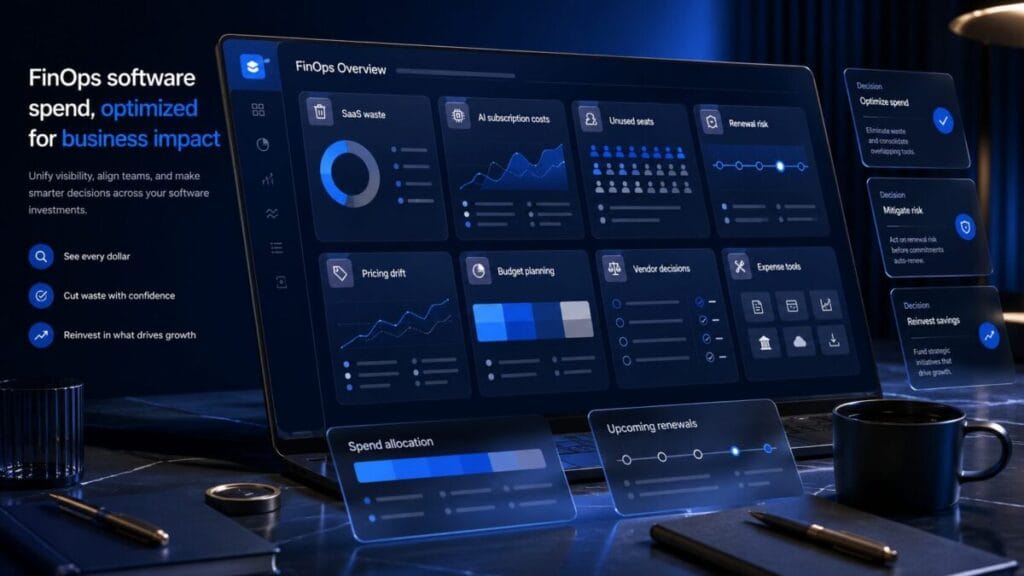
ToolRelief FinOps Insights dashboard for software spend SaaS waste AI costs and renewal risk
FINOPS INSIGHTS

FinOps Insights

FinOps Insights is not a finance blog. It is an operational finance decision layer for software spend, SaaS waste, AI subscription costs, renewal risk, pricing drift, unused seats, expense tools, procurement friction, and budget leaks.

Decision Console

FinOps Insights Decision Console

FinOps Insights turns software cost pressure into decision routes. The goal is not vague savings advice. The goal is to identify where money is leaking, who owns the decision, whether the tool still earns budget, and what action fits next.

Route

Unclear software cost problem

The issue may involve spend, renewal, usage, overlap, ownership, procurement, or stack design.
Find

Money leak detection

The team needs to locate waste before deciding whether to keep, cut, downgrade, or audit.

Renew

Renewal decision pressure

A renewal is approaching and the team does not know whether the tool still deserves budget.

Seats

Unused license pressure

Paid access may be inactive, duplicated, unassigned, or disconnected from active work.

AI

AI subscription overlap

AI plans may duplicate each other across writing, research, coding, meetings, agents, or automation.

Audit

Stack needs review

The team needs a structured review before making cuts, renewals, downgrades, or replacement decisions.

Benchmark

Cost feels hard to judge

The team needs a clearer way to compare software cost pressure before acting.

Partner

Decision-stage audience

FinOps, expense, procurement, AI cost, and SaaS partners should support clearer software spend decisions.

Positioning

The budget leak is usually a decision leak

Software spend does not become messy because teams are careless. It becomes messy when ownership, usage, seats, renewals, AI plans, pricing changes, and workflow value are not reviewed with the same discipline as the purchase.

Ownership

Cost without ownership becomes invisible

A tool becomes risky when nobody owns the budget, the renewal, the seat count, the usage review, or the workflow it is supposed to support.

AI Cost

AI spending needs sharper review

AI plans, agents, usage billing, and overlapping subscriptions can create cost pressure when adoption moves faster than ownership.

Renewal

The worst renewal is the one nobody noticed

A renewal should force a decision: keep, cut, downgrade, consolidate, replace, monitor, or audit. Silence is not a strategy.

Signal Stream

FinOps Signal Stream

These are operational finance signals, not generic savings tips. When one appears, the question is what decision caused the leak and what action should happen next.

Detected

Unused seats

Paid access that is inactive, unassigned, underused, or disconnected from active work should trigger a seat review.

Detected

AI plan overlap

Multiple AI subscriptions can appear useful while solving the same job across writing, research, coding, or meetings.

Detected

Pricing drift

Plan packaging, feature gates, usage billing, or seat changes can make yesterday’s fit weaker today.

Detected

Renewal silence

A renewal without a review is a decision made by default instead of judgment.

Detected

Duplicate workflow tools

Different teams can pay for separate tools that manage the same job before anyone sees the overlap.

Detected

Procurement friction

When approval, ownership, and budget rules are unclear, software buying becomes scattered.

Detected

Expense tool sprawl

Cards, reimbursements, receipts, travel, subscriptions, and expense software can overlap without clear visibility.

Detected

Useful but not necessary

A tool can be helpful and still not deserve budget if the stack already covers the job.

External Service Demand Engine

FinOps Insights External Service Demand Engine

FinOps Insights tracks external service categories where SaaS spend, AI subscription cost, renewals, pricing drift, procurement friction, and vendor spend decisions create real operating pressure for lean teams in 2026.

Demand Lane License Visibility

SaaS management and license visibility platforms

Decision pressure

Teams need clearer visibility into paid tools, active users, orphaned accounts, duplicate subscriptions, and renewal exposure before software spend becomes normal background cost.

Why it matters in 2026

SaaS stacks keep expanding across teams, AI workflows, contractors, and departments, which makes ownership and license visibility harder to manage manually.

External services examples
Zluri Torii BetterCloud Productiv Trelica
Search intent
  • SaaS management software 2026
  • SaaS license management tools
  • Zluri vs Torii
  • BetterCloud alternatives
Future asset path

comparison / checklist / SaaS visibility template / alternatives / renewal risk guide

Review SaaS visibility
Monitored Category AI Cost Pressure

AI subscription cost and usage-based pricing control

Decision pressure

AI plans can spread across users, teams, agents, copilots, research workflows, and usage-based billing before the business knows which tools still earn budget.

Why it matters in 2026

AI adoption is moving faster than approval, ownership, usage review, and budget discipline in many small and lean teams.

External services examples
ChatGPT Team Claude Team Gemini Business Perplexity Pro AI usage monitoring tools
Search intent
  • AI subscription cost control
  • usage-based AI billing risk
  • ChatGPT Team vs Claude Team
  • AI tools budget for small business
Future asset path

comparison / calculator / AI cost checklist / pricing guide / risk guide

Check AI cost pressure
Decision Pressure Expense Control

Spend management, cards, and expense control

Decision pressure

Software, travel, subscriptions, cards, reimbursements, receipts, and approvals can fragment across finance workflows until spend is visible only after it has already happened.

Why it matters in 2026

Lean teams need faster spend visibility and cleaner controls as software, AI tools, remote work, and travel costs move through more payment paths.

External services examples
Ramp Brex Airbase Spendesk Expensify
Search intent
  • Ramp vs Brex
  • spend management software 2026
  • expense management for startups
  • corporate card for small business
Future asset path

comparison / checklist / spend control template / alternatives / risk guide

Review spend control
Commercial Route Renewal Control

Procurement, renewal negotiation, and subscription control

Decision pressure

Renewals become expensive by default when procurement, negotiation, subscription ownership, approval timing, and vendor alternatives are not reviewed before the deadline.

Why it matters in 2026

Pricing drift, AI packaging, annual commitments, and vendor consolidation make renewal discipline more important for teams that cannot absorb silent stack growth.

External services examples
Vendr Sastrify Cledara Substly Tropic
Search intent
  • SaaS procurement software
  • Vendr alternatives
  • Sastrify alternatives
  • SaaS renewal negotiation checklist
Future asset path

comparison / renewal guide / negotiation checklist / alternatives / pricing guide

Assess renewal control
Editorial demand note

ToolRelief may use reader demand, search signals, and category relevance to decide which software spend categories deserve deeper guides, comparison pages, renewal checklists, calculators, or future sponsor-ready placements. Placement should support reader decisions, not replace them.

FinOps Modules

What FinOps Insights tracks

FinOps Insights separates software cost pressure into decision layers. Each layer should answer whether the tool still earns budget, who owns it, and what action fits.

Spend

Software spend layer

Map where software spend lives, who owns it, what job it supports, and whether it still deserves operating budget.

AI Cost

AI subscription cost layer

Review overlapping AI plans, agent costs, usage exposure, seat adoption, and whether each AI tool solves a distinct job.

Renewal

Renewal and pricing risk layer

Track renewal windows, plan changes, seat minimums, pricing drift, annual commitments, and feature-gating changes.

Seats

Unused license layer

Identify seats that are inactive, duplicated, orphaned, over-assigned, or no longer tied to real work.

Benchmark

Cost benchmark layer

Use cost context to understand whether a software stack feels heavy because of price, seats, overlap, renewals, or ownership gaps.

Audit

Software audit layer

Use an audit when the team cannot confidently decide what to keep, cut, downgrade, consolidate, replace, or monitor.

Decision Format

The ToolRelief FinOps decision format

Every FinOps signal should force a decision. If the cost problem cannot explain ownership, cause, value, and next action, it is not ready for a serious spend review.

FinOps questionWhat it forces the signal to explainDecision route
Where is money leaking?The leak may come from unused seats, overlap, renewal silence, pricing drift, usage exposure, or unmanaged ownership. Start with spend signals.
Follow spend signals
Who owns the decision?The owner should be clear enough to defend the tool, review renewal, approve usage, or cut the spend. Route unclear ownership into the system.
Route this issue
Is the tool still earning budget?The tool should have active usage, a distinct job, clear value, and a reason to remain in the stack. Score the waste pressure.
Check the score
What caused the cost?The cause may be usage, seats, renewals, pricing drift, overlap, procurement friction, or ownership failure. Audit the current stack.
Audit the stack
What action fits?The next step should be keep, cut, downgrade, consolidate, replace, monitor, or audit. Convert cost pressure into action.
Check the decision

Decision Matrix

From FinOps signal to action

FinOps Insights should not leave the reader with “try to save money.” It should move software spend into a clear action category.

Keep

Keep the tool

Keep when the tool has clear ownership, active usage, distinct value, and a budget reason that still matches the workflow.

Cut

Cut the tool

Cut when the tool is unused, duplicated, orphaned, low-value, disconnected from work, or no longer owned by a clear decision maker.

Downgrade

Downgrade the plan

Downgrade when the tool is still useful but the current plan, seat count, feature tier, or usage level is heavier than the workflow needs.

Consolidate

Consolidate tools

Consolidate when several tools solve the same job across teams, creators, AI workflows, marketing, operations, or finance.

Replace

Replace the vendor

Replace when pricing, workflow fit, support, lifecycle, security, or vendor direction makes the current tool hard to defend.

Audit

Audit the stack

Audit when the team cannot clearly explain where software spend lives, who owns it, what it supports, and what should happen next.

INTEL HUB ROUTES

Intel Hub Decision Stream

Move across ToolRelief’s decision routes for software, AI, travel, devices, FinOps, security, hosting, offers, and partner-ready intelligence.

Command Center Intel Hub Route software, AI, travel, device, FinOps, security, and offer decisions from one intelligence layer. Move to Intel Hub Decision Route Software Decision Finder Use this when the next step is unclear and the stack needs a practical decision path. Find the path Travel Stack Travel Ops Review business travel apps, eSIMs, VPNs, expense drag, booking friction, and mobility infrastructure. Review travel ops Signal Layer Tech Radar Track software, AI, pricing, security, vendor, and technology movement as decision signals. Check signals Hardware Layer Device Intel Review smartphones, laptops, accessories, security keys, workspace gear, and travel hardware. Review devices Money Layer FinOps Insights Follow software spend, AI subscription costs, renewal risk, pricing drift, and budget leaks. Follow the money AI Stack AI Tools Hub Review AI tool overlap, stack planning, subscription fatigue, and practical AI decisions. Review AI tools Security Layer Cybersecurity Hub Review access risk, remote work security, vendor trust, and cybersecurity stack decisions. Review security Remote Access VPN Checklist Check whether a VPN still fits travel, remote work, privacy, access, and regional needs. Review VPN fit Hosting Layer VPS Deal Tracker Review VPS hosting choices by workload, cost, reliability, performance, and vendor fit. Review hosting Offer Watch Software Offer Signals Watch offers, bundles, discounts, and plan movement before buying or renewing software. Check offers Trend Watch Software Trends Signals Track software category movement, AI shifts, vendor changes, and decision-relevant trends. Check trends Partner Layer Advertise with ToolRelief Reach decision-stage audiences across software, AI, FinOps, travel, devices, security, and hosting. Explore partnership

Action Routes

Move from cost pressure to the correct decision asset

Each route below moves the reader toward a specific software spend, renewal, AI cost, audit, benchmark, or stack decision.

Spend

Software spend pressure

Use this when software cost is scattered across cards, departments, users, subscriptions, vendors, or approval paths.

Renewal

Renewal risk pressure

Use this when a renewal is approaching and nobody can clearly defend the tool, plan, usage, or seat count.

Seats

Unused license pressure

Use this when paid seats may be inactive, duplicated, over-assigned, orphaned, or disconnected from real work.

AI

AI subscription overlap

Use this when multiple AI plans, agents, or tools may be solving the same job across the team.

Audit

Stack audit needed

Use this when the team cannot explain what it pays for, who owns it, what it supports, and what should happen next.

Score

Waste score needed

Use this when software spend feels heavy but the team needs a sharper starting point before deeper review.

Partner Ready

FinOps Insights is built for decision-stage software spend audiences

FinOps Insights can support relevant partners across SaaS management, expense tools, procurement systems, AI cost control, subscription tracking, software audits, benchmarking, finance operations, and business software categories. The standard is not exposure alone. The placement must help a reader make a clearer software spend, renewal, ownership, or stack decision.

Partnership and sponsorship opportunities should be aligned with editorial fit, reader value, and clear disclosure.

FAQ

FinOps Insights FAQ

Is FinOps Insights a finance blog?

No. FinOps Insights is an operational finance decision layer for software spend, SaaS waste, AI subscription costs, pricing drift, renewal risk, unused seats, expense tools, procurement friction, and budget leaks.

Is this accounting or investment advice?

No. FinOps Insights is operational decision intelligence. It helps teams review software costs, ownership, usage, renewals, and stack decisions. It is not tax, legal, investment, or accounting advice.

Should every team cut software spend?

No. The goal is not blind cutting. The goal is to know which tools still earn budget, which tools need review, and which costs exist because of overlap, renewal silence, seat waste, or ownership failure.

How is FinOps Insights different from Software Spend Signals?

Software Spend Signals tracks warning patterns. FinOps Insights turns those patterns into operational decisions: keep, cut, downgrade, consolidate, replace, monitor, or audit.

Final Decision CTA

Useful is not enough. A tool must earn its seat.

Use FinOps Insights to review software spend, SaaS waste, AI subscription costs, pricing drift, renewal risk, unused seats, ownership gaps, and budget leaks before the stack becomes expensive by default.

ToolRelief software decision intelligence system logo
ToolRelief System Page Independent Decision Layer

Verified as part of the ToolRelief Software Decision Intelligence System

This page is part of ToolRelief’s software decision intelligence system for lean teams, founders, operators, software buyers, and budget-conscious users. ToolRelief connects practical decision resources across SaaS waste, AI tool overlap, renewal pressure, unused licenses, VPN decisions, VPS hosting choices, cybersecurity tools, templates, calculators, pricing evidence, offer signals, and software trend signals.

Each page is designed to support clearer software decisions before users buy, renew, replace, consolidate, sponsor, or evaluate a software product or category.

ToolRelief is founded by Waleed Al-Qasem, founder of Nexio Global. The platform is designed to support clearer software decisions for founders, operators, finance teams, software buyers, and small businesses.

ToolRelief is independent. References to tools, vendors, software categories, pricing, offers, or market signals are provided for editorial, educational, and decision-support purposes. No sponsorship, endorsement, ranking position, or commercial relationship is implied unless clearly disclosed.
ToolRelief Articles Read SaaS waste, AI tools, pricing, workflow, and research guides
Scroll to Top