TOOLRELIEF DECISION INTELLIGENCE
- Decision
- Use SaaS Contract Negotiation: Pricing & Terms Before Signing to evaluate the software or technology question investigated on this page before taking the next material action.
- Evidence Basis
- Documented product information, published evidence, comparative analysis, direct observation, and clearly labeled models where applicable.
- Best Used For
- Reducing uncertainty before taking the next material action.
- Decision Boundary
- This page provides independent decision support rather than a guaranteed outcome. Product capabilities, pricing, third-party terms, and operating conditions can change.
Updated: August 29, 2026
SaaS Contract Negotiation: Pricing & Terms Before Signing
Quick Navigation ✔
ToggleSaaS contract negotiation should not end when the vendor agrees to a lower price.
The discount is only one part of the deal.
A contract that looks inexpensive on day one can become expensive later through automatic renewal, usage overages, minimum commitments, price increases, repackaging, weak exit rights, data-export costs, or terms that make switching harder than expected.
That matters even more in 2026 as software pricing becomes less standardized.
Vertice's Q2 2026 pricing data shows a roughly 2.15x gap between the best and worst negotiated SaaS pricing across its dataset. Its research also shows that consumption-based pricing has become more common, increasing the importance of negotiating usage, overage, and commitment terms rather than focusing only on seat price.
The goal of SaaS contract negotiation is not to win the biggest headline discount. It is to control what you pay, what can change, and how easily you can leave if the deal stops working.
This guide focuses on the commercial decisions a buyer should make before signing a new SaaS agreement.
If you are still deciding whether this is the right product, use the ToolRelief Software Decision Finder before negotiating the contract.
Quick Answer: What Should You Negotiate in a SaaS Contract?
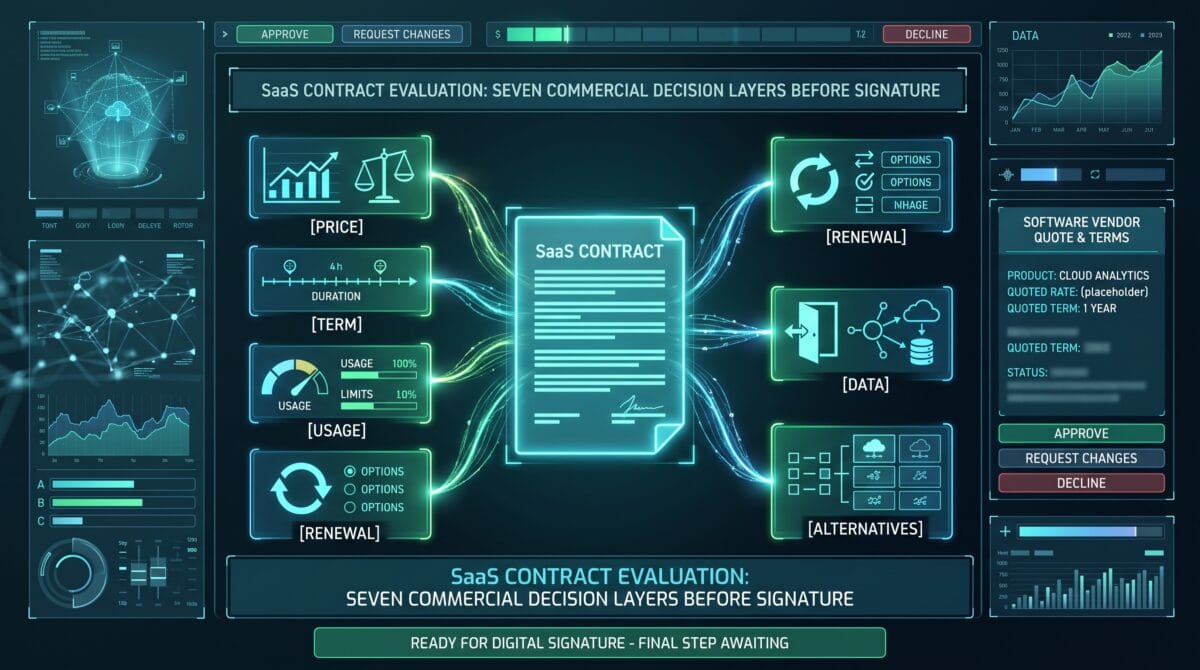
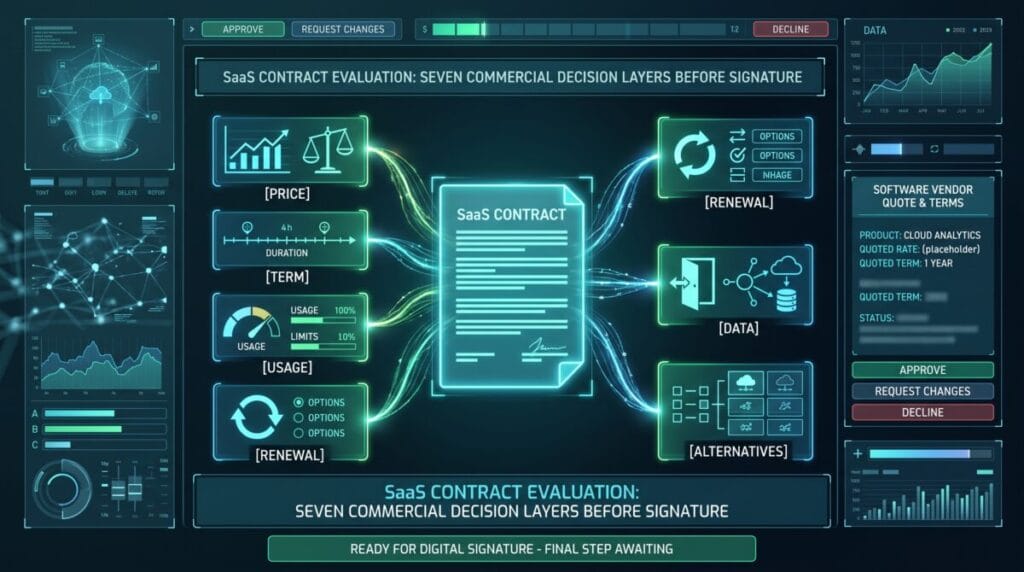
A strong SaaS contract negotiation should cover at least seven areas:
- Price — what you actually pay and what is included.
- Term — how long you are committing and what flexibility you give up.
- Usage — seats, credits, API calls, overages, minimums, and unused capacity.
- Renewal — auto-renewal, future price increases, notice windows, and packaging changes.
- Exit — cancellation, termination, transition, and what happens if the product stops fitting.
- Data — ownership, export, retention, deletion, portability, and security responsibilities.
- Alternatives — whether you have enough competitive leverage to reject a weak deal.
ToolRelief refers to this as the Pre-Signature Contract Decision Framework:
Price → Term → Usage → Renewal → Exit → Data → Alternatives
If one of those areas is unclear, the commercial picture is incomplete.
Why SaaS Contract Negotiation Is About More Than Price
Software vendors often have much more pricing information than individual buyers.
A buyer may see one quote.
The vendor may have negotiated hundreds or thousands of similar contracts.
That information gap is one reason negotiated SaaS prices can vary materially between customers.
Vertice reported in July 2026 that the overall gap between the best and worst negotiated pricing in its dataset was about 2.15x in Q2 2026.
That does not mean every buyer should expect to negotiate a specific percentage off.
It means the first quote should not automatically be treated as a market-clearing price.
The buyer should understand:
- what creates leverage;
- which terms matter beyond price;
- what happens after the initial term;
- and whether another software option creates a better commercial outcome.
The ToolRelief Pre-Signature Contract Decision Framework
1. Price: Negotiate the Real Cost, Not Just the Discount
Start by making the quote comparable.
Identify:
- list price;
- quoted unit price;
- number of seats or units;
- billing frequency;
- implementation fees;
- support fees;
- required add-ons;
- usage charges;
- minimum commitments;
- taxes or other mandatory charges where applicable.
A 25% discount on an inflated configuration may be worse than a 10% discount on the right configuration.
Before negotiating the percentage, verify that you are negotiating the correct package.
2. Term: Do Not Trade Flexibility for a Discount Blindly
Vendors often offer better pricing in exchange for longer commitments.
That trade can work when:
- the product has already been validated;
- usage is predictable;
- the vendor is strategically important;
- switching is unlikely;
- the contract includes adequate price protection.
It becomes riskier when the market is moving quickly.
Vertice's Q2 2026 data shows that average AI software contract length was about 15.4 months, considerably shorter than categories such as development software, where average commitments were close to 30 months.
That difference makes sense.
AI products, capabilities, pricing models, and competitive alternatives are changing quickly. A long commitment can remove the buyer's ability to respond to that change.
A longer contract is only a saving if the software remains the right decision for the full term.
3. Usage: Negotiate What Happens When Consumption Changes
This has become one of the most important SaaS contract issues in 2026.
Vertice reported that consumption-based pricing represented 36.5% of contracts in its Q2 2026 dataset, overtaking per-user pricing at 32.4%.
That changes what buyers need to negotiate.
For usage-based or hybrid software, clarify:
- included usage;
- unit pricing;
- overage price;
- usage tiers;
- minimum commitment;
- unused-credit treatment;
- rollover rights;
- true-up frequency;
- rate limits;
- what happens if usage unexpectedly spikes.
A cheap base fee can become irrelevant if the variable portion of the contract is poorly controlled.
4. Renewal: Protect Tomorrow's Price Before Signing Today
Renewal negotiation is a separate decision stage, but renewal risk should be addressed before the first contract is signed.
Review:
- whether the agreement automatically renews;
- how much notice is required to opt out;
- whether the vendor can increase prices at renewal;
- whether the increase is capped;
- whether the cap survives packaging changes;
- what happens if your current SKU is discontinued;
- whether features can move into a higher-priced tier.
Tropic's 2026 negotiation guidance emphasizes price caps, auto-renewal terms, protection against pricing-model changes, billing terms, rollover treatment, and overage structures as issues buyers should address before signature.
A useful negotiation question is:
If this exact product is renamed, repackaged, or moved into another tier next year, does the price protection still protect us?
For a separate assessment of future renewal exposure, use ToolRelief's SaaS Renewal Risk Calculator.
5. Exit: Negotiate How the Relationship Ends
Buyers naturally focus on getting into a product.
Good contracts also define how they get out.
Review:
- termination rights;
- notice requirements;
- early termination fees;
- refund rules;
- data-export periods;
- transition assistance;
- access after termination;
- what happens to prepaid amounts;
- what happens if the vendor materially changes the service.
This matters more as contract terms get longer.
A lower annual price can be expensive if leaving requires abandoning data, paying an early-termination penalty, or continuing to pay for software the company no longer needs.
6. Data: Make Ownership and Portability Explicit
Software is easier to replace when the buyer can retrieve its own data cleanly.
Before signing, understand:
- who owns customer data;
- how data can be exported;
- which export formats are available;
- whether export requires an additional fee;
- how long data remains available after termination;
- when deleted data is removed;
- whether backups retain data longer;
- what subprocessors handle the data;
- how AI features use customer data where relevant.
For business-critical systems, data portability is not only a technical question.
It is commercial leverage.
The harder your data is to move, the weaker your negotiating position becomes later.
7. Alternatives: Never Negotiate With Only One Acceptable Outcome
The strongest leverage is the ability to say no.
Before the final negotiation, identify:
- the closest alternative product;
- the cost of switching before implementation;
- the minimum features you actually require;
- which vendor-specific features are genuinely essential;
- which requirements are preferences rather than necessities.
If Vendor A knows you have no alternative, your negotiating leverage is weaker.
If you can credibly move to Vendor B, keep your current system, reduce scope, or delay the purchase, the commercial conversation changes.
Use ToolRelief's current commercial opportunity intelligence to check whether current buying signals or alternative routes materially change the decision.
SaaS Contract Negotiation Checklist Before You Sign
| Contract Area | Question to Answer | Red Flag |
|---|---|---|
| Price | What is the true all-in cost? | Large discount but unclear add-on or implementation costs |
| Configuration | Are we buying only what we need? | Mandatory bundle or unused modules |
| Term | How long are we committed? | Multi-year lock-in before the product is validated |
| Seats | Can seat count move down as well as up? | Minimums that remain fixed even when usage falls |
| Usage | How are variable charges calculated? | Uncapped or unclear overage pricing |
| Renewal | What happens at the end of the term? | Automatic renewal with a difficult opt-out window |
| Price increase | Can future increases be limited? | No cap or protection against repackaging |
| Exit | How can we terminate or transition? | No practical route out of the agreement |
| Data | Can we retrieve our data cleanly? | Restricted, expensive, or proprietary export |
| Security | Are responsibilities and required controls clear? | Critical security obligations left ambiguous |
| Alternative | Do we have another acceptable option? | Negotiating with no credible fallback |
Which SaaS Contract Terms Are Usually Negotiable?
The exact answer depends on the vendor, deal size, product, market conditions, and buyer leverage.
But buyers can often ask about more than price.
Potential negotiation areas include:
- unit pricing;
- minimum seat counts;
- contract duration;
- payment schedule;
- implementation fees;
- usage commitments;
- overage pricing;
- rollover rights;
- rate tables;
- future price increases;
- auto-renewal;
- termination rights;
- service levels;
- support;
- data handling;
- export rights;
- security obligations.
The point is not to demand every concession.
Prioritize the terms that create the largest financial or operational risk for your use case.
Discount vs Contract Quality: Which Matters More?
A deeper discount does not automatically produce the better contract.
| Offer | Headline | Possible Hidden Trade-Off |
|---|---|---|
| Deal A | 30% discount | Three-year commitment with weak exit rights |
| Deal B | 20% discount | One-year contract with controlled renewal pricing |
| Deal C | 15% discount | Flexible usage, rollover rights, and clean termination |
Those are illustrative structures, not market quotes.
The economically strongest option depends on:
- expected use;
- confidence in the product;
- switching risk;
- growth expectations;
- future pricing exposure.
How to Negotiate Usage-Based SaaS Pricing
Usage-based and hybrid pricing deserve a separate negotiation approach.
Do not focus only on the advertised unit rate.
Ask:
- What is included in the base commitment?
- What happens when usage exceeds it?
- Are higher volumes cheaper per unit?
- Do unused credits expire?
- Can unused capacity roll over?
- How often are overages billed?
- Can unexpected usage create unlimited exposure?
- Can the vendor change usage metrics during the contract?
This is particularly important for AI and API products, where usage can vary substantially from month to month.
A predictable unit price is not enough if the buyer cannot predict the number of units.
How to Negotiate AI Software Contracts in 2026
AI software creates several additional issues buyers should review before committing.
Look for:
- usage or credit limits;
- model access;
- changes to included models;
- separate charges for premium AI features;
- API pricing;
- training or data-use terms;
- feature availability by plan;
- the ability to remove unwanted AI add-ons;
- pricing protection if packaging changes.
Do not assume an AI feature that is included today will remain included in the same package indefinitely.
For fast-moving AI categories, contract flexibility can be worth more than a marginally deeper multi-year discount.
How Long Should a SaaS Contract Be?
There is no universally correct contract length.
The right term depends on confidence and market stability.
A Longer Contract May Make Sense When:
- the product is already deeply embedded;
- usage is stable;
- switching is unlikely;
- the price protection is strong;
- the vendor is strategically important;
- the financial concession justifies the commitment.
A Shorter Contract May Make Sense When:
- the product category is changing quickly;
- AI capabilities are evolving rapidly;
- usage is uncertain;
- the team has not validated adoption;
- competitive alternatives are improving quickly;
- exit flexibility matters more than the discount.
Current 2026 market data showing shorter average AI software contracts is a useful reminder that buyers are placing value on flexibility in fast-moving categories.
Should You Remove Auto-Renewal From a SaaS Contract?
If the vendor agrees, removing automatic renewal can preserve a cleaner decision point at the end of the term.
If auto-renewal remains, document:
- the renewal date;
- the non-renewal notice deadline;
- the required method of notice;
- the renewal term length;
- the pricing rules that apply at renewal.
The biggest risk is not that automatic renewal exists.
It is discovering the clause after the cancellation window has already passed.
What Is a SaaS Price Increase Cap?
A price increase cap limits how much pricing can rise under defined circumstances, typically at renewal.
But the wording matters.
A weak cap may become irrelevant if the vendor can:
- rename the product;
- move you to a new SKU;
- change packaging;
- introduce a mandatory add-on;
- replace seat pricing with usage pricing.
The commercial question is therefore not only:
“Is there a cap?”
It is:
“Which future pricing changes does the cap actually cover?”
When Should You Walk Away From a SaaS Deal?
A negotiation should not be treated as successful merely because both sides eventually sign.
Consider pausing or rejecting the deal when:
- the vendor will not clarify total cost;
- important usage charges remain undefined;
- minimum commitments substantially exceed expected need;
- data cannot be exported reasonably;
- renewal pricing has unlimited uncertainty;
- security requirements are unacceptable;
- critical functionality is only verbally promised;
- the contract creates disproportionate switching risk;
- a materially better alternative exists.
If the current vendor will not produce an acceptable structure, check ToolRelief's live commercial opportunities and alternative buying routes before accepting a weak contract simply because the sales process is already advanced.
SaaS Contract Negotiation: Buyer Decision Matrix
| Situation | Primary Negotiation Priority |
|---|---|
| Small self-serve team plan | Price, annual commitment, cancellation, renewal |
| Large seat-based SaaS contract | Seat flexibility, unit price, price caps, true-down rights |
| Usage-based software | Overages, rate tables, minimum commitments, rollover |
| AI software | Usage limits, model access, packaging changes, AI add-ons, data use |
| Business-critical system | SLA, support, exit, data portability, transition rights |
| Fast-changing category | Shorter term, flexibility, price protection, clean exit |
Use Alternatives as Negotiation Intelligence
You do not need to threaten a vendor with a competitor.
You do need to understand what the market gives you.
Before accepting the final quote:
- Identify at least one credible alternative.
- Compare the required feature set.
- Compare total commercial commitment rather than list price.
- Check switching and implementation requirements.
- Review current verified commercial opportunities.
For timing-sensitive purchases, see ToolRelief's Best Time to Buy Software: Buy Now or Wait?.
For seasonal self-serve offers, ToolRelief also maintains a Black Friday Software Deals 2026 Verified Tracker.
Before You Sign: Final 10-Minute Review
Before the final signature, answer these questions:
- What is the true first-year cost?
- What could make the cost increase during the term?
- What could make the cost increase at renewal?
- What minimum seat or usage commitment are we accepting?
- What happens to unused seats, credits, or capacity?
- How do we exit?
- How do we retrieve our data?
- Which promised features or services are actually in writing?
- Which commercial risks remain uncapped?
- What is our alternative if we do not sign?
If you cannot answer one of those questions, there is still something worth clarifying before signature.
Related ToolRelief Buying Intelligence
- Commercial Opportunity Intelligence — inspect current commercial signals and verified routes before committing.
- Best Time to Buy Software — decide whether to buy now, wait, or negotiate.
- Software Decision Finder — validate product fit before contract negotiation.
- SaaS Cost Benchmark Tool — add cost context before accepting a quote.
- SaaS Renewal Risk Calculator — assess the future renewal exposure created by today's contract.
- SaaS Price Hike Tracker 2026 — monitor broader software pricing pressure.
- Fake Software Discount Signals — challenge weak discount framing before it affects the negotiation.
SaaS Contract Negotiation: Bottom Line
SaaS contract negotiation should produce a deal that remains defensible after the sales conversation ends.
Do not evaluate the contract only by the discount.
Evaluate:
- price;
- term;
- usage;
- renewal;
- exit;
- data;
- alternatives.
A slightly higher price with cleaner terms, predictable usage, stronger exit rights, and controlled future increases may be commercially better than a deeper discount attached to a rigid contract.
The best SaaS deal is not the contract with the biggest discount. It is the contract that gives the buyer the right product, the right economics, and enough control when circumstances change.
Sources and Methodology
Information reviewed: August 29, 2026.
This guide uses current 2026 market evidence from Vertice on negotiated SaaS pricing dispersion, contract duration, procurement timing, and the shift toward consumption-based pricing, along with Tropic's March 2026 guidance on SaaS and AI contract terms.
ToolRelief's Pre-Signature Contract Decision Framework is editorial decision guidance. It does not represent legal advice, and contract language, enforceability, regulatory obligations, and appropriate legal terms vary by jurisdiction and situation. Buyers should use qualified legal counsel where a contract creates material legal, privacy, security, or regulatory exposure.