
TOOLRELIEF DECISION INTELLIGENCE
- Decision
- Use Best Software Stack for a One-Person Agency to evaluate the software or technology decision covered on this page and identify the next useful action.
- Evidence Basis
- Documented product information, published evidence, comparative analysis, direct observation, and clearly labeled models where applicable.
- Best Used For
- Reducing uncertainty before taking the next material action.
- Decision Boundary
- This page provides independent decision support rather than a guaranteed outcome. Product capabilities, pricing, third-party terms, and operating conditions can change.
Best Software Stack for a One-Person Agency
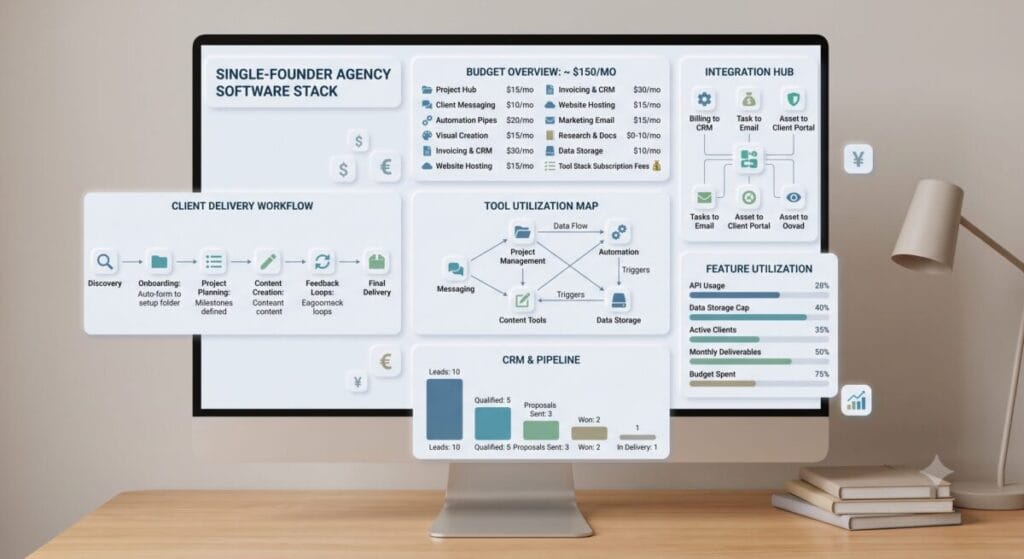
The best software stack for a one-person agency is not the stack with the most apps. It is the stack that lets one person sell, deliver, publish, invoice, track work, and stay profitable without drowning in tools.
A one-person agency has no room for software vanity. Every subscription must earn its seat. If a tool does not help you win clients, deliver faster, protect quality, reduce admin work, or replace another paid tool, it is probably dragging your margins down.
The brutal truth is simple:
A one-person agency does not need a corporate tech stack. It needs a lean operating system.
This page gives you the ToolRelief model for building that system without turning your agency into a subscription junk drawer.
The Short Answer: What Should a One-Person Agency Actually Pay For?
A one-person agency usually needs seven software layers, not twenty-seven tools.
| Stack Layer | What It Handles | Budget Role | What to Avoid |
|---|---|---|---|
| AI Core | Writing, research, planning, client drafts, strategy, editing | Daily leverage | Paying for multiple AI assistants doing the same work |
| Website and Landing Pages | Authority, lead capture, service pages, proof, offers | Sales base | Overbuilding infrastructure before traffic or clients justify it |
| Client Delivery | Project tracking, files, tasks, deliverables, status updates | Execution control | Using enterprise project management for solo work |
| Creative and Content | Visuals, thumbnails, posts, lead magnets, simple video assets | Publishing engine | Separate tools for every format before volume exists |
| Automation | Forms, lead routing, reminders, client intake, repeatable handoffs | Admin reduction | Complex automation that saves almost no time |
| Finance and Admin | Invoices, payments, contracts, expenses, subscription tracking | Margin protection | Letting renewals and trials run without review |
| Analytics and Decisions | Traffic, conversion, client acquisition, software cost review | Business visibility | Collecting dashboards without making decisions |
The best software stack for a one-person agency keeps these layers tight. One layer can be handled by one tool. One tool can cover several layers. That is the point.
The Real Enemy Is Not Expensive Software. It Is Tool Sprawl.
One-person agencies usually do not get killed by one big software bill. They get drained by small subscriptions that quietly stack up.
A writing tool here. A proposal tool there. A scheduling app. A design app. A video app. A project tool. A CRM. A form builder. An AI assistant. Another AI assistant. A dashboard. A reporting tool. A social scheduler.
Individually, each tool looks reasonable. Together, they create a fake business machine that costs more than it produces.
The best software stack for a one-person agency does not ask, “Is this tool cool?”
It asks:
Does this tool help me get clients, deliver work, or protect margin?
If the answer is not clear, the tool is not ready for permanent budget.
The ToolRelief Stack Model for a One-Person Agency
Use this as the baseline model before buying anything else.
1. AI Core
The daily workhorse for client research, proposals, drafts, strategy notes, content repurposing, and editing.
2. Website Base
The trust engine that sells while you work: offers, proof, lead capture, analytics, and publishing.
3. Client Delivery
A simple system for projects, files, tasks, deliverables, approvals, invoices, and next actions.
4. Creative Layer
One broad layer for visuals, thumbnails, posts, lead magnets, short clips, and client-facing graphics.
5. Automation Layer
Repeat-work automation only. No toy box. No complex systems that save almost no time.
6. Finance and Tracking
The boring layer that protects profit: renewals, subscriptions, client expenses, and tool ownership.
7. Decision Layer
A review system for deciding what to keep, cut, replace, delay, or test before the stack bloats.
Control Rule
If the software stack feels like a second job, the agency stack is backwards.
Margin Rule
A tool you forgot about is not a tool. It is a leak.
1. One AI Core for Thinking and Production
Your AI core should be the daily workhorse. It should help with client research, proposals, landing page drafts, email sequences, strategy notes, content repurposing, offer ideas, and editing.
The mistake is paying for three premium AI tools before one of them has become the anchor.
If you are still choosing your AI foundation, compare ChatGPT Plus vs Claude Pro vs Gemini Advanced for daily work before stacking subscriptions.
If you are building from scratch, start with the AI tool stack for solo founders and adapt it for agency delivery.
2. One Website Base That Sells While You Work
Your website should not be a digital business card. It should be a trust engine.
For a one-person agency, the site should carry:
- a clear service offer
- proof or experience signals
- decision pages or helpful guides
- lead capture
- contact or booking flow
- simple analytics
- room for affiliate or sponsor revenue later
Do not overbuild. The website should be fast, credible, easy to update, and focused on conversion.
3. One Client Delivery System
A one-person agency does not need a complicated project management monster. It needs a simple place to track work, deliverables, deadlines, files, and next actions.
The system can be simple. The discipline cannot.
Track:
- client name
- project status
- deliverables
- deadline
- approval stage
- invoice status
- next action
If your delivery system takes more energy than the delivery itself, your stack is backwards.
4. One Creative and Publishing Layer
Most one-person agencies need to publish. That means the stack should support simple visual assets, lead magnets, social posts, blog images, short clips, and client-facing graphics.
The trap is buying one tool for carousels, one for thumbnails, one for AI images, one for video captions, one for brand kits, and one for templates before you even have a consistent publishing schedule.
Start with one broad creative layer. Add specialists only when volume proves the need.
5. One Automation Layer for Repeat Work
Automation should remove repetitive admin. It should not become a toy box.
Good automation for a one-person agency might include:
- new lead to spreadsheet
- contact form to email list
- client intake to project board
- invoice reminder
- content idea capture
- simple reporting notifications
If the workflow does not repeat, do not automate it yet.
If the automation takes longer to maintain than the task itself, kill it.
6. One Finance and Subscription Tracking System
This is where a one-person agency protects profit.
Track every paid tool, every renewal, every client expense, and every software subscription used to deliver work.
Use the SaaS Inventory Template or the SaaS Subscription Tracker Template to keep the stack visible.
A tool you forgot about is not a tool. It is a leak.
7. One Decision Layer for Cutting, Keeping, or Replacing Tools
The strongest agencies review the stack before it becomes bloated.
Before approving another subscription, use the Software Decision Finder to decide whether the tool should be kept, cut, replaced, delayed, or tested.
If your software costs are already messy, run a broader review with the SaaS Waste Audit Tool.
The Best Software Stack for a One-Person Agency by Function
Do not build the stack by brand. Build it by function.
| Function | What the Tool Must Do | Minimum Viable Setup | Upgrade Only When |
|---|---|---|---|
| AI Work | Draft, think, research, edit, plan, summarize | One premium AI assistant | You can prove a second model handles a separate job better |
| Website | Publish, capture leads, explain offers, build trust | Fast WordPress or lean site setup | Traffic, client volume, or technical needs justify more power |
| Project Delivery | Track clients, tasks, files, deadlines, approvals | Simple project board or structured workspace | You manage multiple clients at once and need stronger systems |
| Design | Create visuals, documents, simple creative assets | One broad creative tool | Publishing volume requires specialist tools |
| Automation | Move repeat tasks between systems | Native integrations or one automation platform | Manual handoffs cost hours every month |
| Finance | Invoices, expenses, payments, renewals | Simple finance tool plus subscription tracker | Revenue, tax, or reporting complexity increases |
This is how you build a stack that runs the agency instead of distracting from it.
The Software Stack You Should Avoid
The worst stack for a one-person agency is the stack that looks impressive and feels heavy.
| Bad Stack Pattern | Why It Fails | Better Move |
|---|---|---|
| Multiple AI tools with no clear role | You pay for overlapping thinking engines | Choose one AI anchor first |
| Enterprise project management for solo delivery | You manage the system more than the client work | Use a simple delivery board |
| Separate tools for every content format | The content stack becomes more complex than publishing | Use one creative layer until volume proves otherwise |
| Automation before workflow clarity | You automate confusion | Document the process first |
| No subscription tracking | Renewals leak profit quietly | Track every tool monthly |
A one-person agency should feel light. If the software stack feels like a second job, something is wrong.
The One-Person Agency Stack Budget Model
The budget does not need to be tiny forever. But it should be disciplined from the start.
| Category | Lean Budget Range | Why It Matters |
|---|---|---|
| AI Core | $20–$30/month | Daily thinking, drafting, planning, and production leverage |
| Website and Hosting | $5–$30/month | Authority, publishing, lead capture, and conversion base |
| Creative Layer | $0–$20/month | Fast visual assets for client work and self-promotion |
| Automation | $0–$20/month | Reduces repetitive handoffs when the workflow is proven |
| Project and Admin | $0–$20/month | Keeps delivery, files, and invoices under control |
| Testing Budget | $10–$30/month | Allows tool testing without uncontrolled subscription creep |
The best software stack for a one-person agency can start lean and still be powerful. The difference is control.
If your software cost is climbing faster than your revenue, compare your numbers against SaaS cost per employee and check whether the stack still makes sense.
The 30-Day Cleanup Plan for a One-Person Agency
If your agency stack already feels messy, do not wait for a perfect system. Clean it up in 30 days.
Week 1: List Every Tool
Pull every subscription from your bank account, card statement, app store, email receipts, and invoices.
Week 2: Assign Each Tool
Every tool must connect to a business job: clients, delivery, publishing, money, protection, admin, or replacement.
Week 3: Cut the Overlap
Look for duplicate AI tools, duplicate design tools, old trials, and tools bought for one client project that never ended.
Week 4: Set the Buying Rule
No tool gets added unless it answers what job it performs, what it replaces, how often it is used, and when it gets reviewed.
Memory Warning
Do not trust memory. Memory is where forgotten tools go to bill you quietly.
Agency Rule
This rule keeps your agency from becoming a software museum.
Week 1: List Every Tool
Pull every subscription from your bank account, card statement, app store, email receipts, and invoices.
Do not trust memory. Memory is where forgotten tools go to bill you quietly.
Week 2: Assign Each Tool to a Business Job
Every tool must connect to one of these jobs:
- get clients
- deliver client work
- publish content
- manage money
- protect the website or data
- save repeat admin time
- replace another tool
If a tool does not connect to one of these jobs, put it on the review list.
Week 3: Cut the Overlap
Look for duplicate AI tools, duplicate design tools, unused project management features, old trials, and tools bought for one client project that never ended.
If AI is the main source of waste, compare your setup with the AI tool overlap checklist for marketing teams and adapt the same cleanup logic to your agency.
Week 4: Set the New Buying Rule
No tool gets added unless it answers four questions:
- What job does it perform?
- What current tool does it replace or improve?
- How often will it be used?
- When will it be reviewed again?
This rule keeps your agency from becoming a software museum.
Continue the ToolRelief Decision Path
This page helps one-person agencies build a lean software operating system. The full decision cluster connects solo founders, small teams, AI model choices, marketing overlap, renewals, safe cuts, consolidation, calculator support, and the central Software Decision Finder.
How This Page Connects to the Full ToolRelief Decision System
This page shows the best software stack for a one-person agency, but it also connects to the broader ToolRelief system for building a cleaner, sharper software operation.
If you are building from zero, start with the AI tool stack for solo founders.
If your agency uses multiple AI subscriptions, compare ChatGPT Plus vs Claude Pro vs Gemini Advanced for daily work.
If you manage contractors or a tiny team, read how many AI tools a small team should pay for.
If marketing tools are the messy part, use the AI tool overlap checklist for marketing teams.
If you want the business model angle, read the guide to building a one-person AI marketing agency.
If you need a wider cleanup system, run the stack through the Software Decision Finder.
FAQ: Best Software Stack for a One-Person Agency
What is the best software stack for a one-person agency?
The best software stack for a one-person agency usually includes one AI core, one website base, one client delivery system, one creative layer, one automation layer, one finance and admin system, and one subscription tracking process. The goal is to keep the stack lean enough to protect margin while still supporting sales, delivery, content, and client work.
How much should a one-person agency spend on software?
A one-person agency can often start with a lean software budget under $100 to $150 per month, depending on hosting, AI tools, creative tools, and client delivery needs. The budget can increase when revenue, workload, or risk justifies it, but every tool should have a clear job.
Does a one-person agency need a CRM?
Not always. A simple tracker or project system may be enough at the beginning. A CRM becomes useful when leads, follow-ups, proposals, and client stages become too complex to manage manually.
Should a one-person agency use multiple AI tools?
Usually not at the start. One strong AI assistant should become the core. A second AI tool only makes sense if it clearly handles a different job, such as long-form writing, code support, visual work, or workflow-specific tasks.
What is the biggest software mistake one-person agencies make?
The biggest mistake is buying tools for the agency they imagine instead of the agency they currently run. That creates software bloat before the revenue is there to justify it.
Final Decision: Build a Stack That Protects Your Margin
The best software stack for a one-person agency should not make you feel like a bigger company. It should make you move faster, deliver cleaner work, and keep more profit.
Choose one AI core. Keep the website simple and useful. Track client delivery. Use one creative layer. Automate only repeat work. Watch every renewal. Kill tools that do not earn their place.
If your stack already feels bloated, start with the SaaS Waste Audit Tool and then organize your subscriptions with the SaaS Inventory Template.
The goal is not to buy your way into looking professional. The goal is to run lean enough to stay dangerous.