Enterprise SaaS Pricing 2026: Real Costs & Contract Tiers
Quick Navigation ✔
ToggleA Transparent Procurement Intelligence Briefing on 12 Major "Contact Sales" Platforms
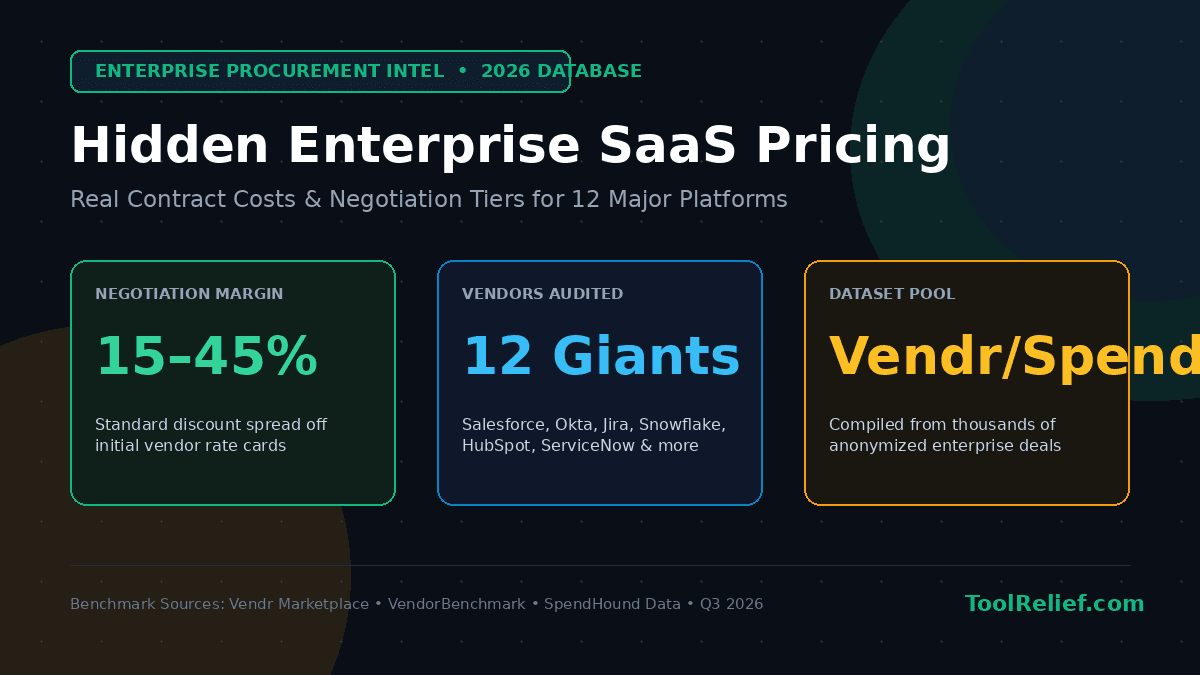
Quick Executive Summary (2026 Enterprise SaaS Pricing): Top enterprise software vendors conceal their contract pricing to maximize price discrimination and renewal leverage. Aggregated 2026 procurement benchmark datasets (Vendr, VendorBenchmark, SpendHound) reveal that first-time buyers with competitive alternatives negotiate standard discounts of 20% to 35% off list, with strategic multi-year enterprise agreements (ELAs) reaching up to 62% in discounts.
What Is Enterprise Software Pricing in 2026?
Enterprise software pricing is rarely a single published price. Large SaaS contracts typically combine a base subscription with one or more variables such as user or seat count, usage or consumption, product modules, data volume, support level, implementation scope, and negotiated contract commitments. That is why two companies buying the same enterprise platform can pay materially different effective rates.
| Enterprise Pricing Model | How It Works | Typical Cost Driver |
|---|---|---|
| Per-seat / per-user | Price scales with licensed users. | Seat count, tier and feature access. |
| Usage-based | Charges rise with actual consumption. | Credits, compute, API calls, data or AI usage. |
| Platform + modules | Base platform cost plus separately licensed capabilities. | Modules, environments, security and support. |
| Committed enterprise contract | Negotiated annual or multi-year spend commitment. | ACV, term length, volume and negotiation leverage. |
How much does enterprise SaaS cost?
There is no defensible universal enterprise SaaS price. The 12 platforms analyzed in this ToolRelief briefing range from relatively small five-figure annual contracts to multi-million-dollar enterprise agreements. Pricing changes materially with deployment size, product mix, usage, contract term, and negotiated discount.
Is enterprise software priced per seat or by usage?
Both models are common, and hybrid pricing is increasingly important. Salesforce, HubSpot and identity platforms can retain strong per-user components, while Snowflake, Databricks and AI-enabled products expose buyers to consumption-based costs. Enterprise contracts can therefore include both a committed base price and variable usage charges.
Why is enterprise pricing usually hidden?
Enterprise pricing is commonly negotiated because vendors price around deployment scale, product configuration, contract length and buyer leverage rather than one universal rate card. The vendor-by-vendor benchmarks below show how those differences translate into real contract ranges and negotiated discount bands.
1. Executive Summary: The "Contact Sales" Opacity Game
Twelve of the largest enterprise software categories—CRM, identity, ITSM, cloud infrastructure, and data platforms—share one deliberate architectural choice: none of them post enterprise-tier pricing. Understanding why enterprise vendors hide pricing is the first step toward reclaiming negotiation leverage.
Why Enterprise Vendors Hide Their Pricing:
- Price Discrimination by Willingness-to-Pay: A 200-seat mid-market firm and a 20,000-seat regulated enterprise should not see the same price point. Published rate cards cap the vendor's extraction ceiling.
- Anchoring Control: Sales reps set inflated opening quotes so that a routine 25% "concession" feels like a major victory for procurement.
- Discount Concealment: Keeping discounts secret prevents existing enterprise customers paying full list price from demanding parity.
- Bundling Opacity & SSO Taxes: Single Sign-On (SSO), audit logs, and API limits get walled off as expensive tier upgrades, as analyzed in our SaaS SSO Tax Analysis.
2026 Enterprise Negotiation Discount Benchmarks:
| Deal Stage & Competitive Leverage | Typical Negotiated Discount off Rate Card |
|---|---|
| First-time enterprise purchase (single competitive bid) | 10%–20% |
| First-time purchase (2+ credible alternatives in active RFP) | 20%–35% |
| Standard renewal (no competitive pressure shown) | 5%–15% (Often net price increase) |
| Renewal with verified competitive alternative + procurement desk | 20%–35% |
| 3-Year prepaid enterprise commitment | 25%–45% |
| Strategic anchor logo / competitive displacement ELA | 35%–62% |
2. The 2026 Real Pricing Breakdown for 12 Major Enterprise Vendors
1. Salesforce — Sales Cloud & Service Cloud Enterprise / Unlimited
- List Price: Enterprise ~$165/user/mo | Unlimited ~$330/user/mo
- Real Contract Range (500–2,000 seats): $95–$220/user/month effective.
- Typical Negotiated Discount: 28%–40% off list; strategic competitive displacements against Microsoft Dynamics or HubSpot have closed up to 62% off list.
- Hidden Add-ons: Sandbox environments, Shield platform encryption, CPQ SKUs, and Agentforce/Einstein AI consumption credits.
- Direct Comparison: See our architectural breakdown on Salesforce vs HubSpot Enterprise.
2. HubSpot — Marketing & Sales Hub Enterprise
- List Price: Marketing Hub Enterprise ~$3,600/mo (10k contacts) | Sales Hub Enterprise ~$150/seat/mo.
- Real Contract Range: $60,000–$250,000/year combined Hub bundle.
- Typical Negotiated Discount: 23%–43% off list.
- SSO Tax & Renewal Trap: SAML SSO is strictly gated to Enterprise tiers. Contact-tier escalations ($50–$100 per 1k contacts) automatically trigger contract uplifts at renewal.
3. Okta — Workforce Identity Cloud & Adaptive MFA
- List Price: $3–$12+/user/month across fragmented SKUs.
- Real Contract Range: $15,000 ACV (small deployments) to seven figures at 10,000+ seat scale.
- Typical Negotiated Discount: 15%–30% standard. Buyers evaluating Microsoft Entra ID as a credible alternative consistently secure top-tier discounts.
- TCO Analysis: Read our complete financial evaluation on Okta vs Ping Identity and research our SSO Tax Evidence.
4. Atlassian — Jira & Confluence Cloud Enterprise
- List Price (Enterprise Annual): Graduated tiers (~$17–$22/user/month equivalent).
- Minimum Spend Floor: Enterprise tier requires a hard minimum of 801 users cloud-side to access unlimited sandboxes and data residency controls.
- Typical Negotiated Discount: 15%–30% off list. SAML SSO and automated SCIM provisioning require full Enterprise tier licensing.
5. ServiceNow — ITSM & ITOM Fulfiller Licensing
- Real Contract Range: $150,000 (small ITSM deployment) to $10M+ multi-product platform ELAs.
- Typical Negotiated Discount: 18%–30% for core ITSM; bundled multi-product deals (ITSM + ITOM + CSM) reach 35%–40%.
- Deep Comparison: Explore our enterprise analysis on Atlassian Jira Enterprise vs ServiceNow.
6. Snowflake — Standard, Enterprise & Business Critical Compute
- On-Demand Credit Pricing: ~$2 (Standard), ~$3 (Enterprise), ~$4 (Business Critical) per compute credit. Storage ~$23/TB/month.
- Real Contract Range: Mid-market commitments commonly land $185,000–$745,000/year; large enterprises reach multi-million dollar annual commitments.
- Typical Negotiated Discount: 15%–40% off on-demand rates via pre-purchased annual capacity commitments.
- Comparative Evaluation: Review our complete benchmark on Snowflake vs Databricks.
7. Databricks — DBU Pricing, Serverless vs Classic Compute
- List Price: DBU rates range $0.07–$0.40+ depending on workload and cloud provider.
- Typical Negotiated Discount: 20%–40% off list DBU rates for committed-use agreements above $500k/year.
- Renewal Trap: Unused committed DBUs do not roll over automatically. Run an audit 90 days before renewal using our SaaS Waste Audit Tool.
8. Cloudflare — Enterprise Plan Contract Minimums & Egress
- Real Contract Range: $50,000–$500,000+/year depending on bandwidth, Bot Management SKUs, and Zero Trust seat count.
- Typical Negotiated Discount: 20%–35% with active competitive pressure from Akamai or Fastly.
- Infrastructure Deep Dive: Read our architectural benchmark on Cloudflare vs Akamai.
9. Zendesk — Enterprise Suite & AI Copilot Surcharges
- Real Contract Range: Deployments with 200–500 agents average $2.2M–$5.5M/year fully loaded with AI, WFM, and QA add-ons.
- Typical Negotiated Discount: 20%–38% standard on 3-year commitments. AI Copilot is billed as a separate consumption-based surcharge.
10. Workday — Core HCM Per-Employee Pricing Models
- Real Contract Range: Mid-market (2k–5k staff) $300k–$1.2M/yr; large enterprises (20k+ staff) reach $3M–$10M+/yr.
- Typical Negotiated Discount: 18%–32% off initial proposal. System Integrator (SI) implementation fees often exceed the year-one software license.
11. ZoomInfo — Advanced & Elite Credit Bundles
- Real Contract Range: Median contract value sits at ~$33,500/year; typical range $15,000–$60,000+/year.
- Renewal Trap: Strict auto-renewal clauses with mandatory 90-to-120 day cancellation windows. Credits do not roll over across renewal periods.
12. Datadog — Host, Log & Custom Metric Ingestion Overage Rates
- Real Contract Range: $15–$150+/host/month blended across Infra, APM, and Logs ($750k–$2M+/year for mid-size tech firms).
- Typical Negotiated Discount: 35%–55% off list for multi-product commitments—one of the widest list-to-real discount margins in enterprise tech.
3. The Enterprise SaaS Negotiation Playbook: 5 Proven Levers
Follow these five empirical procurement levers to secure 20% to 40% in contract savings:
- Time the Renewal to the Vendor's Fiscal Quarter-End: Salesforce and Okta close fiscal years on January 31 (Q4 is November–January). Databricks and Snowflake skew toward calendar quarter closes. Schedule final pricing calls in their closing window when quota pressure peaks.
- Bring a Real, Priced-Out Alternative Quote: Presenting a dated proposal from Entra ID against Okta, or Make.com against Zapier (see our Zapier vs Make.com evaluation) forces sales managers to unlock executive discount approvals.
- Negotiate Contract Mechanisms, Not Just Headline Percentages: Prioritize (a) fixed per-unit pricing across the multi-year term, (b) capped annual uplifts (CPI-linked, not 7–9%), and (c) growth true-ups priced at your negotiated rate rather than standard list price.
- Unbundle Before You Bundle: Request standalone line-item pricing for every module before agreeing to an enterprise suite (ELA) to ensure bundle discounts aren't disguised markups.
- Right-Size Usage 90 Days Before Negotiations: Eliminate zombie seats and idle credits using our Unused SaaS License Cost Calculator and 2026 SaaS Waste Statistics before entering pricing talks.
Frequently Asked Questions (FAQ)
How reliable are third-party enterprise SaaS pricing benchmarks?
They provide statistically robust, directional ranges derived from thousands of anonymized signed contracts. They help buyers identify standard discount margins and prevent anchoring to artificial vendor list prices.
What is the single biggest mistake enterprise buyers make during SaaS renewals?
Focusing solely on the headline discount percentage while missing auto-renewal notice traps (such as 90-day notification windows) and uncapped annual inflation clauses (5%–9% annual uplifts).
Can small and mid-market teams negotiate enterprise SaaS discounts?
Yes. Any contract exceeding $25,000 to $50,000 in Annual Contract Value (ACV) has negotiable discount room, especially when procurement presents a credible competitor or aligns timing with the vendor's fiscal quarter-end.
Where can companies find vetted commercial software deals and tools?
Organizations can review verified partner campaigns and commercial discount tiers inside the Global Offers Hub and the Software Offers Directory.
TOOLRELIEF DECISION INTELLIGENCE
- Decision
- Use Enterprise SaaS Pricing 2026: Enterprise Software Costs to evaluate the software or technology question investigated on this page before taking the next material action.
- Evidence Basis
- Documented product information, published evidence, comparative analysis, direct observation, and clearly labeled models where applicable.
- Best Used For
- Reducing uncertainty before taking the next material action.
- Decision Boundary
- This page provides independent decision support rather than a guaranteed outcome. Product capabilities, pricing, third-party terms, and operating conditions can change.